


Deep in the mountains of Sichuan Province, a light trap set up at a protection station in Huanglong National Nature Reserve has yielded an unexpected prize: a brand-new species of fire-colored beetle, described this week in the Deutsche Entomologische Zeitschrift. The insect, named Dendroides huanglong after the reserve where it was captured, is only the third species of its genus known from the entire Palaearctic Realm, the vast biogeographic region that stretches across Europe, northern Asia and North Africa. For a genus first catalogued more than two centuries ago, the discovery is a reminder of how much unexplored diversity still hides in the forests of East Asia.
Dendroides belongs to the family Pyrochroidae, a group of beetles commonly called fire-colored beetles for the reddish hues many of them display. The genus has a curious distribution: until now, six of its eight described species lived in North America, while only two were known from East Asia. That pattern, with closely related lineages split between eastern Asia and North America, is a classic signature of ancient biogeographic history, and it makes every new Asian species valuable evidence for understanding how the group spread and diversified.
The new beetle was collected in July 2024 by Cheng-Tao Wang during an investigation of insect diversity in the reserve, located in Songpan County in the Aba Tibetan and Qiang Autonomous Prefecture at an elevation of roughly 2,542 meters. The specimens were drawn to a light trap at the Danyunxia Protection Station, a standard technique that exploits the attraction of many nocturnal insects to artificial lights. The holotype, together with a male and a female paratype, is deposited in the Museum of Hebei University in Baoding, China.
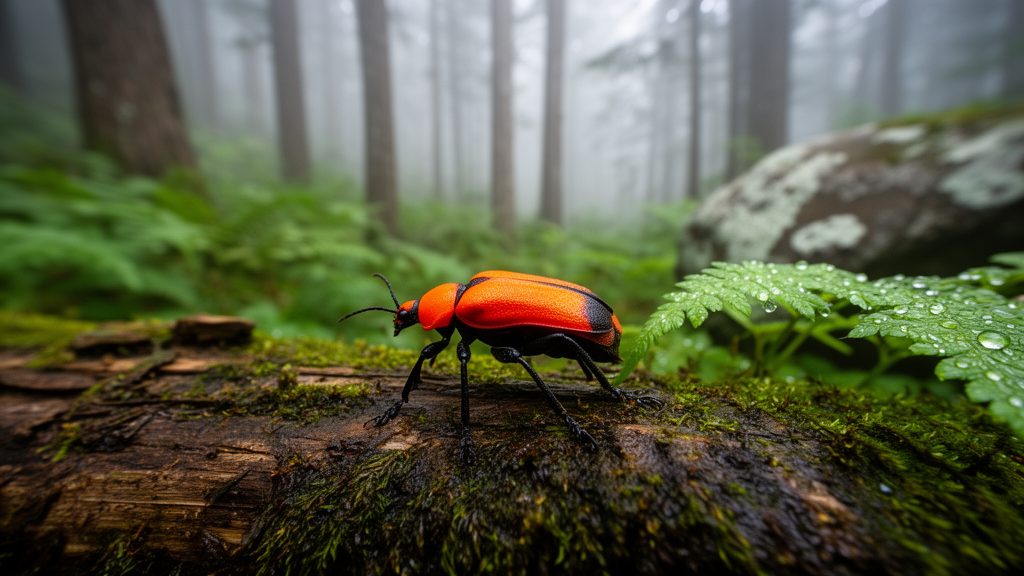
At first glance, Dendroides huanglong resembles its closest relative, Dendroides ussuriensis, which was described in 1977 from the Russian Far East, northeastern China and North Korea. Both species share a distinctive color scheme: the body is reddish testaceous, while the maxillary palpomeres, antennae and most parts of the legs are black. But the differences become obvious once the insects are measured and dissected. The new species is larger, with a body length of 14.5 to 17.2 millimeters compared with 12.0 to 13.0 millimeters in D. ussuriensis.
The most striking distinction lies in the compound eyes. In males of the new species, the very large eyes meet above the head, a condition called dorsal contiguity, whereas the eyes of male D. ussuriensis remain separated. In females, the researchers quantified the difference using the ocular index, a standard ratio that compares the minimum dorsal distance between the compound eyes with their maximal dorsal width. The female of the new species scores 8.1 on this index, while females of D. ussuriensis score between 25.8 and 26.8, meaning their eyes are far more widely spaced.
The antennae provide further diagnostic characters. Male fire-colored beetles in this group bear elongate rami, lateral branches on the flagellomeres that make up the antennal club. In the new species, these rami are extremely elongate and subcylindrical, at least four times the length of the flagellomere they belong to. In females of D. huanglong, the first flagellomere carries a distinct, sub-triangular ramus, while in D. ussuriensis the first flagellomere lacks a ramus altogether. Moreover, the rami of flagellomeres III through VII are each longer than the preceding flagellomere in the new species, but shorter in its relative.
The male genitalia seal the identification. The parameres, part of the aedeagal complex, are elongate, roughly twice as long as the phallobase, and fused along more than nine-tenths of their length in dorsal view. The penis narrows abruptly toward its apex and is produced into a bluntly recurved hook. Such fine anatomical details are the bread and butter of beetle taxonomy, because external appearance often varies little among close relatives while genital structures diverge rapidly and reliably. The authors also documented the pronotum, which is subcampanulate, or bell-shaped, with a conspicuous longitudinal mesal groove and a transverse groove along the posterior margin.
To make the new species usable for other researchers, the study includes an identification key to all three Palaearctic species of Dendroides. The key separates the unicoloured, piceous D. lesnei from Japan, described by Blair in 1914, from the two reddish species, and then distinguishes D. ussuriensis from D. huanglong by body size, eye structure and antennal ramus proportions. The genus itself has a tangled taxonomic history: Kôno described D. nakabusana from Honshu in 1936 based on slightly larger eyes, but Young synonymised it with D. lesnei in 2005 after examining the type specimens of both species. A comprehensive 1975 revision by Young supplied diagnoses and keys for the North American fauna, which had remained unchanged since a species described by Van Dyke in 1928.
Beyond the description itself, the paper addresses the phylogenetic position of Dendroides within the fire-colored beetle family tree. Preliminary molecular results based on mitochondrial DNA COI barcode sequences place Dendroides as a sister group to the clade containing the genera Pseudopyrochroa and Schizotus. The three genera share adult morphological characters, including reduced temples, a short and apically widened antennal pedicel, and male genitalia whose parameres are fused for most or all of their length. The authors propose that three additional genera, Dendroidopsis, Neopyrochroa and Sinodendroides, also belong to this clade.
The molecular picture, however, does not align perfectly with morphology-based comparisons of larvae, pupae and adults. Notably, the penis with recurved apical hooks, once considered a hallmark of Pseudopyrochroa, also occurs in Dendroides, at least in the new species and in the North American D. canadensis, as well as in Neopyrochroa flabellata. Adults of Dendroides can still be told apart from Pseudopyrochroa and Schizotus by a suite of characters: the frons lacks cranial pits, the compound eyes are very large and dorsally contiguous or nearly so in males, the antennal rami are usually four times longer than their respective flagellomeres, the pronotum is slightly wider than long, and the parameres are very elongate. Reconciling these conflicting signals between DNA and anatomy remains an open task for beetle systematists, and each newly described species adds another data point to the analysis.
For now, Dendroides huanglong stands as a small but significant addition to the catalogue of life. Its discovery in a well-known nature reserve in western China suggests that even heavily studied landscapes can conceal undocumented species, particularly among nocturnal insects that only reveal themselves to patient light-trapping at high elevations. With a formal name, illustrated figures, an identification key and type specimens safely housed in a museum collection, the new fire-colored beetle is ready to take its place in the ongoing effort to document Earth’s biodiversity before it disappears.
Subject of Research: Taxonomic description of a new fire-colored beetle species, Dendroides huanglong, from Sichuan, China
Article Title: A new Dendroides species from China ( Coleoptera , Pyrochroidae ), with a key to the Palaearctic species
Article References: Yang, X.-M., Young, D. K., Yang, B.-L., & Pan, Z. (2025). A new Dendroides species from China (Coleoptera, Pyrochroidae), with a key to the Palaearctic species. Deutsche Entomologische Zeitschrift, 72(1), 15-19. https://doi.org/10.3897/dez.72.146919
Image Credits: AI Generated
Keywords: Dendroides huanglong, Pyrochroidae, Coleoptera, taxonomy, new species, China, Sichuan, Huanglong, Palaearctic, beetles, entomology, phylogenetics
Cite Scienmag News
Margaret Porter. (October 18, 2026). New fire-colored beetle species discovered in China’s Huanglong reserve. Scienmag. https://scienmag.com/new-fire-colored-beetle-species-discovered-in-chinas-huanglong-reserve/
Margaret Porter. "New fire-colored beetle species discovered in China’s Huanglong reserve." Scienmag, 18 October 2026, https://scienmag.com/new-fire-colored-beetle-species-discovered-in-chinas-huanglong-reserve/. Accessed 18 October 2026.
Margaret Porter. "New fire-colored beetle species discovered in China’s Huanglong reserve." Scienmag. October 18, 2026. https://scienmag.com/new-fire-colored-beetle-species-discovered-in-chinas-huanglong-reserve/


