


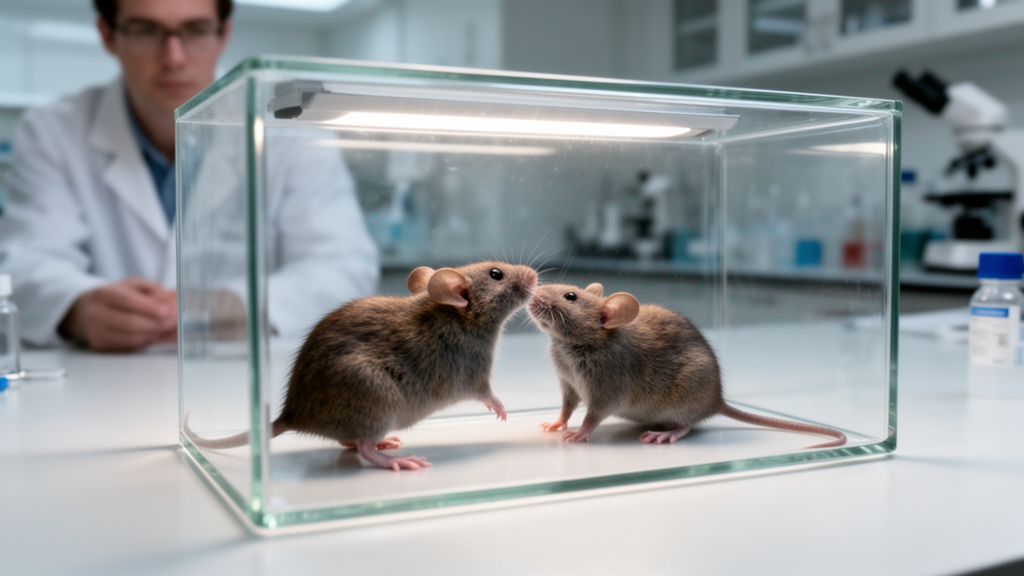
A tiny change in one gene that helps build the brain’s nicotinic acetylcholine receptors may do far more than influence a person’s risk of smoking. New research from a team at the University of Bordeaux, published in the journal iScience, shows that two different mutations of the α5 nicotinic receptor subunit produce strikingly different empathy-related behaviors in mice, with effects that split sharply along sex lines. The findings offer one of the most detailed behavioral portraits yet of how a single genetic variant linked to addiction and schizophrenia in humans may also reshape the social brain.
The α5 subunit is encoded by the CHRNA5 gene, and a well-known single nucleotide polymorphism in that gene, called rs16969968, swaps a single amino acid in the protein. In humans, homozygous carriers of this variant face roughly a twofold increase in the risk of nicotine dependence, and genome-wide association studies have also tied it to alcohol use disorder and schizophrenia. The Bordeaux team, led by Léa Tochon and Vincent David, had previously shown that mice carrying either this human-like variant or a complete deletion of the gene both drink more alcohol, but display opposite emotional profiles: the knock-in mice are hyper-anxious and behaviorally controlled, while the knockout mice are impulsive and low in anxiety. Those two profiles eerily mirror Cloninger’s classic Type I and Type II subtypes of alcoholism, one characterized by anxious self-medication and the other by impulsive sensation-seeking.
What remained unknown was whether these mutations also alter the social-emotional machinery that alcohol use disorder disrupts in patients. Empathy, in its broadest sense, involves perceiving the emotional states of others, sharing their affect, and acting prosocially to help them. Deficits in facial emotion recognition and other empathy-related processes are well documented in alcohol use disorder, and they differ between subtypes: Type I patients are described as eager to help and sensitive to social cues but prone to misreading sadness and contempt, whereas Type II patients overinterpret anger and disgust, show aggressive behavior, and display deficient affective empathy. The researchers therefore set out to test whether their two mouse strains would show divergent social-emotional profiles consistent with these human subtypes.
The team ran two complementary behavioral paradigms. The first, an affective state discrimination task, presented an observer mouse with two unfamiliar demonstrator mice in transparent cylinders, one of which had just undergone fifteen minutes of restraint stress while the other remained neutral. Wild-type mice of both sexes spent significantly more time near the stressed demonstrator, indicating they could detect the negative emotional state. Female wild-type mice were particularly skilled, showing a sniffing preference for the stressed demonstrator with an effect size of more than three standard deviations, and every female tested qualified as a discriminator under the study’s categorical cutoff, while about a fifth of males did not.
The mutants told a very different story. Knockout mice of both sexes failed entirely to preferentially approach the stressed demonstrator, spending equivalent time near both cylinders and showing no sniffing preference. Knock-in mice fell in between: males were severely impaired, but females retained a statistically significant ability to discriminate the stressed from the neutral demonstrator. The impairment could not be explained by reduced social motivation, since a separate three-chamber sociability test confirmed intact social preference in male mutants, and normalizing the preference scores to total investigation time did not change the pattern. The researchers interpret this as a genuine deficit in affective state discrimination rather than generalized social withdrawal.
The second paradigm, a restrainer tube task adapted from classic rat studies, tested prosocial rescue behavior. Mice first learned to open a paper-sealed tube from the inside to free themselves, then from the outside to reach white chocolate chips. In the critical trials, a cagemate was trapped inside one tube while alternatives, an empty tube or a chocolate-containing tube, were also present. Female wild-type mice opened the cagemate tube above chance levels, but males of every genotype did not, instead gravitating toward the empty or chocolate tubes. Remarkably, female knock-in mice opened the cagemate tube in 87.5 percent of trials versus only 12.5 percent for the empty tube, indicating their opening behavior was specifically directed at the trapped companion rather than at the tube itself.
When the researchers pitted chocolate against a trapped cagemate in a direct competition trial, female knock-in mice again stood out, entering the cagemate tube zone more frequently than any other group despite all mice spending more overall time near the chocolate. The team then scored post-release interactions between the rescuer and the freed cagemate, categorizing them as interactive, disinterested, or aggressive. Here the two mutants diverged dramatically. Male knockout mice, after freeing their cagemate, displayed significantly higher levels of aggression than wild-type or knock-in males, a pattern the authors note is consistent with deficient affective empathy in humans. Female knockout mice, by contrast, were predominantly disinterested, while female knock-in mice showed the most interactive, affiliative behavior of any group.
Combining cagemate prioritization and social-contact positivity into a composite empathy-related score, the researchers found that males scored lower than females across all genotypes, knockout mice scored below their wild-type controls in both sexes, and female knock-in mice achieved the highest scores of any group. The two components of the score correlated strongly in female wild-type mice but not in males, and in several male knockout mice the components dissociated entirely, with animals opening the cagemate tube yet then attacking the freed companion. The authors caution that tube opening alone cannot be labeled empathic; a rescue followed by aggression or indifference cannot be classified as prosocial, and the motivation behind opening may range from genuine concern to a desire to terminate distress signals or simply enjoy the task.
Mechanistically, the α5 subunit is an accessory component of nicotinic receptor pentamers that enhances receptor efficacy and calcium permeability. The human-like SNP causes a partial loss of function with reduced intracellular calcium responses, while the knockout eliminates the subunit entirely and alters receptor stoichiometry. Both changes could dysregulate α5-containing receptors in circuits central to social cognition: the prefrontal cortex, where α5 receptors sit on vasoactive interneurons that inhibit somatostatin-expressing interneurons known to control affective state discrimination, and the hypothalamic paraventricular nucleus, where α5 receptors are found on oxytocin-containing neurons whose projections to the amygdala are critical for emotion recognition. The ventral hippocampus, implicated in observational fear, represents another candidate substrate.
The authors acknowledge limitations, including the absence of physiological readouts such as corticosterone or ultrasonic vocalizations, unmonitored estrous cycles in females, and the possibility that pre-existing dominance hierarchies between cagemates influenced post-release interactions, particularly for the aggressive male knockouts. The female knockout subgroup was also small, at only five animals. Nevertheless, the convergence of findings across two independent paradigms, combined with the team’s earlier work linking the same mutations to alcohol overconsumption and opposing anxiety profiles, suggests that α5 nicotinic receptors play a critical and sex-dependent role in shaping the social-emotional deficits seen in addiction and schizophrenia. The researchers propose that future studies test whether alcohol exposure modifies these social behaviors and examine the neural network consequences of α5 mutations, work that could ultimately inform subtype-specific interventions for alcohol use disorder that account for patients’ socio-emotional skills.
Subject of Research: Effects of α5 nicotinic acetylcholine receptor mutations on empathy-related and prosocial behaviors in mice
Article Title: Alteration of empathy-related behaviors in two strains of mice expressing mutations of the α5 cholinergic nicotinic receptor subunit
Article References: Tochon, L., Pagèze, C., Henkous, N., Guillou, J.-L., & David, V. (2026). Alteration of empathy-related behaviors in two strains of mice expressing mutations of the α5 cholinergic nicotinic receptor subunit. iScience, 29(11), Article 117950. https://doi.org/10.1016/j.isci.2026.117950
Image Credits: AI Generated
DOI: 10.1016/j.isci.2026.117950
Keywords: CHRNA5, nicotinic acetylcholine receptors, empathy, prosocial behavior, alcohol use disorder, mouse models, affective state discrimination, social cognition, sex differences, aggression, prefrontal cortex, oxytocin
Cite Scienmag News
Juliet Wilcox. (October 18, 2026). A Single Nicotinic Receptor Gene Shapes Empathy and Aggression in Mice. Scienmag. https://scienmag.com/a-single-nicotinic-receptor-gene-shapes-empathy-and-aggression-in-mice/
Juliet Wilcox. "A Single Nicotinic Receptor Gene Shapes Empathy and Aggression in Mice." Scienmag, 18 October 2026, https://scienmag.com/a-single-nicotinic-receptor-gene-shapes-empathy-and-aggression-in-mice/. Accessed 18 October 2026.
Juliet Wilcox. "A Single Nicotinic Receptor Gene Shapes Empathy and Aggression in Mice." Scienmag. October 18, 2026. https://scienmag.com/a-single-nicotinic-receptor-gene-shapes-empathy-and-aggression-in-mice/


