


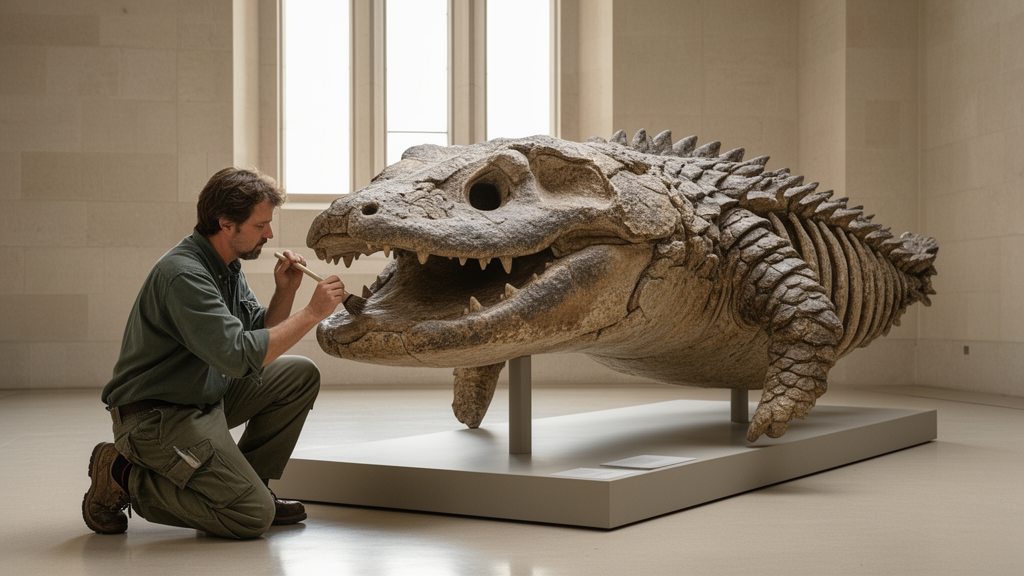
In the shallow lakes and swamps that covered southern Germany some 240 million years ago, an animal lurked that dwarfs every amphibian alive today. Mastodonsaurus giganteus, a giant temnospondyl from the Middle Triassic, grew skulls more than a metre long and bodies reaching up to five metres, making it the undisputed apex predator of European freshwater ecosystems. A new study published in Fossil Record has now assembled, for the first time, a complete growth series of this colossal predator, tracing its development from specimens barely larger than a fingernail to giants whose skulls spanned 1,200 millimetres.
The research, led by palaeontologist Rainer Schoch of the State Museum of Natural History Stuttgart, draws on nearly 200 years of collections from nine localities across Baden-Württemberg and Thuringia. The material ranges from the historically famous alum mine at Gaildorf, which yielded the first temnospondyl remains ever described in 1828, to the spectacular fossil-rich layers excavated at Kupferzell and Vellberg-Eschenau in recent decades. By analysing skulls, mandibles, vertebrae and girdle elements across every size class, the study reconstructs how this animal grew, what its youngest stages looked like, and which habitats it occupied at different points in its life.
The smallest specimens in the sample are astonishingly tiny. Two symphyses, the fused chin regions of lower jaws, recovered from screen-washed sediment at Kupferzell measure just one and two millimetres in length. They belong to individuals with estimated skull lengths of only 12 to 15 millimetres, ranking among the smallest stereospondyl specimens ever identified anywhere in the world. Even at this larval scale, the diagnostic features of Mastodonsaurus were already in place: the enlarged symphyseal fangs and the characteristic arrangement of teeth distinguish these fragments unambiguously from the juveniles of other temnospondyls sharing the same lakes, such as Tatrasuchus, Callistomordax and Trematolestes.
What emerges most strikingly from the analysis is how conservative the animal’s body plan remained throughout its life. Cranial proportions changed remarkably little from juvenile to giant stages. The orbits, the large eye openings that reached one-fifth of skull length, decreased only very moderately in relative size as the animal grew. The postorbital portion of the skull became slightly longer and the occipital margin at the back of the head grew more deeply concave in the largest individuals, but these are subtle shifts for an animal that increased its skull length a hundredfold. Small juveniles already carried the same coarse dermal ornament on their skull bones as the adults, and the heavy, disc-shaped intercentra that formed the vertebral centres were established early in the juvenile phase.
Some changes were nonetheless significant. The largest specimens developed disproportionately large symphyseal fangs at the front of the lower jaw, and their neural arches bore transverse processes that grew with strong positive allometry. In the giant skulls, the ornament on the bone surface became coarser, with larger polygons and relatively thinner ridges than in mid-sized animals. The choana, the internal nostril opening in the palate, was distinctly smaller in the biggest Gaildorf specimen than in smaller adults. These shifts likely reflect changing biomechanics as the animal moved from hunting small prey to tackling increasingly large targets.
The study also mapped the frequency and size distribution of Mastodonsaurus across six different lake deposits in the Lower Keuper of southern Germany, and the results reveal a sophisticated pattern of habitat use across the life cycle. The coal-bearing deposit at Gaildorf stands out: it yielded unusually large specimens, including complete skulls of 60 to 68 centimetres and the lost remains of a giant with an estimated 107-centimetre skull, together with relatively well-ossified limb skeletons. The researchers suggest that the Gaildorf population may have lived longer or grown faster under favourable conditions, and that the presence of the smaller capitosaur Tatrasuchus may have driven character displacement, pushing Mastodonsaurus toward even larger sizes as the apex predator of that lake.
At Kupferzell, the richest tetrapod fossil site in the Lower Keuper, the size distribution of Mastodonsaurus is strikingly bimodal, clustering in the 18 to 32 centimetre and 40 to 65 centimetre skull-length ranges, with tiny larvae identified in screen-washed samples and a single giant specimen of 88.5 centimetres. This lake, interpreted as a shallow, well-aerated water body less than ten metres deep, evidently served as a nursery and growth habitat. By contrast, the lake shore facies at Kupferzell K4 and Vellberg E7 contain only adult specimens, suggesting that juveniles avoided these more exposed environments and dwelled in calmer waters instead.
The Vellberg deposits tell an equally nuanced story. The small lake E5, dominated by the competing predator Tatrasuchus, hosted only occasional adult Mastodonsaurus in a narrow 50 to 60 centimetre range, apparently unable to sustain a full population. The larger, deeper lake E6, however, preserved specimens of every size class, from larvae to giants approaching 120 centimetres in skull length. E6 also provides the only evidence so far of cannibalism in Mastodonsaurus, including a 60-centimetre skull bearing bite marks from a much larger conspecific. Regurgitated bones and corroded lungfish teeth scattered through the deposit confirm that this lake was a hunting ground where the giant ambushed fish, smaller temnospondyls and even the amphibious archosauriform Jaxtasuchus.
Prey was never in short supply. The diverse actinopterygian fish fauna of these lakes ranged from three-centimetre Dipteronotus to 30-centimetre scanilepiforms, providing food for every growth stage of the giant predator. At Gaildorf, the most likely prey was the large bottom-dwelling Plagiosuchus; at Kupferzell, the smaller Gerrothorax, lungfishes and coelacanths; at Vellberg, Plagiosuchus and Tatrasuchus, as evidenced by heavy bite marks on their skulls. Yet the giant itself was not invulnerable: the pseudosuchian archosaur Batrachotomus kupferzellensis scavenged and possibly hunted Mastodonsaurus carcasses, leaving abundant bite marks on bones at both Kupferzell and Vellberg.
The new growth series demonstrates that Mastodonsaurus giganteus was not only the largest temnospondyl known but also one of the most ecologically flexible. It bred and grew in large, resource-rich lakes, visited smaller water bodies only as adults, and partitioned niches with competing predators where conditions allowed. Its presence, the study concludes, was apparently governed less by the stability of living conditions than by the question of which capitosaur reached a lake first. In an age when the ancestors of dinosaurs were still small and inconspicuous, the giants of the Triassic waterways were amphibians, and Mastodonsaurus ruled them all.
Subject of Research: Ontogeny and life history of the giant Triassic temnospondyl Mastodonsaurus giganteus
Article Title: Growing giants: ontogeny and life history of the temnospondyl Mastodonsaurus giganteus ( Stereospondyli ) from the Middle Triassic of Germany
Article References: Schoch, R. R., Witzmann, F., Moreno, R., Werneburg, R., & Mujal, E. (2024). Growing giants: ontogeny and life history of the temnospondyl Mastodonsaurus giganteus (Stereospondyli) from the Middle Triassic of Germany. Fossil Record, 27(3), 401-422. https://doi.org/10.3897/fr.27.125379
Image Credits: AI Generated
DOI: 10.3897/fr.27.125379
Keywords: Mastodonsaurus giganteus, temnospondyl, Triassic, ontogeny, palaeoecology, Germany, Lower Keuper, fossil, amphibian, stereospondyl, Kupferzell, Vellberg
Cite Scienmag News
Cassandra Pierce. (October 18, 2026). Triassic Giant: Fossil Growth Series Reveals the Life Story of Mastodonsaurus, Europe’s Largest Amphibian Predator. Scienmag. https://scienmag.com/triassic-giant-fossil-growth-series-reveals-the-life-story-of-mastodonsaurus-europes-largest-amphibian-predator/
Cassandra Pierce. "Triassic Giant: Fossil Growth Series Reveals the Life Story of Mastodonsaurus, Europe’s Largest Amphibian Predator." Scienmag, 18 October 2026, https://scienmag.com/triassic-giant-fossil-growth-series-reveals-the-life-story-of-mastodonsaurus-europes-largest-amphibian-predator/. Accessed 18 October 2026.
Cassandra Pierce. "Triassic Giant: Fossil Growth Series Reveals the Life Story of Mastodonsaurus, Europe’s Largest Amphibian Predator." Scienmag. October 18, 2026. https://scienmag.com/triassic-giant-fossil-growth-series-reveals-the-life-story-of-mastodonsaurus-europes-largest-amphibian-predator/


