


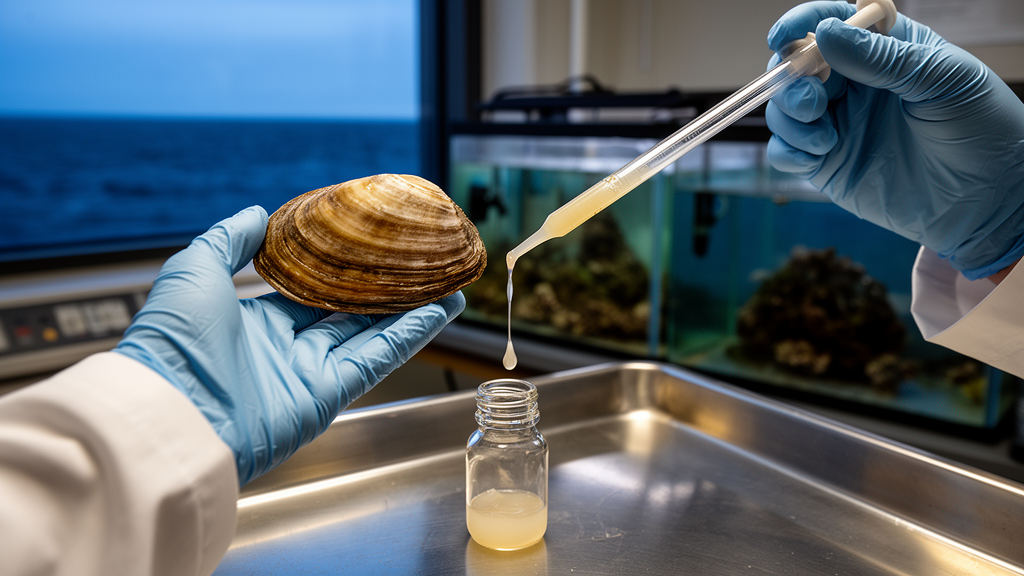
On a stretch of sandy beach along the Bulgarian Black Sea coast, a small burrowing shellfish is quietly keeping a record of the water around it. The wedge clam Donax trunculus, one of the most heavily harvested bivalves in the Mediterranean and Black Sea region, spends its life just beneath the surface of open sandy beaches, filtering seawater and whatever microorganisms it carries. A two-year study conducted at Arkutino, on the Bulgarian coast, has now traced how the bacterial communities inside these clams change with the seasons, and the results include a warning sign: fecal coliform counts in July exceeded Bulgarian water-quality limits by roughly 190 times.
The research, published in the journal BioRisk, set out to answer a deceptively simple question: how does the state of the marine environment shape the microbiota of wedge clams? The team collected clams from the Arkutino area between May 2019 and May 2021, using specimens of similar size, weight, and shape, with an average shell length of 2.2 centimeters, to keep the methods as uniform as possible. Each sampling round gathered three subsamples of about one kilogram, which were chilled to 4 degrees Celsius and transported to the laboratory at the University of Shumen for immediate analysis, without freezing, so that the natural microbial communities would be preserved as faithfully as possible.
Alongside the microbiological work, the researchers measured four key physicochemical parameters of the seawater at the sampling site, at depths of two to four meters. Water temperature followed a clear seasonal arc, declining from September 2020 to a low of 19.8 degrees Celsius in January 2021, then climbing slowly from February onward. Salinity ranged between 11.2 and 13.5 parts per thousand, dipping to its lowest values in August, September, and October, while dissolved oxygen fell to its minimum between November and January. Notably, when the team compared May 2020 with May 2021, the water in 2021 was 1.5 degrees Celsius colder, a difference that turned out to matter for at least one bacterial species.
To identify the bacteria, the team used the Biolog Microbial Identification System, a phenotypic platform that profiles microorganisms across 94 biochemical tests on a standardized microplate, generating a metabolic fingerprint that can be matched against databases covering more than 2,900 species of bacteria, yeasts, and fungi. Before identification, the clam tissue was carefully prepared: shells were scrubbed clean, washed in a hypochlorite solution, rinsed with sterile distilled water, and opened with sterile instruments, after which roughly 100 grams of tissue liquor were homogenized for analysis. Fecal coliforms were enumerated using a most-probable-number technique, with incubation at 37 degrees Celsius followed by 44 degrees Celsius, and confirmed bacteria were cultured on selective media including MacConkey agar for E. coli and Cetrimide agar for Pseudomonas species.
The results revealed a microbial cast of characters that rotated with the calendar. Enterococcus hirae appeared from May through August, Pseudomonas mendocina favored the warmer months and was isolated in April and May, while Pseudomonas alcaligenes dominated the colder season, appearing in November, December, and January. Citrobacter farmeri was isolated only in September, and Acinetobacter gyllenbergii showed up in February and March. The most striking finding concerned Escherichia vulneris, a fecal coliform detected only in July, at a density of 1.6 times ten to the seventh cells per milliliter, a figure the authors calculated to be about 190 times above the maximum allowed under Bulgarian Ordinance No. 4 of 20 October 2000, which governs the quality of fisheries water and shellfish breeding areas.
The seasonal temperature data helped explain some of these patterns. The colder May of 2021 coincided with a doubling of Pseudomonas alcaligenes numbers compared with May 2020, suggesting that this species prefers lower optimum temperatures when other parameters remain stable. Enterococcus hirae behaved differently: its numbers stayed constant in May of both years but declined as temperatures rose through the summer, and the strain appeared to develop preferentially at a pH of 7.78. Acinetobacter gyllenbergii grew best between 20.3 and 25.7 degrees Celsius, with an optimum at the upper end of that range, while Citrobacter farmeri preferred a temperature of 26.2 degrees Celsius and a pH of 7.3. The lowest dissolved oxygen levels, recorded from November to January, overlapped with the peak abundance of P. alcaligenes.
The authors interpret these findings through a useful conceptual lens borrowed from earlier bivalve microbiology: the distinction between resident and transitional microbiota. Resident microbes are stable members of the animal’s internal community, largely unaffected by environmental swings, while transitional species reflect the conditions of the surrounding water at a given moment. In this study, the fecal coliform E. vulneris and the September-only Citrobacter farmeri most likely belong to the transitional category, whereas Pseudomonas species, Enterococcus species, and Acinetobacter gyllenbergii appear to be resident inhabitants of the wedge clams. That distinction matters, because transitional pathogenic species are precisely the ones that signal a temporary deterioration in water quality.
The July spike in fecal coliforms points to a seasonal worsening of seawater conditions driven by human activity, the researchers conclude, and the concern is amplified by the clam’s own biology. Because Donax trunculus lives buried within the sand, persistent pollution would accumulate in its habitat rather than being flushed away. Bivalves can acquire pathogenic bacteria from seawater, from the microalgae they filter as food, and from anthropogenic contamination of the environment, and conditional pathogens, free-living bacteria that turn harmful under favorable conditions, pose a risk both to the shellfish themselves and to the humans who eat them. Mass die-offs of coastal bivalve populations have been linked to such bacterial outbreaks, making the sanitary status of wild stocks a matter of economic as well as ecological concern.
The wedge clam is commercially significant across the Mediterranean and Black Sea region, with annual European Donax production estimated at 970 to 1,353 tons according to the State of World Fisheries and Aquaculture. In Galicia, Spain, its market value rose to 42.37 euros per kilogram in 2017, and along the southern Black Sea coast, extraction sites have multiplied in recent years, with most of the catch exported at high prices. That pressure has drastically depleted wild stocks in some areas, including Bulgaria. Against this backdrop, the microbial findings from Arkutino carry practical weight: elevated coliform levels in summer could render clams unsafe for consumption precisely when harvesting pressure is high.
The study also situates itself in a sparse literature. The first analysis of the normal microbiota of a bivalve, conducted on the Pacific oyster in 1960, found that more than 80 percent of the associated bacteria were Gram-negative, dominated by Pseudomonas and Vibrio. Since then, most research has focused on pathogens of aquaculture species, such as Vibrio tapetis, the agent of Brown Ring Disease in Manila clams, whose severity increases at lower salinity. The Arkutino results align with that pattern: salinity dropped to 11.2 parts per thousand in late summer, coinciding with the appearance of transitional species. The dominance of Pseudomonas, which one earlier study found made up about 52.8 percent of bivalve microbiota, also matches the Bulgarian data. The authors argue that their findings, the first cultivated bacterial species reported from Black Sea mussels, underscore the need for deeper research combining culture-based and molecular methods, particularly as global bivalve consumption rises and new diseases may emerge from the interplay of pathogen, host, and environment.
Subject of Research: Seasonal variation of the microbiota of the wedge clam Donax trunculus in relation to physicochemical conditions on the Bulgarian Black Sea coast
Article Title: Seasonal variations of the microflora of wedge clam Donax trunculus (Linnaeus, 1758) from the region of Arkutino (Bulgarian Black Sea aquatory)
Article References: Ibryamova, S., Pavlova, B., Stanachkova, E., Salim, S., Lyatif, A., Dimitrov, D., Bachvarova, D., Chipev, N., Natchev, N., & Ignatova-Ivanova, T. (2022). Seasonal variations of the microflora of wedge clam Donax trunculus (Linnaeus, 1758) from the region of Arkutino (Bulgarian Black Sea aquatory). BioRisk, 17, 253-262. https://doi.org/10.3897/biorisk.17.77097
Image Credits: AI Generated
Keywords: Donax trunculus, wedge clam, Black Sea, microbiota, fecal coliforms, Pseudomonas, Enterococcus hirae, water quality, seasonal variation, bivalve, marine pollution, Biolog identification
Cite Scienmag News
Morgan Morrow. (October 18, 2026). Hidden bacteria in Black Sea wedge clams shift with the seasons, study finds. Scienmag. https://scienmag.com/hidden-bacteria-in-black-sea-wedge-clams-shift-with-the-seasons-study-finds/
Morgan Morrow. "Hidden bacteria in Black Sea wedge clams shift with the seasons, study finds." Scienmag, 18 October 2026, https://scienmag.com/hidden-bacteria-in-black-sea-wedge-clams-shift-with-the-seasons-study-finds/. Accessed 18 October 2026.
Morgan Morrow. "Hidden bacteria in Black Sea wedge clams shift with the seasons, study finds." Scienmag. October 18, 2026. https://scienmag.com/hidden-bacteria-in-black-sea-wedge-clams-shift-with-the-seasons-study-finds/


