


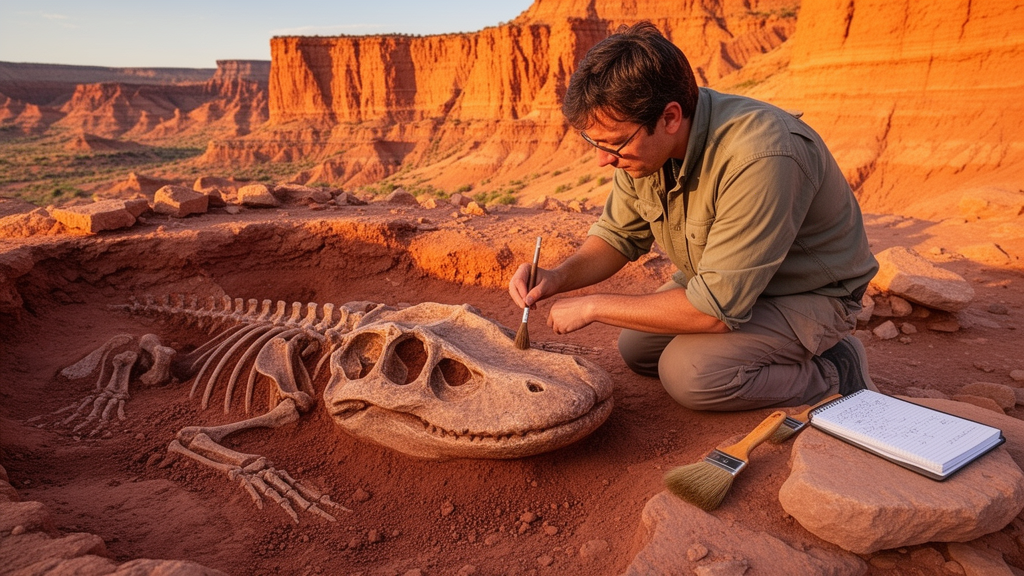
Scientists have significantly expanded the anatomical understanding of a massive prehistoric amphibian known as Cherninia denwai, a creature that dominated the aquatic ecosystems of Central India during the Middle Triassic period. This new research, published in the journal Fossil Record, presents a comprehensive osteological analysis based on a diverse array of newly discovered specimens. These findings provide the first detailed description of the animal’s postcranial skeleton, including its limbs, vertebrae, and girdles, which were previously unknown or poorly documented. The study offers a revised diagnosis of the species, clarifying its unique biological traits and its evolutionary relationship with other mastodonsaurid amphibians. By integrating these new skeletal elements with previously overlooked skull specimens, researchers have been able to construct a more accurate picture of this ancient predator’s biology and lifestyle.
The Denwa Formation, located within the Satpura Gondwana Basin in Central India, is renowned for its rich deposits of Triassic vertebrate fossils. This geological unit, dating to the Anisian stage of the Middle Triassic, preserves a significant assemblage of temnospondyl amphibians, particularly those belonging to the family Mastodonsauridae. Prior to this study, knowledge of Cherninia denwai was largely restricted to two holotype skull specimens, which limited the scope of anatomical analysis. The current investigation utilizes approximately eighty skeletal elements, including a partial skull, a large mandible, clavicles, interclavicles, vertebrae, and limb bones. This extensive collection allows for a detailed examination of the animal’s skeletal structure, moving beyond the cranial focus that has characterized previous descriptions of this taxon.
One of the most striking aspects of the new material is the sheer size of the specimens recovered. A fragmented cranium exceeds one meter in length, while a nearly complete mandible measures close to 96 centimeters. These dimensions suggest that Cherninia denwai was a colossal amphibian, potentially reaching lengths of four to five meters. The presence of such large individuals in the central stratigraphic section of the Denwa Formation indicates that this area served as a sanctuary for these giant temnospondyls. The robust nature of the bones, particularly the interclavicles which are three to five centimeters thick, reflects the substantial body mass of the animal. This size class places Cherninia denwai among the largest known amphibians from the Mesozoic era, highlighting the ecological dominance of mastodonsaurids in Triassic aquatic habitats.
The osteological analysis reveals several distinctive features that help distinguish Cherninia denwai from other related species. The skull roof exhibits conspicuous, paired, and forked ridges anterior to the orbits, a characteristic that is not observed in the same form in other mastodonsaurids. The otic notch, a large opening at the back of the skull, has an angular anterior rim, with angles measuring between 40 and 60 degrees. The tabular horns, which project from the skull, are directed posteriorly and recurved distally. These cranial traits, combined with the presence of a septomaxilla and specific configurations of the interpterygoid vacuities, form the basis of the emended diagnosis for the species. The mandible is notably slender and long, featuring a well-developed hamate process and a distinct post-glenoid area. The morphology of the post-glenoid area is complex, sharing features with both Type I and Type II classifications defined by previous researchers, which adds nuance to the understanding of mastodonsaurid jaw mechanics.
The postcranial skeleton provides critical insights into the locomotion and habitat preferences of Cherninia denwai. The vertebral column includes intercentra that are wedge-shaped in lateral view, a trait associated with semiaquatic lifestyles in temnospondyls. The neural arches and spines are generally short and stout, with variations between post-atlantal and presacral regions. The ribs show distinct morphological differences depending on their position in the body, with cervical ribs having separate facets and thoracic ribs varying from elliptical to cylindrical shapes. The pectoral girdle is robust, with large interclavicles and clavicles that have long, twisted dorsal processes. These heavy bones may have served as ballast, aiding the animal in maintaining a benthic, bottom-dwelling posture in the water column. The limb bones, including the ulna, femur, and fibula, are relatively small and primitive compared to the massive skull, further indicating an adaptation to an aquatic rather than terrestrial mode of life.
Functional analyses suggest that Cherninia denwai was a passive benthic predator, inhabiting the bottom of lakes and rivers. The triangular shape of the skull, with almost parallel lateral margins and wide cheek regions, is indicative of a primarily aquatic lifestyle. Histological studies of limb bones have revealed stable fibrolamellar bone tissue with growth marks that suggest seasonal fluctuations in growth rates. This pattern of growth is consistent with animals that experience environmental changes affecting food availability or temperature. The heavy interclavicles and the overall skeletal structure support the hypothesis that the animal relied on buoyancy and stability in the water rather than active terrestrial locomotion. The lack of well-developed digit bones and the relatively small size of the limbs further reinforce the conclusion that Cherninia denwai was not adapted for life on land.
The study also addresses the phylogenetic position of Cherninia denwai within the superfamily Capitosauroidea. While the family Mastodonsauridae is widely recognized, the placement of the genus Cherninia has been debated. Some researchers have placed it within the Parotosuchidae, while others maintain its status within Mastodonsauridae. The current study supports the retention of the family name Mastodonsauridae, pending a comprehensive phylogenetic analysis that includes all known taxa. The distinct synapomorphies identified in this study, such as the short pterygoid-parasphenoid suture and the specific configuration of the palatal vacuities, help to define the unique evolutionary lineage of Cherninia. These features distinguish it from other mastodonsaurids, such as Cherninia megarhina, which shares some characteristics but differs in key aspects like the shape of the postparietals and the presence of a parasphenoid groove.
The discovery of these new specimens has significant implications for our understanding of Triassic biodiversity in the Satpura Gondwana Basin. The Denwa Formation is known for its diverse vertebrate assemblage, including fish, archosauromorphs, and other amphibians. The detailed osteology of Cherninia denwai provides a baseline for future comparative studies and phylogenetic analyses. It highlights the importance of postcranial material in understanding the biology of extinct vertebrates, as skull-only descriptions can limit the scope of functional and ecological interpretations. The findings contribute to the broader narrative of temnospondyl evolution, showing how these amphibians adapted to various aquatic niches during the Mesozoic era. The study underscores the need for continued exploration and detailed analysis of fossil collections in the region, as new specimens continue to reveal unexpected anatomical details.
In conclusion, this research marks a significant advancement in the paleontological knowledge of Cherninia denwai. By providing the first detailed description of its postcranial skeleton and revising its diagnosis, the study offers a more holistic view of this giant amphibian. The combination of cranial and postcranial data allows for a better understanding of its anatomy, physiology, and ecological role. The findings support the view that Cherninia denwai was a large, semiaquatic predator that thrived in the fluvio-lacustrine environments of the Middle Triassic. This work sets the stage for future investigations into the phylogeny of mastodonsaurids and the broader evolution of temnospondyls. As more fossils are discovered and analyzed, the picture of life in the ancient Satpura Basin will continue to become clearer, revealing the complex interactions between these ancient creatures and their environment.
Subject of Research: Osteology and revised diagnosis of Cherninia denwai from the Middle Triassic Denwa Formation, Satpura Gondwana Basin, Central India
Article Title: Osteology and revised diagnosis of Cherninia denwai from the Middle Triassic Denwa Formation, Satpura Gondwana Basin, Central India
Article References: Roy, P., Chakravorti, S., & Sengupta, D. P. (2024). Osteology and revised diagnosis of Cherninia denwai from the Middle Triassic Denwa Formation, Satpura Gondwana Basin, Central India. Fossil Record, 27(3), 423-443. https://doi.org/10.3897/fr.27.135664
Image Credits: AI Generated
DOI: 10.3897/fr.27.135664
Keywords: Osteology, revised, diagnosis, Cherninia, denwai, Middle, Triassic, Denwa, Formation, Satpura, Gondwana, Basin
Cite Scienmag News
Gavin Prescott. (October 18, 2026). New Fossils Redefine Giant Triassic Amphibian. Scienmag. https://scienmag.com/new-fossils-redefine-giant-triassic-amphibian/
Gavin Prescott. "New Fossils Redefine Giant Triassic Amphibian." Scienmag, 18 October 2026, https://scienmag.com/new-fossils-redefine-giant-triassic-amphibian/. Accessed 18 October 2026.
Gavin Prescott. "New Fossils Redefine Giant Triassic Amphibian." Scienmag. October 18, 2026. https://scienmag.com/new-fossils-redefine-giant-triassic-amphibian/


