


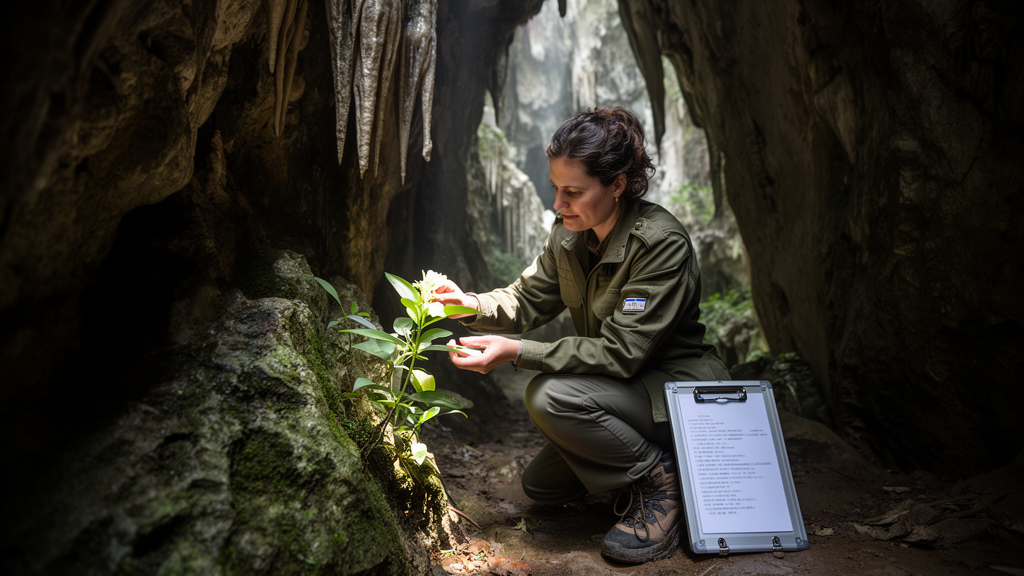
In the dim, humid recesses of a karst cave in Guangxi, China, botanists have identified a new species of flowering plant that challenges existing understandings of plant evolution in subterranean environments. The species, named Ornithoboea brachycarpa, was formally described in a study published in the journal PhytoKeys. This discovery adds to the growing body of evidence that cave ecosystems harbor unique flora adapted to extreme conditions, often evolving distinct morphological traits that set them apart from their surface-dwelling relatives. The identification of this new species highlights the ongoing importance of botanical surveys in underexplored regions, particularly in Southeast Asia, where karst landscapes support high levels of biodiversity.
The genus Ornithoboea, a group of calcicolous perennial herbs, is primarily distributed across Southeast Asia, ranging from Peninsular Malaysia and Thailand to southern China. It is characterized by complex floral structures, including a prominent palatal beard at the base of the lower corolla lip and an annulus of hairs around the mouth of the corolla tube, known as a circlet. While the genus is well-studied, with seventeen recognized species and one variety, significant intraspecific variability in leaf morphology has historically posed challenges for accurate species identification. The new species, O. brachycarpa, stands out due to its unique combination of features, particularly the presence of a beard on the sterile projections of its stamens, a character not observed in any other known member of the genus.
The discovery of O. brachycarpa began in late March 2025 during a botanical survey of the karst cave flora in Shanglin County, Nanning City. Researchers initially encountered an unknown species of Gesneriaceae, identifiable by its caulescent habit, opposite cordate leaves, and persistent axillary infructescences from the previous growing season. However, the absence of flowers at the time prevented definitive identification. A follow-up expedition in early June 2025 revealed the plants in full bloom, allowing for detailed morphological analysis. The presence of genus-specific floral traits, such as the palatal beard and circlet, confirmed its placement within Ornithoboea, while floral dissections revealed the distinctive yellow beard on the sterile stamen projections.
Morphologically, O. brachycarpa is a biennial to perennial herb with a monocarpic habit, meaning the entire plant senesces after fruit maturation, though it can perennate via dormant rhizome buds. The stems are erect to ascending, reaching heights of 20 to 50 centimeters, and are densely covered in glandular pubescence. The leaves are opposite, petiolate, and suborbicular to ovate, with irregularly denticulate margins. The inflorescence is terminal or subterminal, bearing light purple to violet flowers with a bilabiate corolla. The most striking feature, however, is the fruit: a straight, non-spirally twisted capsule that is extremely short, measuring only 2.5 to 3 millimeters in length, representing the shortest capsules in the genus.
To determine the phylogenetic placement of the new species, researchers conducted a molecular analysis using internal transcribed spacer (ITS) and trnL-F sequences. The study involved extracting genomic DNA from silica-dried leaves and performing next-generation sequencing on the Illumina HiSeq 4000 platform. The resulting data were used to construct a phylogenetic tree, which placed O. brachycarpa as the sister species to O. feddei with strong statistical support. This finding is significant because, despite their close phylogenetic relationship, the two species exhibit striking morphological differences. O. feddei lacks sterile projections, possesses twisted fruits, and has a longer corolla tube, suggesting that the distinct traits of O. brachycarpa may have evolved as specific adaptations to its cave-dwelling habitat.
The ecological niche of O. brachycarpa is restricted to the entrance or ground inside a karst cave at an elevation of approximately 140 meters. It grows on dry rock surfaces, co-occurring with species such as Ficus tinctoria subsp. gibbosa, Pteris vittata, and Adiantum capillus-veneris. The cave environment presents unique selective pressures, including low light levels and stable humidity, which may drive convergent evolution in cave-dwelling plants. The morphological similarity between O. brachycarpa and O. flexuosa, another cave-dwelling species, in terms of corolla size and fruit structure, despite their distant phylogenetic relationship, supports the hypothesis that similar environmental pressures can lead to similar evolutionary outcomes.
Conservation concerns are paramount for O. brachycarpa, as it is currently known from only one population comprising approximately 150 to 200 mature individuals. The species is provisionally assessed as Endangered (EN D) under the IUCN Red List Categories and Criteria. The cave habitat is subject to human activity, including the storage of ritual burial jars and occasional visits by villagers for ceremonial practices. These activities, while not intentionally targeting the plant, pose a risk of damage or removal of individuals, highlighting the vulnerability of this newly described species to anthropogenic disturbance.
The functional significance of the bearded sterile projection in O. brachycarpa remains an open question for future research. In other plant groups, staminal structures often play a role in pollinator attraction or pollen deposition. The yellow beard on the sterile projection could potentially mimic fertile anthers, guiding pollinators to a specific position within the flower. Given that the flower lacks a nectar disc, a deceptive pollination strategy is plausible. Further field observations of pollinator behavior are needed to clarify whether the sterile projection is physically contacted during foraging and how it influences reproductive success.
This discovery underscores the rich biodiversity hidden within the karst landscapes of China and the broader region. It also highlights the importance of integrating morphological and molecular data in taxonomic studies to accurately characterize new species. As climate change and human development continue to impact natural habitats, the documentation and conservation of such unique species become increasingly urgent. O. brachycarpa serves as a reminder of the delicate balance between human activity and the preservation of biological diversity, particularly in specialized ecosystems like caves.
Subject of Research: Discovery and description of a new cave-dwelling Gesneriaceae species in Guangxi, China
Article Title: Ornithoboea brachycarpa ( Gesneriaceae ), a new cave-dwelling species from Guangxi, China
Article References: Xiong, C., Wei, J., Liu, H., & Wen, F. (2026). Ornithoboea brachycarpa (Gesneriaceae), a new cave-dwelling species from Guangxi, China. PhytoKeys, 276, 229-243. https://doi.org/10.3897/phytokeys.276.181524
Image Credits: AI Generated
DOI: 10.3897/phytokeys.276.181524
Keywords: Ornithoboea brachycarpa, Gesneriaceae, Cave flora, Guangxi, Phylogenetics, New species, Conservation, Karst ecosystems, Ornithoboea, brachycarpa, cave-dwelling, species
Cite Scienmag News
Gavin Prescott. (October 18, 2026). New Cave Plant Species Discovered in Guangxi China. Scienmag. https://scienmag.com/new-cave-plant-species-discovered-in-guangxi-china/
Gavin Prescott. "New Cave Plant Species Discovered in Guangxi China." Scienmag, 18 October 2026, https://scienmag.com/new-cave-plant-species-discovered-in-guangxi-china/. Accessed 18 October 2026.
Gavin Prescott. "New Cave Plant Species Discovered in Guangxi China." Scienmag. October 18, 2026. https://scienmag.com/new-cave-plant-species-discovered-in-guangxi-china/


