


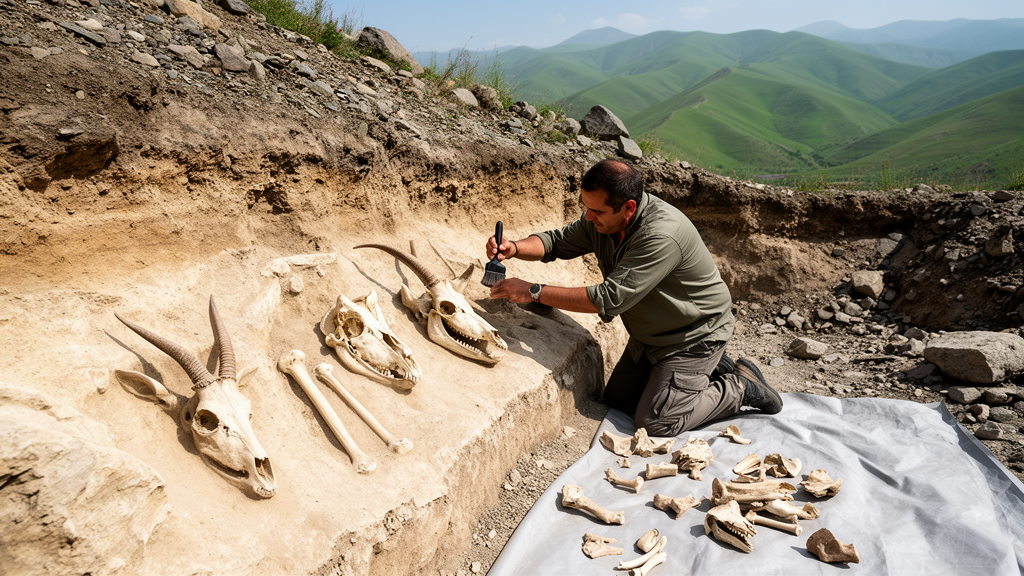
Deep inside a diatomite mine in central Armenia, paleontologists have pieced together a rare snapshot of life roughly four million years ago, when the South Caucasus served as a crossroads between Asia and Europe. A new study published in the Swiss Journal of Palaeontology describes fossil ruminant remains from the Pliocene site of Jradzor, identifying seven distinct ruminant lineages that together fill a major gap in the mammal record of Southwest Asia. The findings carry significant implications for understanding how deer, cattle, antelopes, and goats dispersed across Eurasia during a pivotal interval of Earth history.
Jradzor sits within the Gegham volcanic province of the Lesser Caucasus, a landscape shaped by eruptions, ash flows, and volcanic lakes. The diatomite deposits there were first discovered in the 1960s and have been actively mined since the 2000s. Paleontological investigations, directed by Dr. Davit Vasilyan, began during the active phase of mining and recovered a rich assemblage of fishes, reptiles, birds, and mammals. What makes the site exceptional is its dating: the stratigraphic section has been pinned down through a combination of argon-40/argon-39 radiometric analyses, magnetostratigraphy, and biochronological correlations, giving researchers an unusually precise temporal framework for the fossils.
The sedimentary succession records a complex depositional history. A short-lived dammed lake formed around 4.3 million years ago and was subsequently overwhelmed by pyroclastic density flows between roughly 4.3 and 3.93 million years ago. Paleosols then developed between 3.9 and 3.1 million years ago. The ruminant remains analyzed in the study originate from four fossiliferous horizons. Three of them, labeled JZ-2a, JZ-11, and JZ-3s, date to between 4.16 and 3.98 million years ago and represent pyroclastic flows rich in small vertebrate fossils but containing relatively few large-mammal remains. The fourth horizon, JZ-7, dated to 3.3 plus or minus 0.03 million years ago, corresponds to a catastrophic lahar, a violent volcanic mudflow, that buried an abundant large-vertebrate fauna alongside a limited number of small-vertebrate fossils.
Large-mammal faunas from this interval are poorly documented across Southwest Asia. The only other locality that has yielded a comparable assemblage is Çalta in Turkey, dated to about four million years ago. Within this context, Jradzor constitutes a regionally important site that provides new insights into the Pliocene faunal diversity of this geographic crossroad. The available specimens are few in number and not sufficiently diagnostic for higher-resolution taxonomic identification, and further discoveries are unlikely because the fossiliferous deposits at the site have been fully exhausted. The material described in the paper therefore represents the entire taxonomically significant ruminant record currently available from Jradzor.
From the lower horizons, dated to the end of the Early Pliocene, the researchers identified four lineages from just four isolated teeth. One tooth, an incomplete upper molar with distinctly wrinkled enamel, points to a very large cervid, a deer belonging to the subfamily Cervinae. The size of the specimen indicates the presence of a very large deer at Jradzor around four million years ago, comparable to the largest specimens of the Early Villafranchian genus Arvernoceros from Europe and to Rucervus simplicidens from the Early Pliocene of the Siwaliks. The buccal walls of the tooth lobes are not obliquely oriented to the longitudinal axis, a feature that excludes large members of the subfamily Capreolinae and supports attribution to Cervinae. Identification based on a single tooth is inherently problematic, but the researchers note that the specimen, together with the deer from Çalta, may represent one of the earliest large-sized cervines in the Palearctic realm.
A second tooth from the lower horizons, an unerupted deciduous upper fourth premolar lacking roots and crown wear, belonged to a bovine calf only a few weeks old. The enamel pattern and overall morphology are characteristic of the tribe Bovini, the group that includes cattle and their relatives. Remarkably, the relatively complex occlusal relief and stronger, localized paracone fold distinguish the Jradzor specimen from the European Pliocene genera Parabos, Alephis, and Grevenobos, suggesting a more derived morphology. This condition is comparable to that of Leptobos, although it does not necessarily imply affiliation with the clade comprising bison, aurochs, and their allies. The Jradzor fossil postdates, or closely coincides with, molecular estimates for the divergence of the bison-aurochs clade, which occurred between roughly 5.0 and 3.3 million years ago, whereas the buffalo clade had already differentiated by the Late Miocene. From a biogeographic point of view, this bovine represents a lineage of Oriental origin, and its occurrence predates the earliest known derived bovines in the Palaearctic zone by roughly one million years.
The remaining two teeth from the lower horizons belong to antelopes. An isolated lower third molar with notably thick enamel, a pronounced goat fold, and a smooth undulating lingual surface may belong to a different, smaller antelope than the spiral-horned Gazellospira found higher in the sequence. Although its small size could suggest attribution to the genus Gazella, the thicker enamel and the well-developed goat fold seem more consistent with the Eurasian spiral-horned antelopes, though this interpretation remains tentative. A deciduous upper fourth premolar with smooth enamel, a central fossetta, and a robust mesostyle points to a large representative of the subfamily Caprinae, possibly with affinities to the musk ox or goat-antelope tribes.
The upper horizon, dated to 3.3 million years ago and corresponding to the beginning of the early Villafranchian, yielded three lineages. Gazellospira, a medium-size spiral-horned antelope, is the most abundant ruminant at Jradzor, represented by maxillae, mandible fragments, and complete metapodials. The size, proportions, and detailed morphology of the Jradzor antelope are fully consistent with Gazellospira torticornis, though a definitive species-level attribution is not justified owing to the absence of cranial material and the challenged taxonomy of medium-size spiral-horned antelopes. The two complete metapodials fall within the lower size range of the Villarroya assemblage in Spain and are longer than those of younger Gazellospira populations from southern Europe, reflecting a reported temporal and latitudinal trend in metapodial size variation across Europe. The Jradzor occurrence constitutes one of the earliest confidently dated records of the genus and documents a widespread radiation of this antelope lineage throughout Western Temperate Eurasia, from the Caucasus to the Iberian Peninsula.
A complete right metacarpal from the upper horizon exhibits typical caprine morphology and shows striking similarity, in both morphology and size, to a specimen belonging to Eosyncerus ivericus from the Early Villafranchian Kvabebi fauna in Georgia. Eosyncerus is a problematic taxon, initially assigned to Bovinae, but cranial, dental, and postcranial morphology indicate that it more appropriately belongs to Caprinae. Based on this morphological resemblance and the close geographic proximity, despite a temporal gap of approximately 600,000 years between Kvabebi and Jradzor, the specimen is referred to Caprinae indeterminate, cf. Eosyncerus. A smaller distal metacarpal fragment from the same horizon, with a deep and wide intertrochlear incision, abrupt distal widening, and triangular outline of the trochlear external margins, suggests the presence of a goat-like bovid at Jradzor and represents some of the earliest evidence of the Caprini clade in Southwest Asia.
Overall, the Jradzor site provides evidence for the earliest Western Palearctic occurrences of several lineages of Central and East Asian origin, including the Caprini and the cf. Eosyncerus from the upper assemblage, and of Oriental origin, including the Bovini and possibly the large Cervinae from the lower assemblage. The fauna documents crucial evidence for Pliocene faunal exchanges between the Oriental, Eastern, and Western Palearctic regions and underscores the biogeographic significance of the South Caucasus as a major migration corridor during the Pliocene. Despite the limited number of specimens, the exceptionally well-dated and carefully collected fossil material from Jradzor, combined with the general scarcity of Pliocene mammal faunas in Southwest Asia, makes the site an important reference point for understanding the palaeobiogeographic and biostratigraphic patterns of Eurasian ruminants. As the researchers acknowledge, the scarcity of the material raises more questions than it provides answers, but the Jradzor record now stands as a crucial anchor for reconstructing the assembly of Eurasian mammal communities at a time when the continent’s faunal geography was being redrawn.
Subject of Research: Fossil ruminants from the Pliocene site of Jradzor, Armenia
Article Title: Fossil ruminants from the Pliocene site of Jradzor, Armenia
Article References: Bukhsianidze, M. (2026). Fossil ruminants from the Pliocene site of Jradzor, Armenia. Swiss Journal of Palaeontology, 145, 199-211. https://doi.org/10.3897/sjp.145.177453
Image Credits: AI Generated
Keywords: Fossil, ruminants, Pliocene, site, Jradzor, Armenia, scientific research
Cite Scienmag News
Gavin Prescott. (October 18, 2026). Pliocene fossils from Armenia reveal seven ruminant lineages in the Caucasus. Scienmag. https://scienmag.com/pliocene-fossils-from-armenia-reveal-seven-ruminant-lineages-in-the-caucasus/
Gavin Prescott. "Pliocene fossils from Armenia reveal seven ruminant lineages in the Caucasus." Scienmag, 18 October 2026, https://scienmag.com/pliocene-fossils-from-armenia-reveal-seven-ruminant-lineages-in-the-caucasus/. Accessed 18 October 2026.
Gavin Prescott. "Pliocene fossils from Armenia reveal seven ruminant lineages in the Caucasus." Scienmag. October 18, 2026. https://scienmag.com/pliocene-fossils-from-armenia-reveal-seven-ruminant-lineages-in-the-caucasus/


