


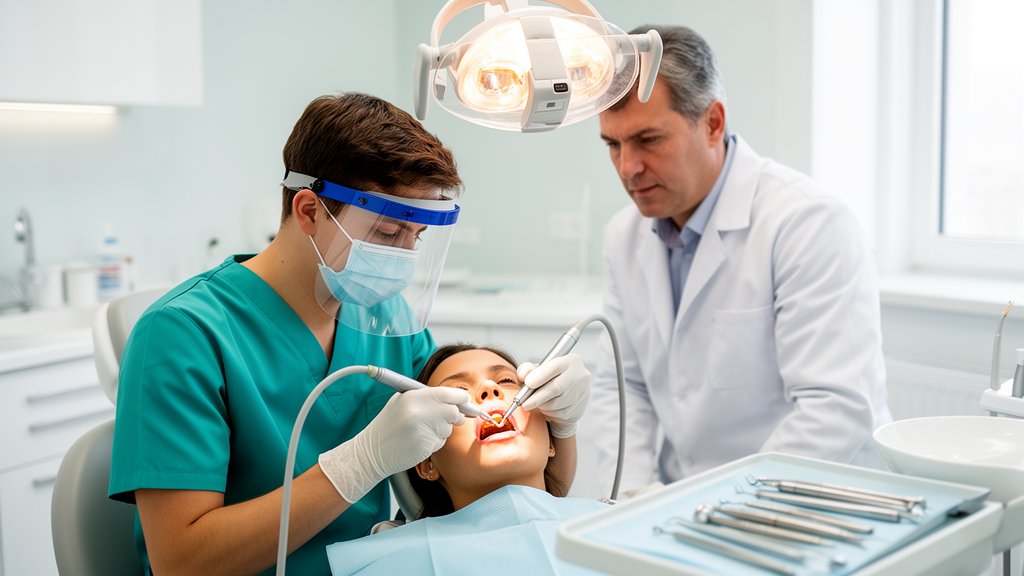
When the COVID-19 pandemic shut down dental clinics worldwide, educators worried about more than missed lectures. They worried about hands. Root canal treatment, one of the most technically demanding procedures a dental student must master, depends on hundreds of hours of supervised clinical repetition. A new retrospective cohort study from Marmara University in Istanbul now offers some of the clearest evidence yet that the continuity of that hands-on training, not merely the total amount of instruction, determines whether students can deliver technically adequate endodontic care. The findings, published in BMC Medical Education, suggest that the Class of 2022, which endured the deepest disruption to clinical rotations, produced the poorest root canal treatments, while the Class of 2024, whose third- and fourth-year clinical training proceeded without interruption, outperformed even the pre-pandemic control group.
The research team, led by Irem Cosar Tufekci and colleagues in the Department of Endodontics at Marmara University School of Dentistry, together with Fatima Betul Basturk of Istanbul Gelisim University, set out to answer a question that has lingered since 2020: did the pandemic’s patchwork of closures, restrictions, and hybrid teaching leave a measurable scar on endodontic competence? Rather than surveying student confidence or exam scores, the researchers chose a harder, more objective endpoint, the technical quality of the first maxillary molar root canal treatments performed by fifth-year undergraduate students on real patients.
The study design exploited a natural experiment created by the pandemic itself. Four consecutive graduating classes experienced distinctly different patterns of disruption during their preclinical and clinical endodontic training. The Class of 2019, which completed its education entirely before COVID-19 arrived, served as the pre-pandemic control. The Class of 2022 absorbed the heaviest blow, with the greatest interruption of hands-on clinical training during the critical middle years of the curriculum. The Classes of 2023 and 2024 experienced progressively milder disruption, with the Class of 2024 ultimately receiving uninterrupted clinical training throughout its third and fourth years. By comparing these cohorts side by side, the researchers could trace how the timing and duration of lost clinical exposure translated into treatment quality.
Only first molar treatments documented with high-quality periapical radiographs at four critical stages were included in the analysis: diagnosis, working length determination, master cone fit, and obturation. This radiographic gatekeeping mattered. Root canal treatment quality cannot be judged without clear images of the canal anatomy, the instruments’ depth, and the final filling, so the strict imaging criterion protected the comparison from being confounded by poor documentation. In total, 324 maxillary first molars entered the analysis, distributed across the four cohorts: 87 from the Class of 2022, 73 from the Class of 2023, 100 from the Class of 2024, and 64 from the pre-pandemic Class of 2019.
Each treatment was graded against the guidelines of the European Society of Endodontology, the reference standard for endodontic quality assessment in Europe and beyond. Three dimensions determined whether a root canal filling counted as adequate: the length of the obturation, meaning whether the filling material terminated within the correct apical range rather than short of the apex or extruding beyond it; the density of the filling, meaning a homogeneous, void-free seal of the canal space; and the absence of procedural errors such as instrument separation, canal transportation, or perforation. Treatments meeting all criteria were classified as adequate, while any shortfall rendered the case inadequate. Differences between cohorts were tested with chi-square statistics, with significance set at a p value below 0.05.
The results told a striking story. The Class of 2022, the cohort whose clinical training was most severely disrupted, achieved an adequacy rate of just 24.1 percent, meaning roughly three out of every four of their first molar root canal treatments failed to meet the European quality standard. The Class of 2023, whose disruption was somewhat less severe, reached 30.1 percent. The pre-pandemic Class of 2019 control group sat at 32.8 percent, establishing the historical baseline. And the Class of 2024, the first cohort to pass through the third and fourth years of clinical training without pandemic-related interruption, topped the table at 43.0 percent. The difference across cohorts was statistically significant, with p equal to 0.049, just under the conventional threshold.
That the Class of 2024 exceeded the pre-pandemic baseline is perhaps the most intriguing finding. It suggests that uninterrupted clinical continuity in the final two years may do more than simply restore lost ground; it may consolidate skills in a way that even the pre-pandemic curriculum, with its ordinary scheduling gaps and competing demands, did not fully achieve. The authors interpret this pattern as evidence that continuity itself, the steady accumulation of supervised clinical experience without forced pauses, is a decisive ingredient in endodontic competence. Skills that are built and then repeatedly exercised appear to consolidate differently from skills built in fragmented bursts separated by months of clinical inactivity.
The technical dimensions of the assessment help explain why root canal treatment is such a sensitive barometer of clinical training. Obturation length requires the student to accurately determine the working length of each canal, typically with electronic apex locators and radiographs, and then to consistently maintain that reference throughout cleaning, shaping, and filling. Density depends on meticulous canal preparation, appropriate master cone selection, and disciplined compaction technique. Procedural errors, from ledge formation to instrument fracture, tend to cluster in the hands of operators whose psychomotor skills have not been sufficiently rehearsed. Each of these abilities decays or fails to consolidate when supervised practice is interrupted, which is precisely the situation the pandemic imposed on dental schools around the world.
The study’s retrospective design and single-institution setting carry inherent limitations. Radiographic assessment captures technical quality but not biological outcomes such as healing or long-term survival of the treated tooth, and the analysis was restricted to first maxillary molars with complete, high-quality imaging, which may not represent the full spectrum of cases students treated. The authors also note that the study was approved by the Marmara University Ethics Committee and conducted in line with the Declaration of Helsinki, with written informed consent obtained from all participants prior to treatment. The research received no specific funding from any public, commercial, or not-for-profit agency, and the authors declared no competing interests.
Nevertheless, the implications reach well beyond one dental school in Istanbul. As education systems worldwide continue to debate how to recover from pandemic-era learning losses, this study provides a quantitative argument that clinical continuity is not a luxury but a structural requirement for procedural disciplines. For dental educators, the message is that simulation-based and distance learning, however valuable, could not fully substitute for the supervised, patient-centered repetition that endodontics demands. For curriculum designers, the findings suggest that when disruption is unavoidable, protecting the continuity of clinical rotations in the final pre-graduation years may be the single most effective safeguard of graduate competence. And for the students of the Class of 2024, whose treatments outshone every cohort before them, the results stand as quiet proof that steady, uninterrupted practice at the chairside is what turns a dental student into a competent clinician.
Subject of Research: The effect of COVID-19 pandemic disruptions to clinical training on the technical quality of root canal treatments performed by undergraduate dental students.
Article Title: Clinical training continuity during the COVID-19 pandemic improves root canal treatment quality in dental students: a retrospective cohort study
Article References: Cosar Tufekci, I., Basar, U. G., Basturk, F. B., & Turkaydin, D. (2026). Clinical training continuity during the COVID-19 pandemic improves root canal treatment quality in dental students: a retrospective cohort study. BMC Medical Education. https://doi.org/10.1186/s12909-026-10430-4
Image Credits: AI Generated
DOI: 10.1186/s12909-026-10430-4
Keywords: dental education, endodontics, root canal treatment, COVID-19, clinical training, clinical competence, preclinical education, BMC Medical Education, retrospective cohort study, Marmara University, pandemic disruption, dental students
Cite Scienmag News
Courtney Benton. (October 18, 2026). Uninterrupted Clinical Training During COVID-19 Boosted Dental Students’ Root Canal Quality. Scienmag. https://scienmag.com/uninterrupted-clinical-training-during-covid-19-boosted-dental-students-root-canal-quality/
Courtney Benton. "Uninterrupted Clinical Training During COVID-19 Boosted Dental Students’ Root Canal Quality." Scienmag, 18 October 2026, https://scienmag.com/uninterrupted-clinical-training-during-covid-19-boosted-dental-students-root-canal-quality/. Accessed 18 October 2026.
Courtney Benton. "Uninterrupted Clinical Training During COVID-19 Boosted Dental Students’ Root Canal Quality." Scienmag. October 18, 2026. https://scienmag.com/uninterrupted-clinical-training-during-covid-19-boosted-dental-students-root-canal-quality/


