


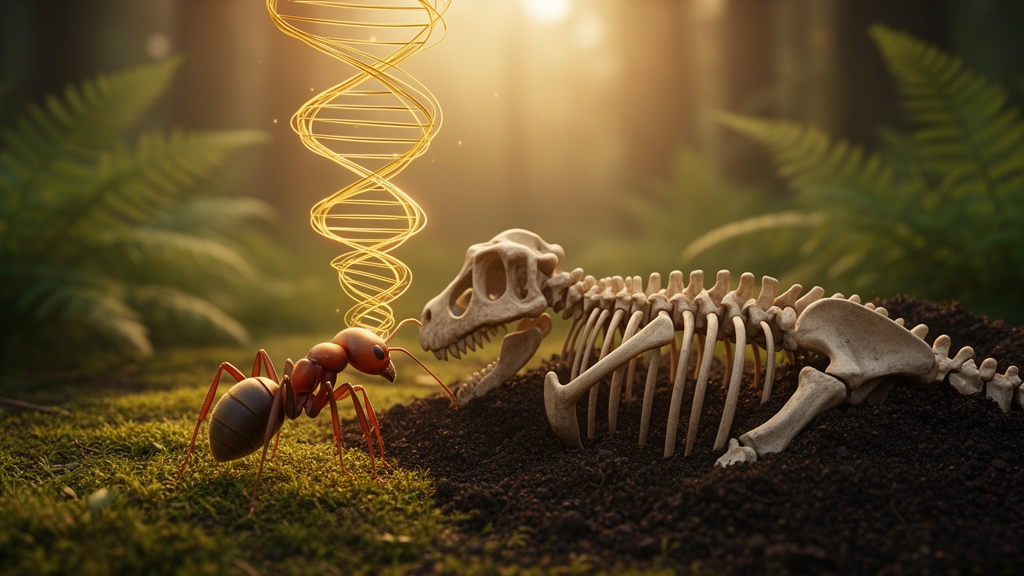
When an asteroid slammed into Earth roughly 66 million years ago, it wiped out the dinosaurs and reshaped life on the planet. In the ecological upheaval that followed, one group of insects seized the moment with remarkable success: the ants. Today, ants form the largest family of social insects, with more than 15,000 known species distributed across nearly every terrestrial habitat on Earth. A new study published in the journal Science Advances suggests that the secret to this evolutionary triumph may lie within the ants’ own genomes, in stretches of DNA long dismissed as genetic junk.
The research, led by Dr Lukas Schrader of the Institute for Evolution and Biodiversity at the University of Münster in Germany, together with an international team of collaborators, points to transposable elements as a driving force behind ant diversification. These DNA sequences, often called jumping genes, have the ability to copy and paste themselves to new locations within a genome. For decades, biologists regarded them as genomic parasites, selfish sequences that multiply without benefiting their host and, in the worst cases, disrupt essential genes or contribute to disease. That view has shifted dramatically in recent years, and the new findings add ants to a growing list of animals in which jumping genes appear to have acted as engines of evolutionary innovation.
The central discovery of the study is a striking correlation: the ant lineages carrying the most transposable elements in their genomes are also the most species-rich today. More remarkable still, the researchers identified independent bursts of transposable element activity in the ancestors of the largest ant groups during the early Palaeogene, around 66 million years ago, shortly before those lineages split into the thousands of species alive now. The timing places these genomic explosions immediately after the mass extinction that ended the Cretaceous period, when the disappearance of dinosaurs and many other organisms opened up ecological space for surviving groups to expand into.
The asteroid impact had dramatic consequences for the environment. We have now found the genomic mechanism that connects these ecological upheavals to the subsequent rapid diversification of the ants: transposable elements, Schrader explains. In other words, the catastrophic environmental change triggered by the impact may have set off waves of transposable element activity in ant genomes, and that heightened genomic dynamism could have supplied the raw genetic variation on which natural selection acted as new species formed.
Comparable patterns have been documented in other animal groups. Previous studies have shown bursts of jumping gene activity during more recent phases of increased speciation, for example in primates and in bats. The consistency of this pattern across distant lineages suggests that transposable elements may play a general role in fueling diversification after ecological disruptions, providing a mechanistic bridge between environmental upheaval and the proliferation of new species. In ants, the effect appears to have been particularly consequential, given the scale of their subsequent radiation.
The team did not stop at counting jumping genes. They also linked transposable element activity to the expansion of important gene families involved in chemical communication, the sensory backbone of ant social life. Odorant receptors, the proteins that detect smell and taste molecules, played a particular role in this process. Ants navigate, recognise nestmates and coordinate their colonies almost exclusively by smell, so the capacity to perceive and interpret chemical signals is central to their ecology. The researchers propose that the restless activity of transposable elements within the ants’ genomes may have enhanced this ability, generating new receptor variants and expanding the repertoire of chemical cues that colonies could detect and respond to.
This connection between genome dynamics and social behavior offers a compelling explanation for why ants, among all social insects, achieved such extraordinary diversity. A colony of ants functions as a tightly integrated superorganism in which individuals coordinate foraging, defense and brood care through pheromones and other chemical signals. Any mutation that broadens or refines this chemical vocabulary could improve colony efficiency, open new ecological niches or enable the exploitation of novel food sources. If bursts of transposable element activity repeatedly generated such variation in the wake of the end-Cretaceous extinction, they could have accelerated the pace at which ant lineages adapted and split into new species.
For the current study, the team analysed and compared the genomes of 163 ant species drawn from twelve of the sixteen ant subfamilies living today. By reconstructing the evolutionary history and activity of transposable elements across this broad sample, the researchers were able to trace genomic events over the past 100 million years. This timescale encompasses not only the asteroid impact and the early Palaeogene bursts but also the subsequent branching of ant lineages into the major subfamilies and the enormous species diversity within them. The comparative approach allowed the team to distinguish ancient waves of transposable element activity from more recent insertions and to correlate these patterns with species richness across the ant tree of life.
The findings contribute to a broader reassessment of transposable elements in evolutionary biology. Once viewed primarily as threats to genome integrity, jumping genes are now understood to generate new regulatory sequences, shuffle existing genetic material and occasionally create entirely novel genes. In this capacity, they can supply the variation that fuels adaptation, particularly during periods of environmental change when populations face new selective pressures. The ant study adds macroevolutionary weight to this perspective, showing that the legacy of ancient genomic upheavals is still visible in the composition of modern genomes and in the diversity of the species that carry them.
As research continues, the ant genomes assembled for this study will likely serve as a resource for exploring how genomic flexibility translates into ecological success. The story they tell is one of chance and opportunity: a catastrophic event 66 million years ago cleared the stage, and the restless DNA of ants helped them fill it. What was once dismissed as parasitic clutter in the genome now looks like a catalyst of one of evolution’s greatest success stories, a reminder that even the most destructive forces in biology can, over deep time, become sources of creativity.
Subject of Research: The role of transposable elements in ant diversification after the end-Cretaceous extinction
Article Title: “Jumping genes” helped ants in their evolutionary triumph after the extinction of the dinosaurs
Article References: “Jumping genes” helped ants in their evolutionary triumph after the extinction of the dinosaurs. (n.d.). Original publication
Image Credits: AI Generated
DOI: Not provided
Keywords: ants, transposable elements, jumping genes, evolution, speciation, genomics, odorant receptors, chemical communication, Paleogene, dinosaur extinction, Science Advances, University of Münster
Cite Scienmag News
Juliet Wilcox. (October 18, 2026). Jumping Genes Fueled the Rise of Ants After the Dinosaurs Died. Scienmag. https://scienmag.com/jumping-genes-fueled-the-rise-of-ants-after-the-dinosaurs-died/
Juliet Wilcox. "Jumping Genes Fueled the Rise of Ants After the Dinosaurs Died." Scienmag, 18 October 2026, https://scienmag.com/jumping-genes-fueled-the-rise-of-ants-after-the-dinosaurs-died/. Accessed 18 October 2026.
Juliet Wilcox. "Jumping Genes Fueled the Rise of Ants After the Dinosaurs Died." Scienmag. October 18, 2026. https://scienmag.com/jumping-genes-fueled-the-rise-of-ants-after-the-dinosaurs-died/


