


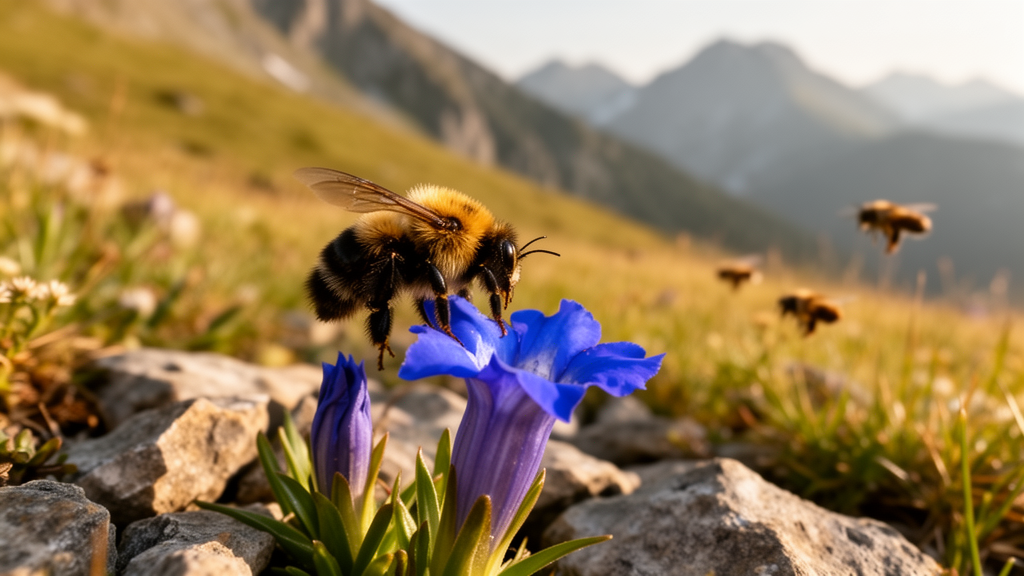
Long-term ecological monitoring in the mountainous regions of southwestern Bulgaria has revealed a concerning trend in the pollination dynamics of a key medicinal plant. Researchers compared bumblebee activity and reproductive success in Gentiana asclepiadea, a perennial gentian species, between two distinct periods: the early 1990s and the recent years from 2017 to 2020. The study, published in the journal BioRisk, highlights that even in montane habitats where direct anthropogenic hazards such as intensive pesticide use are presumed to be lower, pollinator effectiveness has measurably declined over time. This finding adds to a growing body of evidence suggesting that insect population declines are a pervasive global phenomenon, affecting even relatively remote and protected ecosystems.
The selection of Gentiana asclepiadea for this comparative study was driven by two primary factors. First, the research team had previously collected detailed data on this specific plant and its pollinators in the 1990s, providing a robust baseline for comparison. Second, as a montane species growing at altitudes between 1500 and 1900 meters, it was hypothesized to be less exposed to the immediate threats of habitat destruction and agricultural chemicals that plague lowland pollinators. The plant is a perennial with thick, branched rhizomes and straight, non-branched stems that can reach up to 80 centimeters in height. Its funnel-shaped flowers, which are not capable of spontaneous self-pollination, rely heavily on specific insect vectors for reproduction, making them an ideal indicator species for assessing pollinator health.
The field investigations were conducted at three specific study sites in Mt. Vitosha, a mountain range located near Sofia. Sites one and two were situated in open woodlands within the coniferous forest belt, while site three was located in subalpine meadows just above the tree line. Observations took place during the flowering seasons of August and September in both the 1990-1994 period and the 2017-2020 period. The researchers spent a total of 66 hours over 48 days observing bumblebee activity under various meteorological conditions. To avoid altering the natural behavior of the insects, the team refrained from collecting specimens, relying instead on visual identification and recording of visitation rates and behavior.
Identifying bumblebee species in the field presented certain challenges, particularly for species with similar coloration. For instance, Bombus wurflenii and Bombus lapidarius, though belonging to different subgenera and possessing different ecological niches, are difficult to distinguish with certainty in the field. Similarly, Bombus hortorum and Bombus subterraneus, as well as Bombus lucorum and Bombus terrestris, were often recorded as undistinguished pairs. To maintain scientific rigor while acknowledging these limitations, the researchers used an approximate approach in their data analysis. A pollinator activity index was calculated by dividing the number of pollinators recorded by the minutes of observation, multiplied by 60, providing a standardized metric for comparison across years and sites.
The results indicated that the species composition of bumblebees visiting the Gentiana flowers remained largely consistent between the two study periods. The primary visitors included Bombus pascuorum, Bombus pratorum, and the aforementioned undistinguished pairs. However, a slight but notable decline in overall bumblebee activity was observed in the 2017-2020 period compared to the 1990-1994 baseline. Linear regression analyses, while limited by the significant time gap between the two observation periods, showed decreasing trends in total activity at all three study sites. This decline was not uniform; fluctuations were observed within years and between sites, likely influenced by local colony dynamics, foraging ranges, and the presence of competing floral resources.
The reproductive success of the Gentiana plants mirrored the trends in pollinator activity. The researchers tested free pollination fruit set by monitoring 100 flowers each year for the development of fruit capsules. They also assessed seed set by counting matured seeds and non-fertilized ovules in 10 fruit capsules annually. A slight decrease in both fruit set and seed set was recorded during the final four years of the study. This correlation suggests that the reduction in bumblebee visits directly impacted the plant’s ability to reproduce, highlighting the critical role these insects play in the life cycle of this medicinal species. The data underscores that even minor changes in pollinator abundance can have measurable effects on plant reproductive output.
Several ecological factors may contribute to the observed fluctuations and declines in bumblebee activity. The study notes that the foraging range of bumblebees can extend up to 10 kilometers, meaning that local populations may be influenced by conditions in surrounding areas. Colony failure rates are known to be high, with fewer than 30% of Bombus pascuorum colonies producing new queens, and success rates even lower for other species. At site three, the subalpine meadow, fewer bumblebees were recorded, possibly due to competition from large populations of Epilobium angustifolium and Solidago virgaurea, which are known to attract bumblebees. This competition for pollinators may have reduced the frequency of visits to the Gentiana flowers, further impacting seed set.
Behavioral observations also provided insights into the interactions between bumblebees and the plant. In 1991, high activity of male Bombus hortorum or Bombus subterraneus was recorded in early September, likely due to their phenology and the timing of colony life cycles. In 2017, high activity of Bombus wurflenii at site two was attributed to nectar robbing behavior, where workers extract nectar by making holes in the base of the corolla tube. While nectar robbing can have negative, neutral, or positive effects on plants, in this case, it was considered neutral to slightly positive, as the workers still pollinated the flowers while attempting to access the nectar through the normal route. These behavioral nuances highlight the complex nature of plant-pollinator interactions and the importance of detailed field observations.
The study concludes that the slight decline in bumblebee activity and subsequent reduction in fruit and seed set demonstrate that negative effects on pollinators are detectable even in mountain habitats with fewer direct hazards. This finding aligns with broader research, such as a study showing a 76% decline in insect biomass in German nature reserves between 1989 and 2016. While the specific causes of the decline in the Vitosha Mountains are not definitively established, the authors speculate that urbanization of the foothills and increased agricultural activity in the surrounding lowlands may play a role. Additionally, climate change is a known hazard for certain bumblebee species, potentially driving them to higher altitudes, though the study lacks sufficient data for definitive conclusions on this factor. The research emphasizes the need for continued long-term monitoring of pollinators in diverse habitats to fully understand the drivers of their decline and to develop effective conservation strategies.
Subject of Research: Long-term monitoring of bumblebee pollination and reproductive success in Gentiana asclepiadea in Mt. Vitosha, Bulgaria.
Article Title: Monitoring bumblebee pollinator visits to the medicinal plant Gentiana asclepiadea L. (Gentianacese) – a comparison between the periods 1990–1994 and 2017–2020
Article References: Kozuharova, E., & Simeonov, V. (2022). Monitoring bumblebee pollinator visits to the medicinal plant Gentiana asclepiadea L. (Gentianacese) – a comparison between the periods 1990–1994 and 2017–2020. BioRisk, 17, 317-327. https://doi.org/10.3897/biorisk.17.76577
Image Credits: AI Generated
Keywords: bumblebees, pollination, Gentiana asclepiadea, insect decline, montane habitats, Bulgaria, long-term monitoring, ecology, reproductive success, bioindicators, Monitoring, bumblebee
Cite Scienmag News
Gavin Prescott. (October 18, 2026). Bulgarian Study Reveals Decline in Bumblebee Pollination of Alpine Gentian. Scienmag. https://scienmag.com/bulgarian-study-reveals-decline-in-bumblebee-pollination-of-alpine-gentian/
Gavin Prescott. "Bulgarian Study Reveals Decline in Bumblebee Pollination of Alpine Gentian." Scienmag, 18 October 2026, https://scienmag.com/bulgarian-study-reveals-decline-in-bumblebee-pollination-of-alpine-gentian/. Accessed 18 October 2026.
Gavin Prescott. "Bulgarian Study Reveals Decline in Bumblebee Pollination of Alpine Gentian." Scienmag. October 18, 2026. https://scienmag.com/bulgarian-study-reveals-decline-in-bumblebee-pollination-of-alpine-gentian/


