


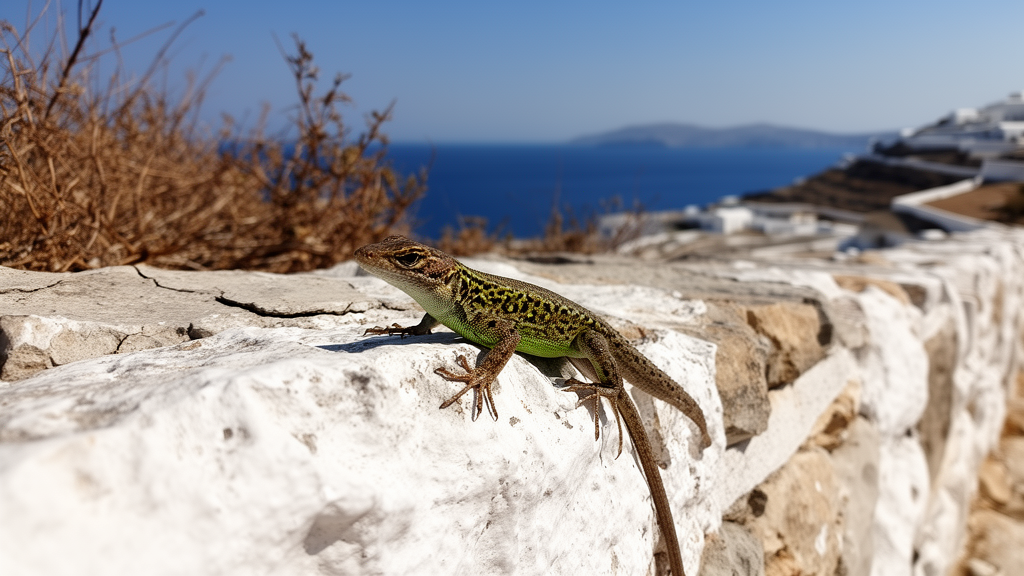
Forty-five years after its initial discovery, a population of Erhard’s wall lizards continues to thrive on Spanopoula, a tiny rocky islet located less than 120 meters off the north coast of Kea Island in the Aegean Archipelago of Greece. This remarkable persistence was confirmed during a herpetological survey conducted on June 13, 2024, by researchers who aimed to verify the species’ presence after a significant gap in published records. The last known documentation of Podarcis erhardii on this specific islet dates back to 1980, when the species was first recorded by Grillitsch and Tiedemann during a broader expedition across Greek islands. Since that initial observation, there had been no other scientific references to confirm the lizards’ continued existence or to estimate the status of their population, making the recent findings a crucial update to the biological record of this isolated habitat.
The survey team, comprising researchers CA and EL, arrived at the islet at 11:00 hours, navigating the shallow waters that separate Spanopoula from the neighboring Kea Island. The islet itself is extremely small, with an area of approximately 0.02 square kilometers, and its rugged limestone terrain presents significant challenges for access, as boats cannot moor directly and visitors must swim and climb to reach the shore. Upon arrival, the researchers immediately noticed a flourishing breeding colony of yellow-legged gulls, which dominate the local avian landscape. In addition to the target species, the team recorded one individual of the ocellated skink, Chalcides ocellatus, and one individual of Kotschy’s gecko, Mediodactylus kotschyi, both found sheltering under rocks. The presence of the gecko marks the first time this species has been reported from Spanopoula, adding a third species to the islet’s herpetofauna list and highlighting the dynamic nature of its small ecosystem.
The Erhard’s wall lizard, Podarcis erhardii, is the most widespread lizard species in the Aegean region, found on all adjacent Cycladic islands such as Kithnos, Serifos, Andros, Tinos, and Syros. However, it is notably absent from the larger neighboring island of Kea, which makes the population on the tiny Spanopoula islet particularly intriguing. The lizards were observed almost exclusively on the upper third of the islet, towards its highest point on the northeast shore, where the altitude reaches up to 20 meters. This area is characterized by the presence of caper bushes, Capparis spinosa, which serve as the dominant vegetation and provide essential shelter and thermoregulation spots for the lizards. The researchers noted that the caper bushes offer protection from adverse weather conditions, such as strong north winds, and support a rich arthropod fauna that serves as a food source for the lizards.
During the survey, the team captured six lizards using a fishing technique with Tenebrio larvae as bait. For each captured individual, the researchers measured the snout-vent length (SVL) using a digital caliper to the nearest 0.1 millimeter and collected a small tail tip tissue sample for genetic analysis before releasing the lizards at the same location. The measurements indicated that the lizards on Spanopoula are of medium size, with adult males measuring 64, 60, and 65 millimeters in SVL, and adult females measuring 60, 62, and 65 millimeters. The mean SVL for all individuals was 62.67 millimeters, with a 95% confidence interval of ± 2.46 millimeters. None of the captured females were carrying oviductal eggs, and all adults had intact tails, except for one female, and all adult males displayed orange abdomens, a characteristic feature of the species.
To determine the genetic origin of the Spanopoula population, DNA was extracted from the collected tail tips, and the mitochondrial marker cytochrome b was PCR-amplified and sequenced. The resulting sequences were aligned with other available sequences, and a maximum likelihood tree was constructed to test the placement of the lizards within the known maternal phylogeny of Podarcis erhardii. The analysis revealed two previously undetected haplotypes, which differed from each other by a single mutation. These haplotypes were placed within a clade grouping lizards from western Attica, northeastern Peloponnese, and Evvoia Island, with very high bootstrap support of 99%. This genetic evidence strongly suggests that the population on Spanopoula belongs to the mainland form, P. erhardii livadiacus, rather than the genetically differentiated lineage found on the Cyclades islands.
The findings support a human-mediated dispersal scenario for the establishment of the lizard population on Spanopoula. Since the subspecies P. erhardii livadiacus is not present in adjacent Kea or nearby islands, the lizards likely arrived on the islet through human activity, possibly via transport on boats or in vegetation. The exact source of this human-induced population cannot be traced with certainty, as representative sequences from eastern Attica or other insular populations are not available. However, the genetic data clearly excludes the local Cycladic lineage as the source, pointing instead to mainland populations in regions such as Evvoia and the northeastern Peloponnese. This case of human-mediated dispersal highlights the significant role that human activities play in shaping the distribution of species in isolated island environments.
Despite the rich organic material available on the islet, including seabird fecal material and carcasses of juvenile seagulls, the lizards on Spanopoula do not exhibit the large body size typically seen in other insular populations of Podarcis. For example, on the southeastern Aegean islet of Plakida, which is larger at 0.52 square kilometers, P. erhardii reaches up to 81 millimeters in SVL, with a mean size of 72.6 millimeters. The medium size of the Spanopoula population is surprising given the common pattern of insular gigantism in small island environments. This deviation from the expected pattern is likely due to the recent colonization of the islet from a medium-sized mainland population, which has not yet had sufficient time to undergo significant evolutionary changes in body size. The population on Spanopoula could serve as a valuable model for future field studies to investigate the long-term effects of local adaptation to insular environments on the body size of Podarcis lizards.
The estimated population size on Spanopoula is approximately two hundred individuals, based on the extent of the available habitat and the number of lizards observed associated with the caper plants. The lizards are limited to a vegetated area with a perimeter of less than 300 meters, yet this area is rich in organic material and provides essential resources for their survival. The presence of marine subsidies, such as seabird feces and associated arthropod fauna, contributes to the food availability on the islet, but does not seem to drive a large body size in these lizards. This unique combination of factors makes the Spanopoula population a fascinating subject for further ecological and evolutionary research, offering insights into the processes that shape species in isolated island ecosystems.
The confirmation of the thriving population of Erhard’s wall lizards on Spanopoula after 45 years underscores the importance of long-term monitoring in conservation biology. The recent survey not only verified the presence of the species but also provided new data on its genetic composition, body size, and habitat preferences. The addition of Kotschy’s gecko to the islet’s herpetofauna list further highlights the dynamic nature of this small ecosystem. As human activities continue to influence species distributions, understanding the mechanisms of dispersal and adaptation in isolated populations becomes increasingly important. The Spanopoula population serves as a compelling example of how human-mediated dispersal can lead to the establishment of new populations in remote locations, with potential implications for conservation and management strategies in the Aegean region.
Subject of Research: Population status and genetic origin of Podarcis erhardii on Spanopoula islet
Article Title: Revisiting Spanopoula islet: Podarcis erhardii (Bedriaga, 1886) population thriving 45 years after first recorded
Article References: Adamopoulou, C., Linardaki, E., & Thanou, E. (2025). Revisiting Spanopoula islet: Podarcis erhardii (Bedriaga, 1886) population thriving 45 years after first recorded. Herpetozoa, 38, 93-95. https://doi.org/10.3897/herpetozoa.38.e149373
Image Credits: AI Generated
DOI: 10.3897/herpetozoa.38.e149373
Keywords: Podarcis erhardii, herpetology, Aegean Archipelago, island biogeography, genetic analysis, conservation biology, human-mediated dispersal, lizard population, Revisiting, Spanopoula, islet, Podarcis
Cite Scienmag News
Margaret Porter. (October 18, 2026). Wall Lizard Population Thrives on Greek Islet 45 Years Later. Scienmag. https://scienmag.com/wall-lizard-population-thrives-on-greek-islet-45-years-later/
Margaret Porter. "Wall Lizard Population Thrives on Greek Islet 45 Years Later." Scienmag, 18 October 2026, https://scienmag.com/wall-lizard-population-thrives-on-greek-islet-45-years-later/. Accessed 18 October 2026.
Margaret Porter. "Wall Lizard Population Thrives on Greek Islet 45 Years Later." Scienmag. October 18, 2026. https://scienmag.com/wall-lizard-population-thrives-on-greek-islet-45-years-later/


