


Across France, a quiet experiment in emotional education is about to put a deceptively simple question to the test: can ten sessions of games and interactive activities measurably improve how children manage their emotions, solve problems, and treat one another at school? A research team led by Philippe Martin of Université Paris Cité and Inserm has published the study protocol for Feel Good, a school-based life skills intervention developed with socio-educational stakeholders and now scheduled for rigorous evaluation in schools across the Île-de-France region. The protocol, published in BMC Psychology, describes a non-randomized controlled before-and-after study designed to determine whether the program genuinely moves the needle on children’s life skills, school climate, and well-being, or whether it simply feels good in the moment without leaving lasting traces.
The concept of life skills sits at the heart of the project. The World Health Organization has long framed these as transversal competencies, abilities that cut across academic subjects and daily situations alike: problem-solving, empathy, critical thinking, and emotion management. Unlike reading or arithmetic, these capacities are rarely taught explicitly, yet they shape how children navigate conflict, cope with stress, and build relationships. In France, national education policy has increasingly recognized life skills as a lever for mental health promotion, but the evidence base for specific classroom programs remains thin. Feel Good was co-developed with teachers, educators, and coordinators precisely to close that gap, translating abstract competencies into playful, interactive activities that fourth and fifth grade pupils, known in France as grand 4 and grand 5, can actually engage with.
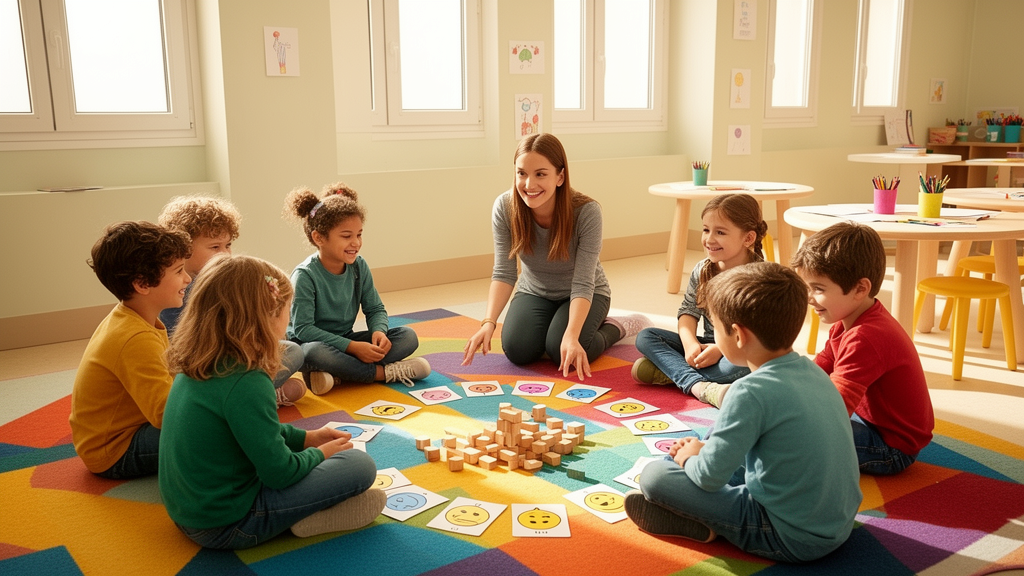
The intervention itself unfolds across ten sessions delivered during the school year. Each session uses games and participatory exercises rather than lectures, a design choice grounded in the understanding that young children acquire social and emotional competencies through practice and repetition, not through being told what empathy means. The program’s structure reflects a broader shift in school psychology away from one-off awareness days and toward sustained, curriculum-embedded approaches. What distinguishes Feel Good from many similar programs, the researchers argue, is that it was built collaboratively with the people who would actually run it, an approach intended to improve both the quality of implementation and the likelihood that schools will sustain it beyond the study period.
Evaluating such a program properly is harder than it sounds, and the protocol devotes considerable attention to methodological rigor. The core design is a controlled before-and-after study, a non-randomized design in which classes receiving the intervention are compared with classes that do not, with measurements taken before and after the program in both groups. The team has calculated a required sample size of approximately 500 participants per group, recruited by whole classes in schools across Île-de-France. That scale matters: many school-based interventions are evaluated with samples too small to detect modest but meaningful effects, and the field is littered with promising programs whose benefits evaporate under properly powered scrutiny.
Measurement relies on a paper-based self-report questionnaire composed of validated scales targeting three distinct outcomes. Life skills will be assessed directly, capturing changes in children’s self-reported problem-solving, empathy, and emotion management. School climate will be measured using the EMCCE, the Échelle de mesure du climat social de la classe à l’école élémentaire, a French instrument designed to quantify the social climate of the classroom. Well-being will be tracked with the Multidimensional Students’ Life Satisfaction Scale, or MSLSS, which probes satisfaction across domains of a child’s life rather than collapsing happiness into a single number. Questionnaires are administered at three time points over the school year: a baseline before the intervention begins, and a follow-up two weeks after the program ends. Score changes across these time points will be analyzed using paired t-tests, and the researchers will examine whether changes are associated with sociodemographic characteristics, comparing intervention and control groups with appropriate statistical models.
What makes this protocol unusually ambitious is that the effectiveness study is only one of three interlocking components. A separate process evaluation will apply mixed methods to understand how the intervention actually unfolded in real classrooms: qualitative semi-structured interviews with children and adult stakeholders, contextual and satisfaction questionnaires, and quantitative process indicators tracking fidelity and delivery. This matters because school-based programs rarely fail on paper; they fail in practice, when a session is shortened, a teacher departs mid-year, or an activity lands badly with a particular class. The process study draws on the Consolidated Framework for Implementation Research, a widely used model for systematically examining the contextual factors that determine whether an intervention succeeds or stalls.
The third component is a Delphi consensus study, a structured method for building expert agreement across iterative rounds of feedback. Experts and stakeholders will work toward recommendations for designing, implementing, and evaluating school-based life skills interventions for children. The goal is explicitly transferable: rather than producing findings relevant only to Feel Good, the team wants to generate guidance that other researchers and education authorities can apply when building their own programs. In a field where interventions are often designed in isolation and evaluated inconsistently, such shared standards could prove as valuable as the effectiveness results themselves.
The study’s institutional scaffolding reflects its seriousness. It is registered as clinical trial NCT07804940, and it received a favorable opinion from the Inserm Ethical Evaluation Committee in December 2024, with data protection authorization from Université Paris Cité following in June 2025. Funding comes from two public sources: the Île-de-France Regional Health Agency, which has financed the intervention’s implementation for six years, and the Institut pour la Recherche en Santé Publique, which funded the research under its 2024 Health Services, Interventions and Policies program, itself subject to peer review. The research team spans Université Paris Cité, Inserm laboratories, the Robert Debré hospital’s public health department, the French National Institute for Demographic Studies, and CRIPS Île-de-France, the regional health education organization that delivers the program.
There is also a deliberate equity dimension embedded in the recruitment strategy. Schools in the region include institutions classified under the Priority Education Network and its enhanced variant, designations that flag schools serving disadvantaged communities. By recruiting across this spectrum, the study can examine whether the intervention works differently depending on context, a question that effectiveness evaluations frequently sidestep. The researchers frame the entire project as intervention research in the tradition of the Medical Research Council’s guidance on developing and evaluating complex interventions, meaning the program, its context, and its implementation are treated as inseparable parts of a single system rather than as noise around a treatment effect.
The stakes extend well beyond one region of France. Child mental health has deteriorated across many high-income countries in the aftermath of pandemic-era disruptions, and education ministries everywhere are searching for scalable, evidence-based responses that do not require clinical resources schools simply do not have. If Feel Good demonstrates meaningful improvements in life skills, school climate, and well-being at this scale, with implementation data explaining how and for whom the effects arise, it would strengthen the case for embedding life skills education as a standard part of primary schooling rather than an optional enrichment. If it does not, the process evaluation and consensus recommendations should still clarify why, and that, too, would advance a field that badly needs honest answers. Results are not yet available; what has been published is the blueprint. But the blueprint itself signals a maturing discipline, one increasingly willing to subject well-intentioned programs to the same controlled scrutiny demanded of any medical treatment.
Subject of Research: Evaluation of a school-based life skills intervention for children's well-being and school climate in France
Article Title: Improving school climate and children’s well-being through the life skills “Feel Good” intervention in French schools: A controlled before-and-after study protocol
Article References: Martin, P., Theodosiou, A., Lusignan, J.-B., Eloire, M., Bourmaud, A., Alberti, C., Eyraud, C., & Collin, C. (2026). Improving school climate and children’s well-being through the life skills “Feel Good” intervention in French schools: A controlled before-and-after study protocol. BMC Psychology. https://doi.org/10.1186/s40359-026-05627-7
Image Credits: AI Generated
DOI: 10.1186/s40359-026-05627-7
Keywords: life skills, school climate, child well-being, Feel Good intervention, French schools, mental health promotion, study protocol, controlled before-and-after study, school-based intervention, Île-de-France, BMC Psychology, implementation research
Cite Scienmag News
Glenn Wilkins. (October 18, 2026). Can Ten Playful Classroom Sessions Teach French Children Life Skills? A New Study Aims to Find Out. Scienmag. https://scienmag.com/can-ten-playful-classroom-sessions-teach-french-children-life-skills-a-new-study-aims-to-find-out/
Glenn Wilkins. "Can Ten Playful Classroom Sessions Teach French Children Life Skills? A New Study Aims to Find Out." Scienmag, 18 October 2026, https://scienmag.com/can-ten-playful-classroom-sessions-teach-french-children-life-skills-a-new-study-aims-to-find-out/. Accessed 18 October 2026.
Glenn Wilkins. "Can Ten Playful Classroom Sessions Teach French Children Life Skills? A New Study Aims to Find Out." Scienmag. October 18, 2026. https://scienmag.com/can-ten-playful-classroom-sessions-teach-french-children-life-skills-a-new-study-aims-to-find-out/


