


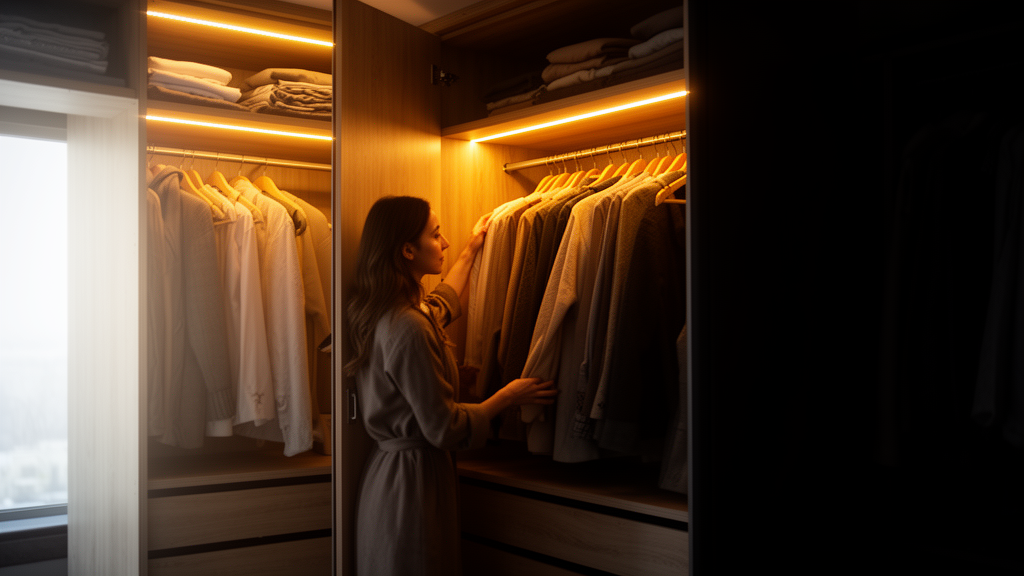
Smart wardrobe lighting systems—LED arrays and sensors embedded into closet interiors that illuminate garments when doors open, adjust color temperature to mimic daylight, and increasingly connect to home automation platforms—have been engineered with impressive technical sophistication. Yet a new study argues that designers have been building these products largely blind to the people who use them. Research published in Humanities and Social Sciences Communications by Chengmin Zhou, Xinran Wang, and Yawen Qian of Nanjing Forestry University, together with Jake Kaner of Nottingham Trent University, offers one of the first systematic investigations of how users actually experience smart wardrobe lighting, and it arrives at a striking conclusion: what drives people’s interactions with these systems is not what ultimately determines whether they are satisfied with them.
The research team framed their inquiry around a well-established model from the user experience literature: the User Experience Honeycomb, originally proposed by information architect Peter Morville. The honeycomb decomposes experience into seven facets—Usefulness, Usability, Desirability, Findability, Accessibility, Credibility, and Value—each representing a distinct question a user implicitly asks of a product. Is it useful? Can I use it easily? Do I want it? Can I find what I need? Can I access it? Do I trust it? Does it deliver worth? While the framework has been applied to websites, apps, and consumer electronics, it had never been empirically deployed in the context of wardrobe-integrated lighting, a product category that sits at the intersection of furniture design, interior architecture, and the Internet of Things.
Methodologically, the study adopted a mixed-methods design. The researchers conducted qualitative interviews to surface the lived frustrations and delights of users, then followed up with a questionnaire survey targeting young adults, a demographic the authors identify as the core early-adopter group for smart home furnishings. Interview participants provided written informed consent, including consent for audio recording and transcription, and the human-participant component of the study received ethics approval from Nanjing Forestry University’s Animal Welfare and Ethics Committee in February 2024. All data were anonymized, and participants could withdraw at any time—a procedural detail that matters in a study whose findings center on users’ concerns about data handling.
From the survey responses, factor analysis—a statistical technique that identifies latent dimensions underlying a set of observed variables—extracted five core experience dimensions: Usability, Findability, Value, Credibility, and Accessibility. In plain terms, users’ experiences with smart wardrobe lighting cluster around whether the system is easy to operate, whether they can quickly locate the lighting functions and garments they need, whether the product feels worth its cost, whether they trust it, and whether it accommodates people across abilities and situations. Notably, the analysis of this particular product context did not yield the full seven honeycomb facets as separable dimensions; instead, the facets compressed into these five empirically distinct factors, suggesting that in embedded furniture systems, some experiential qualities merge in users’ minds.
The study then went a step further than most user experience research by quantifying how much each dimension matters. Using the Criteria Importance Through Inter-criteria Correlation method—known as CRITIC—a weighting technique that derives the objective importance of criteria from the statistical correlations and variability among them, the researchers assigned weights to the experience dimensions. The result was unexpected: Desirability and Usefulness, the emotional and functional poles of the honeycomb, carried the highest importance. Users, in other words, care most about whether the lighting is appealing and whether it genuinely serves a purpose—not merely whether the interface is polished or the app is responsive.
From these converging findings, the authors distilled what they call the Efficacy–Access Gap. Although users’ day-to-day interactions with smart wardrobe lighting are primarily guided by functional dimensions—Usability, Findability, Accessibility—their ultimate satisfaction hinges on something different: whether the lighting effects actually meet situational needs. A wardrobe light can be flawlessly operable and easy to navigate, yet if its color rendering makes a navy blazer look black, or if its brightness cannot adapt to a dim bedroom at six in the morning, the user walks away dissatisfied. The gap describes a mismatch between the dimensions that shape behavior and the dimension that shapes judgment, and it offers a diagnostic lens for why technically competent smart furniture products can still fail commercially.
Equally consequential is the study’s finding on Credibility. Users expressed concerns over data security and system integration—whether the wardrobe is quietly collecting information about their habits, and whether it will actually interoperate with the other devices in their homes. The researchers found that credibility functions as a foundational condition for long-term engagement: without trust, even the most beautifully lit wardrobe will not retain its user. This positions security and integration not as afterthoughts to be patched in firmware updates, but as prerequisites that must be embedded from the earliest stages of design, alongside the optics and the sensors.
The practical guidance that flows from the study is unusually concrete for user experience research. The authors recommend that designers prioritize usability and findability as the levers that unlock perceived value—make the system effortless to operate and easy to navigate, and users will begin to feel the product is worth having—while simultaneously embedding credibility from day one. For an industry racing to furnish homes with connected everything, the message is that the path to perceived value runs through operational simplicity, and the path to retention runs through trust. The Efficacy–Access Gap adds a third instruction: validate lighting performance against real situational needs, such as early-morning dressing in low ambient light, rather than against laboratory benchmarks.
Why does a wardrobe light deserve this level of scrutiny? Because the wardrobe is a uniquely revealing testbed for smart furniture. It is a confined, frequently used space where lighting quality directly affects a daily ritual—choosing what to wear—and where color fidelity, glare control, and sensor-triggered behavior are experienced at close range, often in dim surroundings. It is also a product where the electronics are hidden inside furniture, meaning failures are felt as failures of the wardrobe itself. If user experience principles can be quantified and prioritized in this demanding micro-environment, the same framework plausibly extends to illuminated mirrors, smart closets, and the broader class of health-oriented home furnishings the research group’s funding projects target.
The study’s originality, as the authors state it, lies in three contributions: applying the User Experience Honeycomb to an underexplored product context, empirically quantifying the weights of experience dimensions rather than assuming them, and identifying a context-specific gap between interaction drivers and satisfaction determinants. Published open access in Humanities and Social Sciences Communications, the work extends user experience theory beyond screens and into furniture, and it hands designers a prioritized checklist grounded in data. As smart home technology seeps into every cabinet and closet, the research suggests the winning products will not be the ones with the most features, but the ones that are easy to use, easy to navigate, trustworthy, and—above all—genuinely effective in the moments that matter.
Subject of Research: User experience of smart wardrobe lighting systems
Article Title: User experience of smart wardrobe lighting systems: identifying pain points and prioritizing core elements
Article References: Zhou, C., Wang, X., Qian, Y., & Kaner, J. (2026). User experience of smart wardrobe lighting systems: identifying pain points and prioritizing core elements. Humanities and Social Sciences Communications. https://doi.org/10.1057/s41599-026-09359-2
Image Credits: AI Generated
DOI: 10.1057/s41599-026-09359-2
Keywords: smart wardrobe lighting, user experience, User Experience Honeycomb, CRITIC weighting method, factor analysis, usability, findability, credibility, data security, smart furniture, human-centered design, Internet of Things
Cite Scienmag News
Courtney Benton. (October 18, 2026). Smart Wardrobe Lighting Study Reveals an Efficacy–Access Gap in User Experience. Scienmag. https://scienmag.com/smart-wardrobe-lighting-study-reveals-an-efficacy-access-gap-in-user-experience/
Courtney Benton. "Smart Wardrobe Lighting Study Reveals an Efficacy–Access Gap in User Experience." Scienmag, 18 October 2026, https://scienmag.com/smart-wardrobe-lighting-study-reveals-an-efficacy-access-gap-in-user-experience/. Accessed 18 October 2026.
Courtney Benton. "Smart Wardrobe Lighting Study Reveals an Efficacy–Access Gap in User Experience." Scienmag. October 18, 2026. https://scienmag.com/smart-wardrobe-lighting-study-reveals-an-efficacy-access-gap-in-user-experience/


