


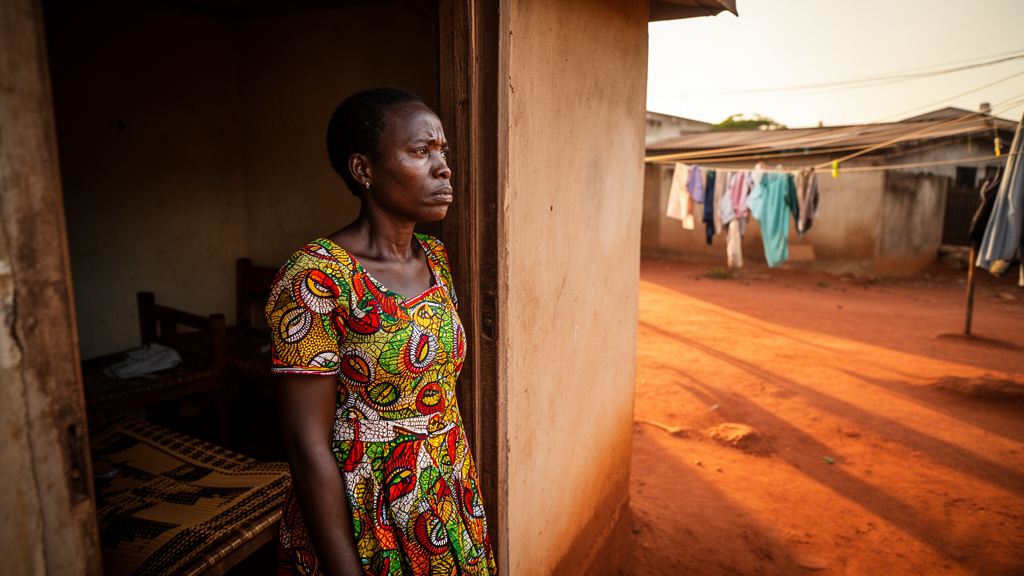
One in three women in Ghana believes a husband is justified in beating his wife under at least one circumstance — and the women most likely to hold that belief are the ones with the least education, the least money, and the fewest options for leaving. That is the central finding of a sweeping new analysis of nationally representative survey data, published in SN Social Sciences, which for the first time maps attitudes toward intimate partner violence across all ten of Ghana’s administrative regions using rigorous survey-weighted statistics. The numbers are stark, the gradients are steep, and the geographic pattern is not what many researchers expected.
The study, led by Ebenezer Adjartey of the University of Cape Coast’s Department of Data Science, draws on the sixth round of the Multiple Indicator Cluster Survey — MICS6 — a UNICEF-supported household survey program conducted in Ghana in 2017 and 2018. The analytic sample comprised 14,359 women, a figure large enough to support something rare in this literature: formal statistical decomposition of how much of the variation in attitudes comes from individual women and how much comes from the regions they live in. The researchers deployed a two-level random-intercept model alongside cluster-robust logistic regression, Cramér’s V and Cochran’s Q tests for categorical association, analysis of variance with eta-squared effect sizes, and variance inflation factor diagnostics to guard against multicollinearity. In plain terms, this is not a poll with a margin of error waved at a headline; it is a layered statistical architecture designed to survive scrutiny.
The headline number is 32.4 percent — the share of Ghanaian women who justified intimate partner violence in at least one of the scenarios the survey presented, such as a wife going out without telling her husband, neglecting the children, arguing with him, refusing sex, or burning the food. But the aggregate conceals the real story, which lives in the gradients. Among women in the poorest wealth quintile, 47.0 percent held justifying attitudes; among the richest quintile, the figure was 15.8 percent — a gap of 31.2 percentage points. Education produced an even steeper cliff: 48.8 percent of women with no formal education justified violence in at least one scenario, compared with just 8.5 percent of women with higher education. That is nearly a sixfold difference between the least and most schooled.
Those dose-response patterns — each step up the wealth or education ladder associated with a measurable drop in justification — matter because they are consistent with several converging theoretical frameworks the authors deliberately wove together. The integrated ecological model developed by Lori Heise in 1998 frames violence-accepting attitudes as the product of nested layers: individual characteristics, relationship dynamics, community norms, and broader societal structures. Human capital theory, running from Theodore Schultz and Gary Becker, predicts that education expands a woman’s options, bargaining power, and perceived entitlement to bodily autonomy. Resource theory, rooted in the classic 1960 work of Robert Blood and Donald Wolfe on marital power, suggests that control over economic resources shifts negotiation within households. And social norms theory holds that people’s expressed attitudes track what they believe their community expects of them. The Ghana data do not adjudicate between these mechanisms — a cross-sectional survey cannot — but the fact that all of them predict the same direction of association, and the data oblige, is itself informative.
Then comes the finding that breaks expectations. Modernization theory — the influential tradition associated with Ronald Inglehart — holds that as societies develop, younger cohorts absorb progressively more egalitarian values, and attitudinal change flows downward through generations. Ghana’s numbers refuse to cooperate. Younger women in the survey showed higher justification of intimate partner violence than older cohorts, a reversal the authors flag explicitly as contrary to modernization theory. The pattern echoes findings from other contexts, including Rachel Sullivan Pierotti’s cross-national work showing that rejection of partner violence does not spread automatically with generational turnover, and it raises uncomfortable questions about whether the normative gains of the 1990s and 2000s are stalling or even reversing among women who came of age after them.
The regional analysis is where the study makes its most original technical contribution. Using the multilevel model, the researchers quantified the intraclass correlation — the share of total variance in attitudes attributable to region — and found that regional variation was substantial. Women in different parts of Ghana inhabit genuinely different normative environments, not merely different individual circumstances. More striking still, when the authors formally tested whether education’s protective association was uniform across the country, they found it was not. The buffering effect of schooling was significantly attenuated in the Volta and Upper West regions — meaning education bought women less attitudinal protection there than elsewhere. The authors are careful to note that this attenuation was not confined to the northern regions as a bloc, complicating the common assumption that Ghana’s north-south development divide maps neatly onto its attitudinal geography.
Methodologically, the team was unusually transparent about limits. Survey weights were applied throughout so that estimates reflect Ghana’s actual population rather than the survey’s sampling design, and cluster-robust standard errors accounted for the fact that women within the same enumeration area share environments and are not independent observations. The authors pre-specified their hypotheses before analysis, demonstrated dose-response gradients rather than binary associations, and replicated the directional findings across independent datasets — the triangulation strategy epidemiologists use to strengthen causal inference where randomization is impossible. Still, they are categorical that the cross-sectional design precludes causal attribution: it is possible, for instance, that poverty produces justifying attitudes, or that women who hold such attitudes face constrained economic trajectories, or that unmeasured community factors drive both. The data show association with unusual precision; they do not show mechanism.
Why does attitudinal data matter at all, when the outcome that matters is violence itself? Because attitudes are the soil in which behavior grows, and because they are measurable at scale. The World Health Organization estimated in 2025 that 840 million women worldwide have faced partner or sexual violence in their lifetime, and the landmark 2022 Lancet prevalence study by Lynnmarie Sardinha and colleagues established that attitudinal acceptance is one of the strongest community-level correlates of actual perpetration. A woman who believes beating is justified is less likely to report it, less likely to leave, and more likely to be surrounded by neighbors who will not intervene. Conversely, structured community interventions — the Ugandan SASA! program, evaluated by Nambusi Kyegombe and colleagues in 2014, is the canonical example — have demonstrated that normative attitudes can be shifted deliberately, not merely waited upon. That is the study’s most consequential implication: normalization is not immutable.
The policy arithmetic that falls out of the analysis is specific. The authors argue for concurrent investment on three fronts — poverty reduction, girls’ education, and community-level normative change — rather than treating any single lever as sufficient, and they suggest that Ghana’s northern regions may warrant above-average budget allocation given the concentration of risk there. The 31.2-percentage-point wealth gradient is, in effect, a map of where attitude-change programming would reach the most women per cedi spent. The finding that education’s protection weakens in Volta and Upper West adds a second layer: schooling interventions may need community-norm components attached in those regions specifically, or the classroom gains may not survive contact with the surrounding social environment.
What makes this study travel beyond Ghana is its method. The eta-squared and multilevel variance decomposition techniques it applies to intimate partner violence attitudes are standard tools in education and economics research but have rarely been combined in this literature, and the formal testing of education-by-region interactions is, according to the authors, a first for Ghana’s MICS6 data. As similar surveys accumulate across sub-Saharan Africa — comparable multilevel analyses have now been published for Eswatini, Nigeria, and ten West African countries — the Ghana study offers a template for asking not just whether socioeconomic status predicts acceptance of violence, but where, for whom, and how much of the answer belongs to the woman and how much to the place she lives. One in three is the number that will make headlines. The gradients beneath it are the number that should make policy.
Subject of Research: Socioeconomic and regional determinants of women's attitudes justifying intimate partner violence in Ghana
Article Title: Women’s socioeconomic status and attitudes toward intimate partner violence in Ghana: a survey-weighted regional analysis
Article References: Adjartey, E., Gyabaah, P., Anim, I. K., Kpakpo-Mensah, I., Kusi, L. Y., & Annan-Prah, E. C. (2026). Women’s socioeconomic status and attitudes toward intimate partner violence in Ghana: a survey-weighted regional analysis. SN Social Sciences, 6(8), Article 350. https://doi.org/10.1007/s43545-026-01635-x
Image Credits: AI Generated
DOI: 10.1007/s43545-026-01635-x
Keywords: intimate partner violence, Ghana, MICS6 survey, socioeconomic status, women's education, gender norms, multilevel analysis, survey weighting, sub-Saharan Africa, poverty, regional disparities, attitude change
Cite Scienmag News
Courtney Benton. (October 18, 2026). One in Three Ghanaian Women Justifies Partner Violence, Landmark Survey Finds. Scienmag. https://scienmag.com/one-in-three-ghanaian-women-justifies-partner-violence-landmark-survey-finds/
Courtney Benton. "One in Three Ghanaian Women Justifies Partner Violence, Landmark Survey Finds." Scienmag, 18 October 2026, https://scienmag.com/one-in-three-ghanaian-women-justifies-partner-violence-landmark-survey-finds/. Accessed 18 October 2026.
Courtney Benton. "One in Three Ghanaian Women Justifies Partner Violence, Landmark Survey Finds." Scienmag. October 18, 2026. https://scienmag.com/one-in-three-ghanaian-women-justifies-partner-violence-landmark-survey-finds/


