


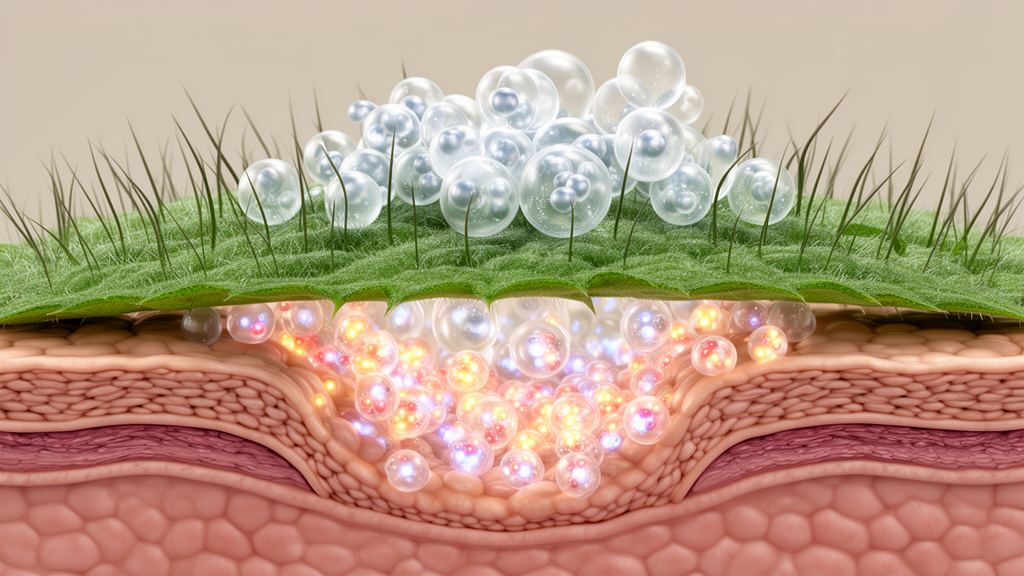
Psoriasis is one of dermatology’s most stubborn targets, and the reason lies in the skin itself. In patients with the disease, the outermost layer of the epidermis, the stratum corneum, becomes abnormally thickened and encased in hyperkeratotic plaques. This hardened barrier is precisely what blocks topical medicines from reaching the inflamed tissue below, which is why potent corticosteroids such as clobetasol propionate often underperform despite their strong anti-inflammatory activity. A research team in Iraq has now built a delivery system designed to crack that barrier using an unlikely ally: the stinging hairs of the common nettle, stripped of their irritant chemistry and repurposed as natural microneedles.
The study, published in the journal Pharmacia, describes a three-part composite platform. Clobetasol propionate was first encapsulated in nanoliposomes, vesicles built from soybean phosphatidylcholine and cholesterol with phospholipid bilayers capable of carrying both water-loving and fat-loving drugs. These nanovesicles were then dispersed in a Carbopol 940 hydrogel enriched with hyaluronic acid and glycerin, creating a moist, adhesive matrix that clings to the skin and prolongs residence time. Finally, microneedle-like trichomes harvested from Urtica dioica, the stinging nettle, were washed repeatedly and folded into the gel, giving the formulation a physical penetration-enhancing arm that no synthetic patch can match for simplicity.
The nettle’s contribution is elegant in its biology. Anatomical measurements of its stinging hairs, technically called trichomes, show an average length of 1.38 millimeters with a hollow lumen of roughly 3.85 nanoliters, an elongated, acicular architecture that behaves like a naturally occurring microneedle. When the delicate tip contacts skin, it fractures, allowing the sharp shaft to pierce the stratum corneum and release its contents. In the engineered formulation, that piercing action is purely mechanical, creating microchannels through which the nanoliposomal payload can diffuse into deeper epidermal layers. The hollow interior, once emptied of its natural cargo, may also serve as an additional micro-reservoir for drug entrapment.
Before the trichomes could be safely deployed, the team had to solve a serious safety problem. Nettle stinging hairs contain histamine, serotonin, acetylcholine, and formic acid, the very molecules responsible for the plant’s notorious sting. Because these compounds are water-soluble, the researchers subjected the isolated trichomes to up to ten successive washing cycles with deionized water, monitoring the process by high-performance liquid chromatography. Chromatograms after the first cycle showed prominent peaks corresponding to the irritants, but these diminished steadily with each wash until, after the tenth cycle, the chromatogram was indistinguishable from that of pure water, confirming removal of the stinging chemistry while the needle-like morphology remained intact.
The nanoliposomal component was optimized through a systematic screen of 24 formulations, varying drug-to-lipid ratio, phosphatidylcholine-to-cholesterol ratio, hydration pH, sonication time, and hydration temperature. The winning formula, designated F2, achieved a vesicle size of approximately 100 nanometers, a low polydispersity index of 0.152 indicating a narrow and uniform size distribution, and a moderate zeta potential of −16.73 millivolts. Encapsulation efficiency reached 98.8 percent by the indirect method and 94.3 percent by the direct method, remarkable figures for a lipophilic corticosteroid. Vesicles below 200 nanometers are known to penetrate skin more effectively, making this size range well suited to transport across the thickened psoriatic barrier once microneedle-assisted channels are available.
Physicochemical characterization of the freeze-dried optimum formulation confirmed successful drug incorporation. Fourier-transform infrared spectroscopy showed disappearance of the characteristic clobetasol propionate peaks in the lyophilized nanoliposomes, consistent with encapsulation rather than simple physical blending. Thermogravimetric analysis revealed dramatically enhanced thermal stability, with only 8.068 percent weight loss at approximately 350 degrees Celsius compared with 50.29 percent degradation of the pure drug at around 220 degrees, an effect attributed to the protective lipid bilayer. Differential scanning calorimetry and X-ray diffraction indicated conversion of the crystalline drug into a partially amorphous or molecularly dispersed state within the lipid matrix, while field-emission scanning electron microscopy captured spherical nanosized vesicles with smooth surfaces and uniform distribution preserved after freeze-drying.
The hydrogel arm of the platform was tuned by testing two Carbopol 940 concentrations, 0.5 and 2 percent by weight. The more viscous 2 percent gel, F2Hb, showed slower in vitro drug release, delivering 65.69 percent of its payload over eight hours, compared with 74.47 percent from the 0.5 percent gel and 92.33 percent from the marketed Promax product. This sustained profile reflects the dual diffusion barrier created by the tightly cross-linked polymer network and the lipid bilayer encapsulating the corticosteroid. Release kinetics fit the zero-order model with a Korsmeyer–Peppas exponent above 0.45, indicating non-Fickian diffusion governed by both molecular diffusion and polymer swelling, a combination that favors prolonged, controlled delivery rather than an immediate burst.
Ex vivo permeation across excised rat skin revealed a nuanced picture. The nanoliposomal hydrogel with nettle trichomes, F2HbM, achieved a steady-state flux of 48.87 micrograms per square centimeter per hour with a short lag time of 0.39 hours, and produced the highest cumulative skin deposition of 140.127 micrograms per square centimeter after 24 hours, compared with only 9.984 micrograms per square centimeter for the commercial product. Notably, the trichomes’ mechanical action depends on frictional application, and the small 1.5-square-centimeter diffusion area of the ex vivo setup limited their full function, which the authors acknowledge may cause such models to underestimate mechanically assisted delivery systems.
The decisive evidence came from an imiquimod-induced mouse model of psoriasis, in which daily application of the cream triggers psoriasiform lesions marked by erythema, scaling, and skin thickening. Mice treated with F2HbM showed the greatest reduction in these symptoms and the sharpest decline in the key inflammatory cytokines interleukin-17A and interleukin-23, dropping to 101.97 and 103.04 respectively, far below the levels observed in mice treated with the commercial product, which reached 229.372 and 242.147. The nanoliposomal hydrogel without trichomes performed less well, and a hydrogel containing free drug plus trichomes but no nanoliposomes fell short of the full composite, pointing to a genuine synergy between sustained lipid-encapsulated release and microneedle-facilitated penetration.
Safety testing over 72 hours showed the composite formulation was well tolerated, with erythema and edema scores approaching zero, likely reflecting the controlled release profile that minimizes immediate free-drug exposure and the thorough washing that removed the nettle’s irritant chemistry. The authors caution that long-term storage stability and clinical translation remain to be confirmed, but the study demonstrates a compelling proof of concept: a single topical system that pairs a potent corticosteroid with biocompatible nanovesicles, an adhesive hydrogel, and plant-derived microneedles, engineered to overcome one of dermatology’s most resistant biological barriers while favoring local drug retention over systemic exposure.
}
Subject of Research: A clobetasol propionate-loaded nanoliposomal Carbopol hydrogel combined with washed stinging nettle trichomes improved skin deposition and reduced psoriasis-like inflammation in mice.
Article Title: Development and evaluation of clobetasol propionate-loaded nanoliposomal hydrogel integrated with plant-derived microneedle-like microstructures for site-specific psoriasis therapy
Article References: Jafer, S. S., & Almajidi, Y. Q. (2026). Development and evaluation of clobetasol propionate-loaded nanoliposomal hydrogel integrated with plant-derived microneedle-like microstructures for site-specific psoriasis therapy. Pharmacia, 73, Article e199561. https://doi.org/10.3897/pharmacia.73.e199561
Image Credits: AI Generated
DOI: 10.3897/pharmacia.73.e199561
Keywords: psoriasis, nanoliposomes, clobetasol propionate, stinging nettle, microneedles, drug delivery, hydrogel, topical therapy, skin barrier, cytokines, Development, evaluation
Cite Scienmag News
Ophelia Keating. (October 18, 2026). Stinging nettle hairs and nanoliposomes team up to deliver psoriasis drug through thickened skin. Scienmag. https://scienmag.com/stinging-nettle-hairs-and-nanoliposomes-team-up-to-deliver-psoriasis-drug-through-thickened-skin/
Ophelia Keating. "Stinging nettle hairs and nanoliposomes team up to deliver psoriasis drug through thickened skin." Scienmag, 18 October 2026, https://scienmag.com/stinging-nettle-hairs-and-nanoliposomes-team-up-to-deliver-psoriasis-drug-through-thickened-skin/. Accessed 18 October 2026.
Ophelia Keating. "Stinging nettle hairs and nanoliposomes team up to deliver psoriasis drug through thickened skin." Scienmag. October 18, 2026. https://scienmag.com/stinging-nettle-hairs-and-nanoliposomes-team-up-to-deliver-psoriasis-drug-through-thickened-skin/


