


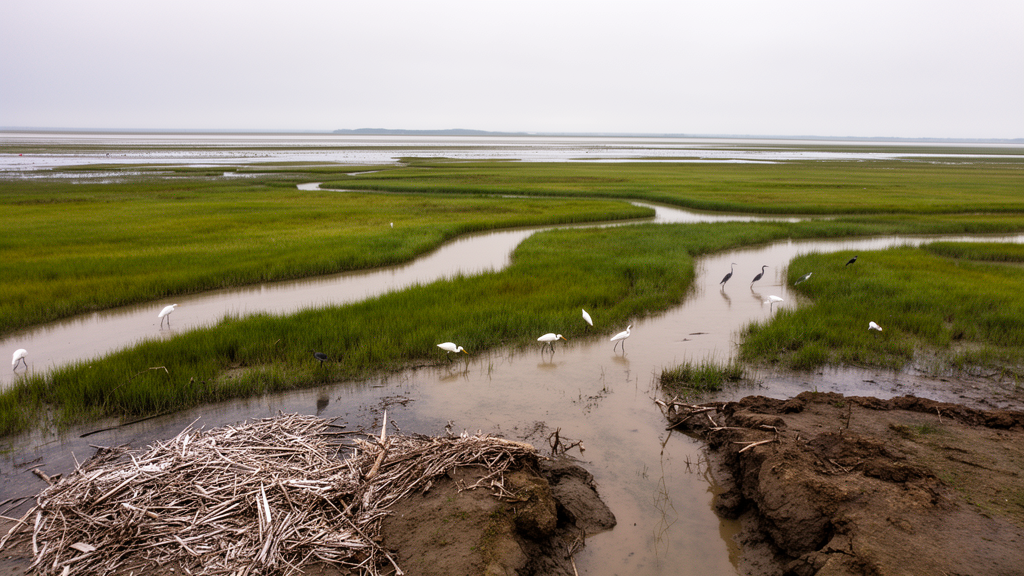
Coastal wetlands, which serve as critical transition zones between terrestrial and marine ecosystems, are facing unprecedented threats from climate change. These habitats, including salt marshes, mangroves, seagrass meadows, and tidal flats, support a rich diversity of vegetation, birds, and fish while providing essential ecosystem services such as storm protection, carbon sequestration, and nursery grounds for fisheries. However, global projections indicate that between 20% and 90% of current coastal wetland areas may be lost due to sea-level rise alone, depending on the severity of climate scenarios. This potential loss poses a dramatic threat to biodiversity, particularly in deltas and estuaries, which are vital for the conservation of coastal species and the maintenance of ecosystem functions. The interplay between rising seas, warming temperatures, and human-induced stressors is accelerating the degradation of these fragile environments, necessitating urgent attention to their preservation and resilience.
Historically, factors such as wetland reclamation, pollution, and altered hydrology have been the primary drivers of coastal wetland loss. According to the WET Index, marine and coastal wetlands have declined by approximately 35% between 1970 and 2015. While climate change previously played a minor role compared to these direct human impacts, its influence is now growing significantly. More than a billion people live within 10 kilometers of the sea, and over one-third of the global population resides within 100 kilometers of the coast, highlighting humanity’s heavy reliance on these areas. Consequently, 40% of coastal areas are developed globally, making their wetlands particularly vulnerable. As sea-level rise and warming accelerate, the cumulative effects of climate change are expected to dominate the trajectory of wetland loss, outpacing traditional drivers of degradation.
Vegetation in coastal wetlands is highly varied, ranging from submerged macrophytes to shrub formations and forests, with compositions that differ significantly across geographic regions. These plants perform critical ecosystem services, including organic matter production, sediment trapping, and wave energy reduction. Monitoring data from over 390 sites suggest that climate change negatively affects all wetland plant communities. Increased salinity and flooding are major ongoing impacts of sea-level rise and warming on salt marshes. For instance, in a disconnected wetland in southern Spain, salinity increased from 4.5 g/L in 2003 to 7.5 g/L in 2008, potentially affecting approximately 20% of species. Experimental studies have also shown that warming can reduce Shannon diversity in salt marsh vegetation by 44–74%, favoring certain invasive or dominant species over others, thereby altering the structural integrity of the ecosystem.
The survival of wetland vegetation in the face of rising seas is strongly correlated with the availability of suspended matter for vertical accretion and the capacity of plant species to migrate inland. Plants with fibrous roots accrete sediment more efficiently than those with tap roots, and perennial plants are generally more effective than annuals in maintaining marsh elevation. However, rising sea levels can compromise the resilience of salt marshes if flooding exceeds thresholds that decrease plant productivity. In transitional waters, species richness is often low at higher salinities, and species are highly sensitive to salinity changes. Warmer conditions tend to favor C4 plant species over C3 species, but salinity stress and alternating flooded and dry conditions make predicting plant responses complex. Rare and endemic species tolerant of specific flooding and salinity regimes, such as Limonium and Salicornia, are particularly threatened by coastal erosion and changes in hydro-saline conditions.
Coastal wetland fauna, including birds and fish, are also experiencing significant impacts from climate change. For birds, nesting declines in species such as flamingos, terns, and sparrows have been directly linked to sea-level changes. Increased flooding risk has more than doubled for six saltmarsh species in the Wadden Sea, sufficient to cause population declines. Most coastal birds build nests near the ground, making them vulnerable to inundation during high tides or storms. For fish, rising water temperatures and altered salinity are disrupting metabolic rates and reproductive cycles. In the German Wadden Sea, the growth and abundance of the non-migratory eelpout declined when summer temperatures and dissolved oxygen levels exceeded critical thresholds. Sea-level rise can cause substantial shifts in coastal habitats, altering environmental factors that influence community structure and the population dynamics of certain fish species, potentially reducing safe zones for juvenile fish that rely on protected areas for food and shelter.
Future scenarios under accelerated climate change paint a concerning picture for coastal wetlands. The Intergovernmental Panel on Climate Change projects that global sea-level rise will average between 40–46 cm and 79–81 cm by 2100, and between 56–62 cm and 122–127 cm by 2150, depending on greenhouse gas emissions scenarios. Passive inundation models suggest that 20–90% of the current coastal wetland area will be lost under low and high sea-level rise scenarios, respectively. In the Mediterranean, widespread coastal marsh loss is projected to range from 8% to 92% of current extents by the end of the 21st century. While coastal wetlands could potentially migrate inland, human infrastructure often prevents this shift, a phenomenon known as coastal squeeze. As sea-level rise rates accelerate, sediment accumulation may be insufficient to maintain the hydrosedimentary balance, leading to the disappearance of certain wetlands and beaches if natural processes are not supported.
Warming temperatures in confined coastal systems such as marshes, lagoons, and bays can have more severe impacts than in the open sea due to shallow depths and small volumes. Modelling studies suggest that water temperature increases in these systems can be 15% greater than in the open sea. The general trend is for water temperature in lagoons to match air temperature trends with short time lags. Increased intensity and duration of marine heat waves might have more severe impacts on biodiversity than average seawater temperature changes. Expected impacts of warming include increased respiration relative to photosynthesis, reducing net primary production, and composition shifts towards species adapted to higher temperatures. Mortality of species susceptible to extreme temperatures and increased hypoxia, particularly fish and bivalves, is a significant concern. Changes in community composition can alter biogeochemical cycles and energy transfer, affecting water quality and the adaptability of species.
Management options to enhance the resilience of coastal wetlands are critical to avoiding biodiversity loss. Natural resilience mechanisms, such as the positive feedback between increased flooding and sedimentation, can allow coastal wetlands to maintain elevation relative to sea level, provided there is sufficient sediment available. However, high rates of sea-level rise or reduced sediment supply can lead to the collapse of these ecosystems. Management strategies must align with natural processes to avoid maladaptation. These include improving hydrological connectivity, increasing sediment inputs, boosting wetland plant productivity, and allowing space for natural coastal processes. In the Mediterranean, for example, implementing coastal management that supports passive inland migration of marshes or actively restores wetlands and river-to-coast connectivity may be necessary to mitigate losses. If upland migration is impossible, maintaining wetlands in place requires substantial increases in sediment supply and biogenic accretion, which can be achieved through the removal of dams and impoundments to release trapped sediment.
Integrated management, large-scale restoration, and comprehensive territorial planning are essential to minimize the loss of coastal wetlands due to climate change. Barriers to restoration are often financial and governance-related rather than technical. Policy recommendations should stress the need for the interconnectedness of land, water, and marine environments, including funding for research and monitoring, incentives for sustainable practices, and frameworks for community involvement in decision-making. Specific management actions include adding sediment to raise elevations, altering hydrology to improve drainage, and engineering shorelines to mimic natural systems. Living shorelines, which offer potential to create new habitats while protecting existing ones, are increasingly seen as an alternative to hardening the coast with physical structures. Restoration efforts can also focus on rehabilitating degraded habitats, such as replanting vegetation in marshes or seagrass beds, to maintain nursery areas and improve water quality.
In conclusion, the future of coastal wetland biodiversity will vary significantly based on the climate scenarios that unfold and the policies implemented. Addressing the challenges posed by climate change requires a comprehensive approach that integrates scientific knowledge, effective management, and robust policy frameworks. By taking proactive measures to enhance the resilience of coastal ecosystems, we can ensure the sustainability of their valuable biodiversity and ecosystem services. The urgency of this task cannot be overstated, as the combined impacts of climate change and other global drivers are already causing significant degradation and loss of these vital habitats. Continued research and adaptive management will be crucial in understanding and mitigating the complex interactions between climate change and coastal wetland ecosystems, ensuring they continue to support the diverse life forms and human communities that depend on them.
Subject of Research: Impact of climate change on coastal wetland biodiversity and resilience
Article Title: To what extent is coastal wetland biodiversity endangered by climate change? How can we boost the resilience of coastal ecosystems?
Article References: Ibáñez, C., Caiola, N., Elphick, C. S., & Grillas, P. (2026). To what extent is coastal wetland biodiversity endangered by climate change? How can we boost the resilience of coastal ecosystems?. Nature Conservation, 62, 63-94. https://doi.org/10.3897/natureconservation.62.154795
Image Credits: AI Generated
DOI: 10.3897/natureconservation.62.154795
Keywords: coastal wetlands, climate change, sea-level rise, biodiversity, salt marshes, ecosystem resilience, habitat loss, conservation, marine ecosystems, sediment dynamics, extent, coastal
Cite Scienmag News
Margaret Porter. (October 18, 2026). Climate Change Threatens Coastal Wetland Biodiversity. Scienmag. https://scienmag.com/climate-change-threatens-coastal-wetland-biodiversity/
Margaret Porter. "Climate Change Threatens Coastal Wetland Biodiversity." Scienmag, 18 October 2026, https://scienmag.com/climate-change-threatens-coastal-wetland-biodiversity/. Accessed 18 October 2026.
Margaret Porter. "Climate Change Threatens Coastal Wetland Biodiversity." Scienmag. October 18, 2026. https://scienmag.com/climate-change-threatens-coastal-wetland-biodiversity/


