


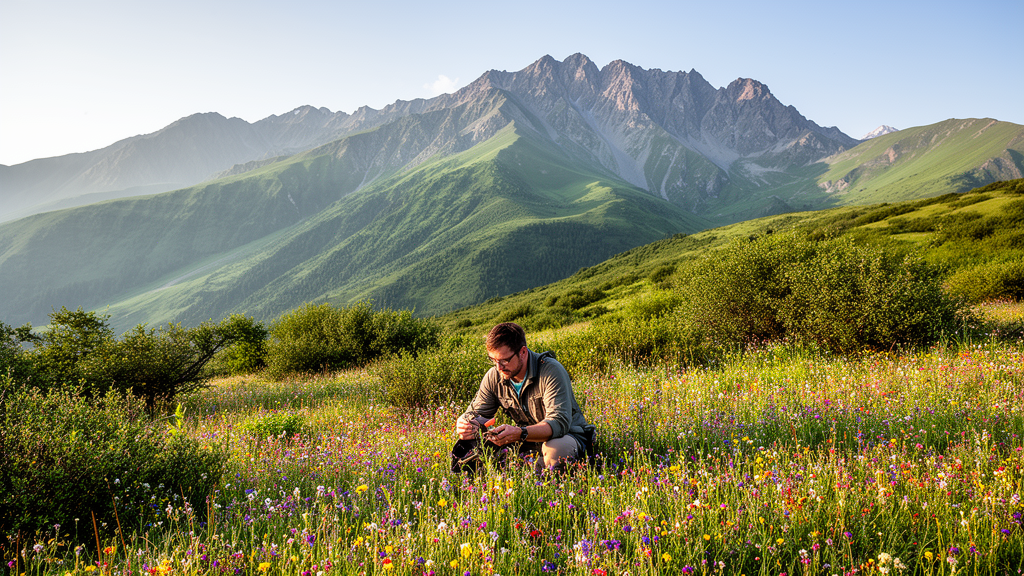
Ecologists have long sought to understand why species richness often peaks at intermediate elevations in mountainous regions, a phenomenon known as the elevational gradient of species diversity. While this hump-shaped pattern is widely observed across the globe, the specific drivers behind it remain a subject of intense debate. In a new study published in the journal Caucasiana, researchers investigated this pattern in the Javakheti Highlands of Georgia, a unique forest-free landscape that offers a distinct perspective on how altitude and area influence plant biodiversity. The findings suggest that climate-related factors, rather than the sheer amount of available land, are the primary architects of this diversity peak.
The Javakheti Highlands, located in the southern part of Georgia on the Lesser Caucasus Mountains, present a compelling case for such investigation. Unlike many mountain systems where forests dominate lower elevations, Javakheti is characterized by a lack of natural forest cover, which is thought to have disappeared due to human impact over the last few millennia. This absence of a treeline ecotone allows researchers to isolate the effects of elevation from the complex interactions typically seen at forest edges. The study area spans a significant vertical range, from 1400 to 3100 meters above sea level, encompassing lower valleys, a highland plateau, and two distinct mountain ranges. This structural homogeneity in vegetation, dominated by mountain meadows and wetlands, provides a controlled environment for testing ecological hypotheses about species distribution.
To capture the full spectrum of plant diversity in this region, the research team conducted a rigorous field survey between 2014 and 2017. They established 170 sampling plots, each measuring 100 square meters, distributed across the elevational gradient using a maximum variation sampling method. This approach ensures that the data reflects the true variability of the landscape rather than being biased by specific microhabitats. Over the course of the three-year study, the researchers recorded a total of 564 vascular plant species belonging to 287 genera and 67 families. The Asteraceae family was the most diverse, contributing 97 species, while other families were represented by single species. This comprehensive inventory provides a robust baseline for analyzing how species richness changes with altitude and area.
The analysis of the data revealed a clear hump-shaped pattern in plant species richness, with the peak occurring at mid-elevations between 1900 and 2200 meters. This finding is consistent with other studies from the Caucasus region, which often locate the diversity peak near the tree line. However, in Javakheti, where forests are absent, this peak persists, suggesting that the mechanism driving diversity is not solely tied to the presence of a forest-grassland transition. The researchers employed various statistical techniques, including regression analyses and rarefaction, to ensure that the observed pattern was not an artifact of uneven sampling effort. By standardizing the data, they were able to confirm that the mid-elevation peak is a genuine ecological signal rather than a sampling bias.
A critical aspect of the study was the disentangling of the effects of elevation and area on species richness. The species-area relationship (SAR) is a well-established ecological principle stating that larger areas tend to support more species. In mountainous environments, the available land area often decreases with elevation, which could theoretically drive a decline in species richness at higher altitudes. To test this, the researchers used a multi-model selection framework to compare the explanatory power of elevation and area. They found that while area was a significant predictor of species richness in some models, its effect was negligible when sampling effort was accounted for. This suggests that the observed elevational gradient is not simply a byproduct of the shrinking land area at higher altitudes.
The study further explored the role of sampling effort in shaping the perceived diversity patterns. Incomplete sampling can often obscure true ecological patterns, leading to misleading conclusions about species distribution. By using asymptotic estimators and rarefaction methods, the researchers assessed the completeness of their species inventory. They found that while the inventory was not fully complete, the removal of sampling bias did not alter the fundamental shape of the elevational richness curve. This robustness of the pattern across different analytical approaches strengthens the conclusion that mid-elevation peaks are a stable feature of plant diversity in this region. The findings imply that other factors, such as temperature and precipitation, which vary predictably with elevation, are likely the primary drivers of this pattern.
The implications of these findings extend beyond the Javakheti Highlands, offering insights into the broader mechanisms of elevational diversity gradients. The study highlights the importance of considering local environmental conditions and historical factors when interpreting biodiversity patterns. In Javakheti, the dry and continental climate, with low annual precipitation at mid-elevations, may create specific ecological niches that support a high diversity of plant species. The presence of extensive wetland ecosystems, which are among the largest in the Caucasus, may also contribute to this diversity by providing unique habitats for specialized plant communities. These local factors, combined with the general climatic trends associated with elevation, likely interact to produce the observed hump-shaped diversity curve.
The research also underscores the limitations of relying solely on regional data or herbarium collections for understanding elevational gradients. Such data sources often suffer from spatial biases and incomplete metadata, which can lead to inaccurate assessments of species distribution. By conducting a standardized plot-based field survey, the researchers were able to overcome these limitations and provide a more reliable picture of plant diversity in the Javakheti Highlands. This methodological approach serves as a model for future studies aiming to disentangle the complex drivers of biodiversity in mountainous regions. The study emphasizes the need for rigorous fieldwork and careful statistical analysis to distinguish between true ecological patterns and artifacts of data collection.
In conclusion, the study demonstrates that the mid-elevation peak in plant species richness in the Javakheti Highlands is a robust pattern that is independent of available area and sampling effort. This finding challenges the notion that the species-area relationship is the primary driver of elevational diversity gradients in all mountain systems. Instead, it suggests that climate-dependent factors play a more significant role in shaping plant diversity in this region. The results contribute to a growing body of evidence that elevational diversity patterns are context-dependent, influenced by a combination of local, regional, and global factors. Further research is needed to fully understand the mechanisms underlying these patterns, particularly in regions with unique environmental histories and vegetation structures. The Javakheti Highlands, with their forest-free landscape, provide a valuable natural laboratory for exploring these questions and refining our understanding of biodiversity in mountain ecosystems.
Subject of Research: Elevational gradients in plant species richness and species-area relationships in the Javakheti Highlands, Georgia
Article Title: Species elevational richness gradient and species-area relationship in mountain vegetation of Javakheti highland (Georgia)
Article References: Mumladze, L., Shetekaur, S., Barnaveli, N., Chelidze, D., & Asanidze, Z. (2023). Species elevational richness gradient and species-area relationship in mountain vegetation of Javakheti highland (Georgia). Caucasiana, 2, 127-135. https://doi.org/10.3897/caucasiana.2.e103599
Image Credits: AI Generated
DOI: 10.3897/caucasiana.2.e103599
Keywords: plant ecology, elevational gradient, species richness, Javakheti Highlands, Georgia, biodiversity, species-area relationship, mountain vegetation, biogeography, field survey, Species, elevational
Cite Scienmag News
Gavin Prescott. (October 18, 2026). Mid-Elevation Peaks Drive Plant Diversity in Georgian Highlands. Scienmag. https://scienmag.com/mid-elevation-peaks-drive-plant-diversity-in-georgian-highlands/
Gavin Prescott. "Mid-Elevation Peaks Drive Plant Diversity in Georgian Highlands." Scienmag, 18 October 2026, https://scienmag.com/mid-elevation-peaks-drive-plant-diversity-in-georgian-highlands/. Accessed 18 October 2026.
Gavin Prescott. "Mid-Elevation Peaks Drive Plant Diversity in Georgian Highlands." Scienmag. October 18, 2026. https://scienmag.com/mid-elevation-peaks-drive-plant-diversity-in-georgian-highlands/


