


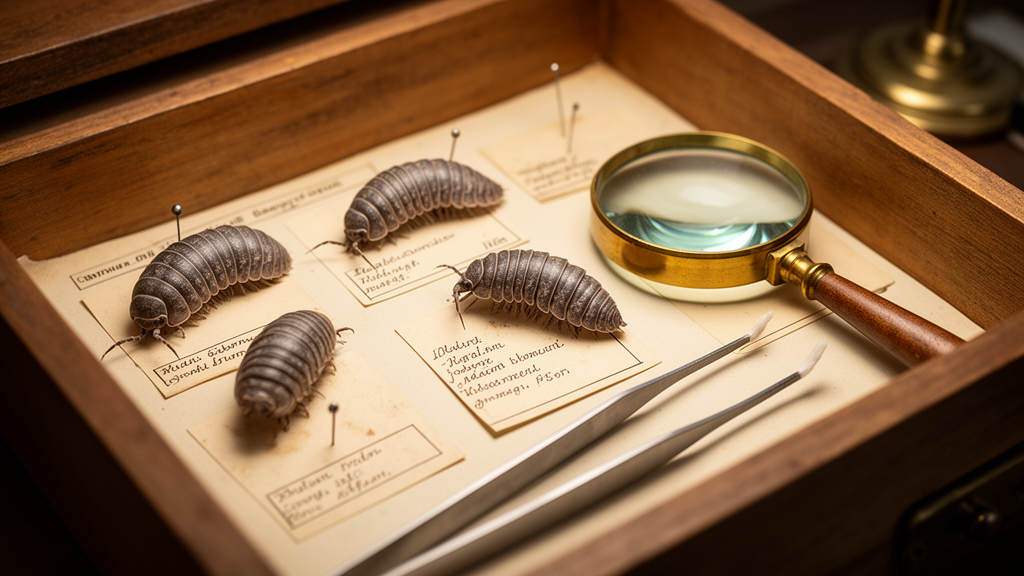
In a dusty corner of European natural history museums, a group of brightly colored pill woodlice has been hiding in plain sight for more than a century. A new taxonomic revision published in Natural History Collections and Museomics has dismantled one of the most recognizable genera of terrestrial isopods, Merulanella, revealing that what hobbyists and scientists long treated as a single widespread group is actually a patchwork of distinct lineages scattered across three biogeographic realms. The work, based entirely on historical specimens and non-destructive morphological analysis, also raises urgent conservation concerns for species being harvested from the wild for the booming invertebrate pet trade.
The study confronts what researchers call the taxonomic impediment, a problem formally recognized in the 1988 Darwin Declaration and highlighted at the 1992 Earth Summit in Rio de Janeiro. At its core lies a simple but crippling shortage: far too few taxonomists exist to identify the organisms already sitting in collections and databases worldwide. The impediment has three dimensions, according to the framework laid out in the Guide to the Global Taxonomy Initiative published in 2008. There are large gaps in taxonomic knowledge, there are insufficient trained experts for most groups, and the infrastructure of reference collections and career pathways falls far short of demand. What has often been overlooked, the authors argue, is the role that scholarly publishers themselves play in perpetuating the problem.
Major non-specialized journals, the paper notes, frequently consider taxonomy on its own unworthy of publication unless it is bolted onto additional analyses such as genetic sequencing. This pushes taxonomic revisions into a narrow space of specialized journals and leaves countless groups in limbo. The authors know this firsthand: an earlier version of their manuscript was rejected on the grounds that the revision required genetic analysis. Yet for historically erected groups characterized by pronounced morphological differences and vast geographic separation, careful morphological work on type specimens can resolve taxonomic tangles without a single DNA sample. The value placed on molecular approaches, they contend, has in some cases exacerbated rather than alleviated the impediment, contributing to the rise of so-called dark taxa in genetic archives like GenBank, where sequences accumulate without formal taxonomic identification.
The genus Merulanella was erected in 1926 by the German zoologist Karl Verhoeff based on two species from New Caledonia, Merulanella carinata and Merulanella wahrbergi. Verhoeff never provided a concise diagnosis for the genus, scattering its defining characters across comparisons and an identification key with sparse illustrations. Later authors added more species from increasingly distant localities: two from the Indonesian island of Flores described by Herold in 1931, one from the Seychelles transferred in 1946, and one from Myanmar moved into the genus in 1983. By the time of this revision, Merulanella comprised seven species spanning the Australasian, Indomalayan, and Afrotropical realms, an extraordinary distribution for a genus of small, flightless, land-dwelling crustaceans.
That distribution, the authors explain, reflects the scientific context in which the taxonomy was built. The genus was defined and expanded before plate tectonics and modern vicariance biogeography took hold, at a time when disjunct distributions were explained either by rare long-distance dispersal events or by hypothetical submerged land bridges, including the now-discredited landmass of Lemuria that was once proposed to connect Africa, India, Southeast Asia, and Australia. Taxonomies created before the 1960s, the paper notes, are snapshots from a time before cladistics, and those created before the 1970s could not have considered vicariance and plate tectonics at all. Reinterpreting Merulanella through this modern lens revealed that its species share only superficial resemblances, with the few supposedly diagnostic characters differing fundamentally in structure.
To untangle the mess, the researchers examined type specimens held in European collections, some first-hand and others through photographs provided by collection managers. The material posed serious challenges: specimens were damaged, preserved in ways that made them fragile, or simply could not be located due to inadequate documentation by earlier authors. Where necessary, lectotypes were designated to anchor names to specific specimens. The morphological evidence, combined with the enormous geographic separation between populations, justified splitting Merulanella into four genera. The genus itself is now restricted to three species from New Caledonia: M. carinata, M. wahrbergi, and M. dollfusi from the Loyalty Islands.
Three new genera were erected for the rest. Floresiodillo accommodates the two tubercle-covered species from Flores, Indonesia, F. gibberum and F. latissimus, named for their island home. Acutodillo contains the single Seychelles species formerly known as Merulanella peltata, now A. peltatus, distinguished by its triangular epimera and pointed telson tip. Ardentiella, named for the fiery black, yellow, and red coloration displayed by many of its members, takes in the Myanmar species formerly called Merulanella bicolorata, along with Cubaris caerulea from the Dawna Hills, now Ardentiella caerulea. The revision also uncovered hidden diversity within the old type material: the syntypes of A. bicolorata in Berlin actually contained two distinct morphospecies, meaning that only a single specimen can conclusively represent the species name, while the remaining specimens likely represent an undescribed species.
The conservation implications are significant. The IUCN Red List currently includes only 14 members of the entire suborder Oniscidea, a minuscule fraction of the nearly 4,000 described terrestrial isopod species, and none of the species treated in this revision appear on it. Yet multiple species of Ardentiella have flooded into the invertebrate pet trade in recent years, circulating under the name Merulanella bicolorata despite the fact that examination of hobbyist cultures revealed none of them actually correspond to that species. Some cultures may instead represent A. caerulea or other undescribed morphospecies. Concerns are regularly voiced among hobbyists about the frequent collection of large numbers of wild individuals, and undescribed species endemic to Vietnam appear particularly at risk from wildlife collectors.
Complicating matters further, the type localities of both A. bicolorata in the Karen Hills and A. caerulea in the Dawna Hills lie within active conflict zones in eastern and southern Myanmar, where the ongoing civil war and humanitarian crisis make fieldwork effectively impossible. Historical material, meanwhile, usually cannot be dissected and rarely yields viable molecular results, leaving detailed morphological work as the primary tool available. The authors acknowledge that their solution is not optimal and cannot provide conclusive species delimitations, but it achieves greater taxonomic stability in the family Armadillidae, supplies a proper generic diagnosis for Merulanella, and offers a framework that makes future research, including population genetic studies, considerably less complicated.
The broader message extends well beyond woodlice. The authors propose that publishers should prioritize revisions of taxonomies built on type specimens collected during colonial expansion, taxonomies created before key evolutionary concepts existed, taxonomies relying on outdated genus-differentia diagnoses rather than type specimens, and taxonomies with direct conservation stakes. As biodiversity loss accelerates and species disappear before they are even formally recognized, they argue that waiting for perfect data is not a viable option. Highly polyphyletic genera, they demonstrate, can be readily resolved with historical specimens and non-destructive morphological analysis alone, and doing so is a necessary step toward protecting the often-overlooked creatures that depend on taxonomic clarity for their survival.
Subject of Research: Taxonomic revision of the terrestrial isopod genus Merulanella using historical type specimens
Article Title: Facing the taxonomic impediment — a reassessment of Merulanella Verhoeff, 1926 ( Oniscidea , Armadillidae ) through historical specimens
Article References: Kästle, B., & Regalado Fernández, O. R. (2025). Facing the taxonomic impediment — a reassessment of Merulanella Verhoeff, 1926 (Oniscidea, Armadillidae) through historical specimens. Natural History Collections and Museomics, 2, 1-38. https://doi.org/10.3897/nhcm.2.144386
Image Credits: AI Generated
Keywords: taxonomy, Merulanella, terrestrial isopods, Armadillidae, taxonomic impediment, new genera, New Caledonia, pet trade, conservation, biogeography, type specimens, museum collections
Cite Scienmag News
Margaret Porter. (October 18, 2026). Century-old woodlouse specimens reveal hidden diversity and pet trade risks. Scienmag. https://scienmag.com/century-old-woodlouse-specimens-reveal-hidden-diversity-and-pet-trade-risks/
Margaret Porter. "Century-old woodlouse specimens reveal hidden diversity and pet trade risks." Scienmag, 18 October 2026, https://scienmag.com/century-old-woodlouse-specimens-reveal-hidden-diversity-and-pet-trade-risks/. Accessed 18 October 2026.
Margaret Porter. "Century-old woodlouse specimens reveal hidden diversity and pet trade risks." Scienmag. October 18, 2026. https://scienmag.com/century-old-woodlouse-specimens-reveal-hidden-diversity-and-pet-trade-risks/


