


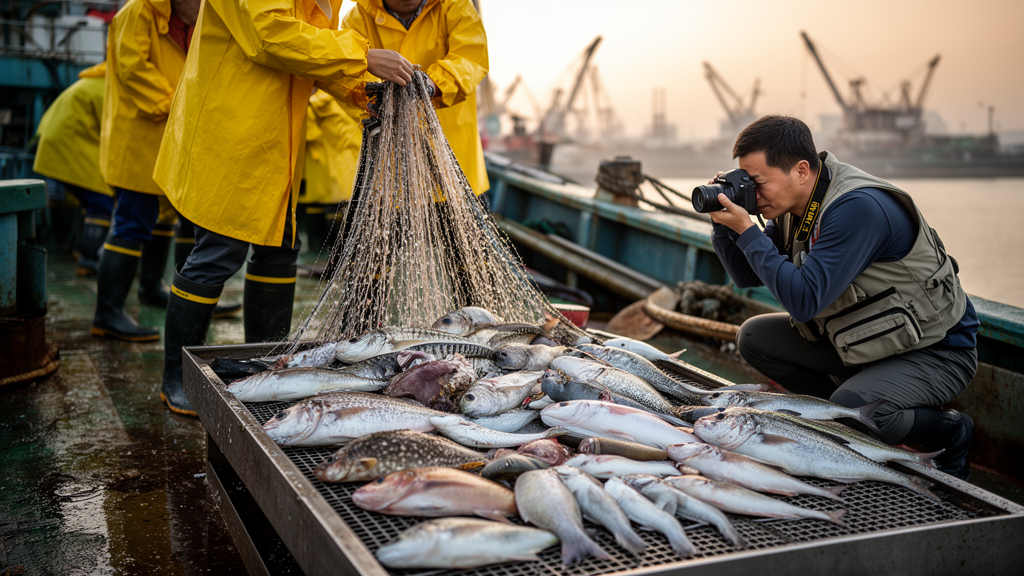
Off the southwestern coast of Taiwan, where shallow sandy seabeds meet some of the most productive fishing grounds in the western North Pacific, commercial trawlers haul up far more than the species that end up on dinner plates. Mixed into every net are dozens of small, unglamorous fish that are discarded at sea or ground into fishmeal, species so obscure that even the world’s largest online fish database holds little or nothing on their basic biology. Now, a multi-year trawl survey has pulled back the curtain on 17 of these forgotten fish, delivering the first length–weight measurements ever recorded for most of them and giving ecologists a rare quantitative foothold on a neglected layer of the marine food web.
The study, published in the journal Acta Ichthyologica et Piscatoria, draws on 16 bottom-trawling hauls conducted between March 2019 and September 2023 by commercial fishing vessels working the waters around the Penghu Islands and the Taiwan Banks. These hotspots owe their richness to topographically driven upwelling, which pushes cold, nutrient-laden water toward the surface and fuels high chlorophyll-a concentrations and abundant primary productivity. The trawl nets used had a vertical opening of roughly 2.5 meters and a horizontal width of about 30 meters, with a codend mesh size of just 2 by 2 centimeters, fine enough to retain even the smallest bottom-dwelling species. Hauls typically ran at night for two to four hours at speeds of 2.0 to 3.8 knots.
In total, the survey randomly subsampled more than 35,000 specimens weighing 684 kilograms, a catch that included elasmobranchs, teleost fish, shrimp, mantis shrimp, crabs, cephalopods, shells, and other benthic organisms. Among the 231 bony fish species examined, which together accounted for roughly 82 percent of the total catch weight, 150 were classified as noncommercial, representing 32 percent of the bony fish catch weight. It is precisely these small-bodied species, often discarded at sea or reduced to trash fish, that the research team set out to quantify, because their ecological importance far outstrips their commercial value.
Small fish occupy a pivotal mid-trophic position in marine ecosystems. They serve as prey for commercially valuable fish and larger predators, and when abundant they can act as keystone species, influencing population sizes at both lower and higher trophic levels. Yet because they are difficult to obtain and rarely studied, basic biological data on them remain limited. Length–weight relationships, or LWRs, are among the most fundamental tools in fisheries biology: they allow researchers to estimate biomass from length measurements alone, assess growth patterns and body condition, model population dynamics, and build ecosystem models, all of which are especially critical for data-poor species that cannot be assessed by conventional stock-assessment methods.
After rigorous data verification, the team narrowed the analysis to 17 species belonging to 11 families. They excluded 112 species with sample sizes below 15 individuals, 13 species already extensively documented in FishBase, six species with abnormally extreme allometric exponents outside the range of 2.5 to 3.5, and two species with coefficients of determination below 0.8. Notably, FishBase held no data at all on 11 of the final 17 species and only a few or no records for the remaining five in the waters surrounding Taiwan. Among them was Trachinocephalus trachinus, a snakefish whose Indo-West Pacific populations were long misidentified as the Atlantic species Trachinocephalus myops; the present study appears to be the first ever to provide LWR data for T. trachinus.
The allometric equation at the heart of the analysis, BW = aL^b, traces back to Le Cren’s classic 1951 formulation. Here BW is wet body weight in grams, L is length in centimeters, a is a coefficient related to body shape, and b is the exponent that reveals how growth proceeds. A b value of exactly 3 indicates isometric growth, meaning fish increase in length and weight proportionally. Values below 3 signal negative allometry, with larger specimens growing more in length than in weight, while values above 3 indicate positive allometry, with weight increasing faster than length as fish approach maximum size. Because trawl capture often damages the posterior tip of the caudal fin in fork-tailed species, the researchers measured fork length for those species and total length only for species with non-forked tails, avoiding systematic underestimation of body size.
The results were striking in their consistency. Twelve of the 17 species exhibited isometric growth, including the conger eel Ariosoma dolichopterum, the flatfish Crossorhombus kanekonis, the wrasse Suezichthys gracilis, the cardinalfishes Jaydia truncata and Ostorhinchus kiensis, the searobin Lepidotrigla punctipectoralis, the cusk-eel Ophidion asiro, the sandperch Parapercis sexfasciata, the flathead Rogadius asper, and three lizardfish species, Synodus binotatus, Synodus fuscus, and Synodus taiwanensis. Four species showed positive allometry: the sand lance Bleekeria mitsukurii, the beaked salmon Gonorynchus abbreviatus, the lizardfish Synodus tectus, and Trachinocephalus trachinus. Only one species, the flathead Ratabulus megacephalus, exhibited negative allometry, with a b value of 2.845.
Statistical correlations were strong across the board, with coefficients of determination exceeding 0.95 for the majority of species and never falling below 0.83. The team attributes the single negative-allometric result to sampling constraints: their R. megacephalus specimens clustered at 4–8 and 14–18 centimeters in total length, well short of the species’ typical maximum of 30 centimeters, and fish generally grow fastest in earlier developmental stages. Conversely, the four positively allometric species were often elongated forms whose sampled specimens approached or exceeded the maximum fork lengths reported in FishBase; at sexual maturity and near maximum body size, fish typically gain weight more rapidly than length, consistent with the observed b values above 3. Sampling across multiple seasons and years suggests the reported parameters represent long-term averages rather than snapshots of a single spawning period or growth phase.
Comparisons with the handful of existing FishBase records revealed both agreements and deviations. For five species—Crossorhombus kanekonis, Suezichthys gracilis, Parapercis sexfasciata, Rogadius asper, and Synodus binotatus—only one or two LWR records existed worldwide, often from distant study areas or with unspecified locations. The b value for R. asper differed significantly from the previous record, which reported 3.355 against this study’s 2.881, while the remaining four species showed no significant differences. Such deviations can arise from environmental, biological, and human sampling factors alike, including sample numbers, body size ranges, seasonal differences, gonad maturity, growth rates, and feeding conditions, underscoring why locally derived parameters matter for regional management.
For a region whose trawling industry discards vast quantities of small fish every year, the study fills a conspicuous data vacuum. All 17 b values fell within the expected range of 2.5 to 3.5, and the regression results were highly significant, lending confidence to the estimates. The findings may guide future research calculating fish biomass, assessing stock status, and modeling ecological dynamics in southwestern Taiwanese waters, where data-poor species have rarely been studied. In an era when ecosystem-based fisheries management demands quantitative knowledge of every trophic link, even the humblest trash fish can prove scientifically priceless.
Subject of Research: Fisheries biology and marine ecology
Article Title: Length–weight relationships of 17 noncommercial fish species ( Actinopterygii ) sampled through bottom trawling in the waters of southwestern Taiwan
Article References: Wang, Y. C., Chen, Y. K., & Lee, M. A. (2025). Length–weight relationships of 17 noncommercial fish species (Actinopterygii) sampled through bottom trawling in the waters of southwestern Taiwan. Acta Ichthyologica et Piscatoria, 55, 333-339. https://doi.org/10.3897/aiep.55.173888
Image Credits: AI Generated
Keywords: Taiwan, bottom trawling, length-weight relationships, noncommercial fish, FishBase, fisheries science, marine ecology, allometric growth, data-poor species, Trachinocephalus trachinus, Length, weight
Cite Scienmag News
Margaret Porter. (October 18, 2026). Hidden Data on 17 Overlooked Fish Species Emerge From Taiwan Trawl Nets. Scienmag. https://scienmag.com/hidden-data-on-17-overlooked-fish-species-emerge-from-taiwan-trawl-nets/
Margaret Porter. "Hidden Data on 17 Overlooked Fish Species Emerge From Taiwan Trawl Nets." Scienmag, 18 October 2026, https://scienmag.com/hidden-data-on-17-overlooked-fish-species-emerge-from-taiwan-trawl-nets/. Accessed 18 October 2026.
Margaret Porter. "Hidden Data on 17 Overlooked Fish Species Emerge From Taiwan Trawl Nets." Scienmag. October 18, 2026. https://scienmag.com/hidden-data-on-17-overlooked-fish-species-emerge-from-taiwan-trawl-nets/


