


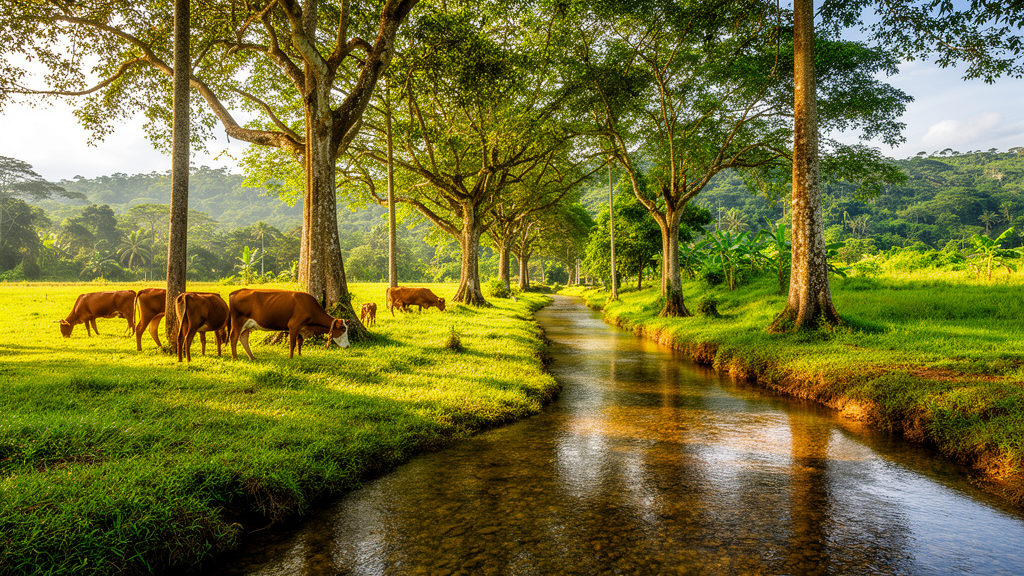
On the cattle ranches of Panama’s Azuero Peninsula, the dry tropical forest survives mostly as ribbons of trees along streams and as living fences strung across pastures. A new field study suggests those scattered trees may be doing more than shading livestock. When researchers surveyed the streams running through five silvopastoral farms, they found that the biological condition of the water tracked the amount of carbon stored in riparian trees rather than the sheer size of the forested corridor. Farms with heavier, taller riparian vegetation supported more pollution-sensitive aquatic insects and greater macroinvertebrate diversity, a preliminary signal that integrating trees into working landscapes could improve stream health in one of Central America’s most heavily converted ecosystems.
The study, published in Neotropical Biology and Conservation, is the first anywhere to examine how silvopastoral practices affect stream water quality. Silvopastoralism is a form of agroforestry that embeds trees into animal pastures, and previous work has shown it improves soil quality, increases shade and fodder for cattle, boosts carbon storage, and provides commercial products for landowners. What remained unknown was whether those benefits extend to the streams that drain the pastures. To find out, the team turned to an unusual but powerful set of witnesses: the aquatic macroinvertebrates living on the stream bottoms.
Macroinvertebrates are classic biological indicators of stream condition. Water chemistry offers a snapshot of the immediate state of a stream, but the insects that spend weeks or months in the water integrate habitat changes over time. Pollution-sensitive taxa such as mayflies, stoneflies, and caddisflies disappear quickly when streams degrade, while tolerant groups such as true flies thrive. By calculating the percent EPT, the percent Diptera, the percent Odonata, taxonomic richness, abundance, and the Shannon Diversity Index at each site, the researchers could score the long-term biological state of each farm’s streams.
The five farms surveyed all participate in the Environmental Leadership and Training Initiative, a program created by the Forest School at the Yale School of the Environment that mentors local landowners in Panama, Colombia, Brazil, the Philippines, and Indonesia to increase forest cover through agroforestry. Each farm contained a mix of pasture, forestry plantations, home gardens, riparian forests, and live fences. During the dry season, between 14 and 18 March 2022, the team selected four stream sections per farm and sampled comparable pools, since low water flow made riffles inconsistent. All sites had primarily sandy or silty bottoms with little cobble.
At each site, the researchers recorded pH and temperature with a combination sensor and tested for fecal coliform bacteria with a field kit. Then came the invertebrate work: disturbing the stream substrate for ten seconds, three times per site, and collecting displaced insects with a 500-micrometer sieve. The animals were washed into a tub, sorted morphologically in an ice cube tray, identified to order, and returned to the stream. Crustaceans were excluded. In total, 852 invertebrates across thirteen orders were identified, with true flies the most abundant group at 358 individuals, followed by mayflies at 189.
The pattern across farms was striking. At farm SP4, where cattle had been excluded from two sample sites, the community was dominated by sensitive taxa: the highest percent Odonata at 16.1 percent, the highest EPT index at 55.6 percent, and the lowest percent Diptera at 7.7 percent. Farm SP3, the largest and most isolated from forest patches, showed the opposite: the lowest percent Odonata at 3.2 percent, the lowest EPT at 12.2 percent, and the highest percent Diptera at 58.7 percent. Shannon diversity and richness peaked at farm SP5, which also stored the most carbon, with 138.4 megagrams of carbon per hectare in riparian areas and 80.4 across the whole farm.
Fecal coliform bacteria were present in every sample, a reminder that cattle manure enters these waterways across the landscape. Yet the physicochemical readings were remarkably consistent: pH ranged narrowly from 6.93 to 7.18, water temperatures from 24.4 to 26.4 degrees Celsius, and canopy cover from 52.83 to 84.75 percent. The biological metrics told a more nuanced story than the chemistry did, which is precisely why the researchers argue that combining both approaches is essential for a comprehensive stream assessment.
When the team ran single linear regressions linking stream metrics to landscape and habitat variables, several relationships emerged. The EPT index rose significantly with live fence connectivity, which explained about 21.5 percent of its variation. Shannon diversity increased significantly with both total farm carbon and riparian area carbon. The EPT index and the EPT index without the pollution-tolerant netspinning caddisflies both rose significantly with riparian area carbon. Notably, the variables the researchers had originally predicted to matter most, riparian area size and distance to the closest forest patch, did not significantly influence water quality in the analysis.
The authors propose that riparian tree carbon may serve as a proxy for riparian area quality rather than quantity. More trees and larger trees mean more aboveground biomass, deeper root systems, and greater capacity to absorb excess nutrients and stabilize stream banks. Live fences, whose carbon is mostly stored below ground, may soak up runoff before it reaches the streams. This would explain why the quality of the riparian vegetation, measured as carbon, predicted stream condition better than the width or total area of the riparian corridor did.
The findings come with caveats. Five farms during one dry season is a small sample, and the researchers emphasize that additional research is needed before drawing firm conclusions. Livestock access likely matters too: at the two SP4 sites where cattle were excluded, the team anecdotally observed greater within-order diversity, though they caution this may have been coincidental. Still, the study provides the first preliminary evidence that implementing agroforestry practices such as silvopastoralism could increase stream condition in the cattle pastures of dry tropical regions, and it suggests that increasing tree cover in agricultural landscapes may be beneficial to streams even when the forest survives only as fragments along the water.
Subject of Research: A preliminary study of five Panamanian silvopastoral farms finds that stream macroinvertebrate diversity and pollution-sensitive taxa rise with riparian tree carbon storage.
Article Title: A preliminary assessment of water quality in silvopastoral systems of Panama’s dry tropical forest
Article References: Portmann, J. M., Davenport, G. H., Starinchak, B. H., & Griscom, H. P. (2024). A preliminary assessment of water quality in silvopastoral systems of Panama’s dry tropical forest. Neotropical Biology and Conservation, 19(2), 173-183. https://doi.org/10.3897/neotropical.19.e111865
Image Credits: AI Generated
DOI: 10.3897/neotropical.19.e111865
Keywords: silvopastoral systems, Panama, dry tropical forest, water quality, aquatic macroinvertebrates, riparian carbon, agroforestry, EPT index, live fences, Azuero Peninsula, stream health, cattle pastures
Cite Scienmag News
William Thompson. (October 18, 2026). Trees on cattle farms may keep Panama’s tropical streams cleaner, first field test suggests. Scienmag. https://scienmag.com/trees-on-cattle-farms-may-keep-panamas-tropical-streams-cleaner-first-field-test-suggests/
William Thompson. "Trees on cattle farms may keep Panama’s tropical streams cleaner, first field test suggests." Scienmag, 18 October 2026, https://scienmag.com/trees-on-cattle-farms-may-keep-panamas-tropical-streams-cleaner-first-field-test-suggests/. Accessed 18 October 2026.
William Thompson. "Trees on cattle farms may keep Panama’s tropical streams cleaner, first field test suggests." Scienmag. October 18, 2026. https://scienmag.com/trees-on-cattle-farms-may-keep-panamas-tropical-streams-cleaner-first-field-test-suggests/


