


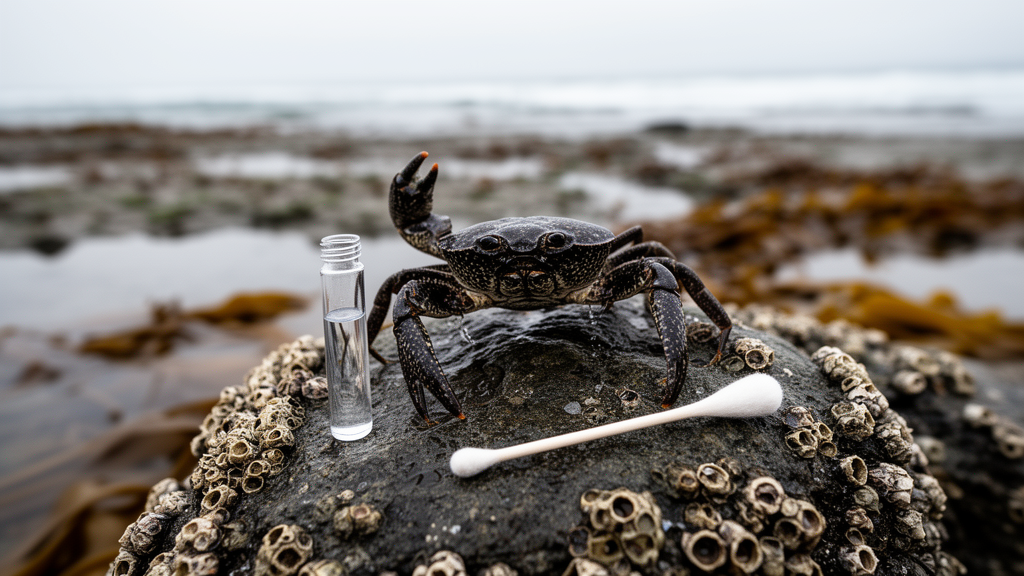
On rocky shores from the Mediterranean to the Pacific, small grapsid crabs of the genus Pachygrapsus scuttle among rocks, algae, rubble and mangroves. A new study published in Metabarcoding and Metagenomics has taken a close look at the DNA barcodes of these familiar intertidal crustaceans, and the results reveal both the power and the patchiness of molecular species identification. By assembling virtually every available COI sequence for the genus and adding new data from the Azores, the researchers found a strikingly clear barcoding gap between species, unusually high variation within some of them, and population splits across entire oceans that may signal speciation in progress.
DNA barcoding relies on a short, standardised stretch of the 5′ end of the mitochondrial Cytochrome c oxidase I gene, or COI, which acts as a molecular identifier unique to each species. The approach was proposed as a complement to traditional morphology-based taxonomy at a time when expert taxonomists are becoming scarce, cryptic species keep turning up under familiar names, and the identification of larval and juvenile stages remains notoriously difficult. Because the same gene region is sequenced across studies, researchers can pool homologous data into shared reference libraries such as GenBank and BOLD, which in turn underpin metabarcoding and environmental DNA surveys of biological communities.
Yet the reference libraries themselves are far from complete. When a sub-sample of major marine invertebrate groups was curated from BOLD around the 8th International Barcode of Life Conference in Trondheim in 2019, 39 percent of the reviewed species showed problems such as misidentification, ambiguity or shared barcodes. A gap analysis of the Iberian macroinvertebrate community found that roughly 63 percent of species lacked a DNA barcode altogether, with a substantial proportion flagged for significant intraspecific divergence and possible hidden diversity. Crustaceans, despite their ecological importance, are among the groups where robust genetic data are most lacking.
The genus Pachygrapsus illustrates these problems well. A 2005 revision recognised 12 species and suggested that P. propinquus should be treated as a junior synonym of P. minutus, but in March 2025 that name was reassigned by a WoRMS taxonomic editor to an entirely different species, Metopograpsus thukuhar. Meanwhile, P. socius had been recovered in 2005 for the Pacific representatives of what was then called P. transversus, on the basis of morphological and genetic differences. Today 13 species are accepted in WoRMS, distributed across tropical and temperate intertidal zones worldwide, but the genetic coverage of these species is anything but even.
To quantify the gaps, the team retrieved all COI 5′ region sequences available for the genus from GenBank and BOLD, amounting to 332 haplotypes across 10 species, and contributed eight new COI sequences of P. maurus collected by hand at low tide from two islands of the Azores Archipelago. The new sequences, obtained from pereopod muscle tissue using standard extraction, PCR with the jgLCO1490 and jgHCO2198 primers, and bi-directional Sanger sequencing, were deposited in GenBank under accession numbers PQ570873-76, with the representative specimens registered in BOLD under the bin AGP6456. The full dataset, including reconstructed original datasets from earlier studies of P. crassipes and P. marmoratus, comprised 1,032 sequences.
The analysis combined a Maximum Likelihood phylogenetic tree built in IQ-TREE 2 under the TN+F+I+G4 model, with four sequences of the outgroup species Grapsus adscensionis, and a statistical parsimony haplotype network generated with TCS at a 95 percent connection limit. Members of the same species formed monophyletic groups with high support values, and the network revealed distinct clusters corresponding to each species. Pairwise divergences were calculated as uncorrected p-distances and Kimura 2-parameter distances in MEGA11, with the barcoding gap assessed for each species as the difference between the minimum interspecific distance and the maximum intraspecific distance.
The headline result is a clear barcoding gap for every species with sufficient data, with average interspecific p-distances of 18.75 percent, exceeding the 17.16 percent previously reported for decapods. Average intraspecific variation, at 0.70 percent, also exceeds the previously described maxima for crustaceans, which hover around 0.38 to 0.48 percent. The authors suggest that this elevated within-species variation may reflect the current taxonomy of the genus overlooking cryptic species, and since K2P distances are known to inflate divergence, the fact that the p-distance values still surpass published figures strengthens confidence in both the gap and the hidden diversity.
Two biogeographic patterns stand out. Populations of P. gracilis from the east and west Atlantic show substantial divergence of 3.6 percent p-distance, with their haplotype networks completely separated at the 95 percent connection limit, suggesting very limited gene flow across the ocean and a possible case of ongoing speciation. Notably, one cluster corresponds to a Galician population thought to have been introduced by ship hull fouling from the Ivory Coast, consistent with earlier records of Pachygrapsus on vessels and an identical 16S match between Galician and Ivory Coast crabs. Similarly, P. crassipes populations from the east and west North Pacific, separated by six mutational steps between their closest haplotypes, echo earlier findings of restricted trans-Pacific gene flow and a proposal to recognise them as two different species.
The study also exposes stark inequities in genetic data availability. Three species, P. corrugatus, P. maurus and P. socius, lacked any information for the standard barcoding region, and in the case of P. socius the available COI sequences come from a different, downstream region of the gene that cannot be compared directly. P. loveridgei, known only from museum collections, has no genetic data at all. By contrast, P. crassipes and P. marmoratus dominate the literature and citizen-science records alike, together accounting for over 90 percent of genus observations on iNaturalist, a skew the authors attribute to abundance, commercial interest and geography in the Northern Hemisphere.
The authors caution that COI phylogenies reflect only maternal lineages and that the high mutation rate of mitochondrial DNA can compromise resolution of deeper relationships, particularly given evidence from earlier studies that Pachygrapsus may be polyphyletic within the family Grapsidae. They therefore call for a thorough taxonomic revision integrating morphological, genetic and ecological data, including multi-locus approaches with both mitochondrial and nuclear markers. Beyond resolving the genus, the findings reinforce the value of DNA barcodes for broad-scale metabarcoding assessments, and highlight the need for greater research effort on the less-studied species to build a truly comprehensive picture of marine biodiversity.
Subject of Research: DNA barcoding of Pachygrapsus shore crabs to assess barcoding gaps, cryptic diversity and taxonomic uncertainties in marine crustaceans
Article Title: Mind the gap: DNA barcoding on Pachygrapsus crabs
Article References: Alves, C., Baptista, L., Madeira, P., Vaz Álvaro, N., Santos, A., Meimberg, H., Ávila, S. P., & Curto, M. (2025). Mind the gap: DNA barcoding on Pachygrapsus crabs. Metabarcoding and Metagenomics, 9, Article e152554. https://doi.org/10.3897/mbmg.9.152554
Image Credits: AI Generated
Keywords: DNA barcoding, Pachygrapsus, COI gene, crustaceans, cryptic species, marine invertebrates, phylogeography, haplotype networks, taxonomic revision, metabarcoding, BOLD, GenBank
Cite Scienmag News
Juliet Wilcox. (October 18, 2026). DNA Barcodes Reveal Hidden Species Splits in Pachygrapsus Shore Crabs. Scienmag. https://scienmag.com/dna-barcodes-reveal-hidden-species-splits-in-pachygrapsus-shore-crabs/
Juliet Wilcox. "DNA Barcodes Reveal Hidden Species Splits in Pachygrapsus Shore Crabs." Scienmag, 18 October 2026, https://scienmag.com/dna-barcodes-reveal-hidden-species-splits-in-pachygrapsus-shore-crabs/. Accessed 18 October 2026.
Juliet Wilcox. "DNA Barcodes Reveal Hidden Species Splits in Pachygrapsus Shore Crabs." Scienmag. October 18, 2026. https://scienmag.com/dna-barcodes-reveal-hidden-species-splits-in-pachygrapsus-shore-crabs/


