


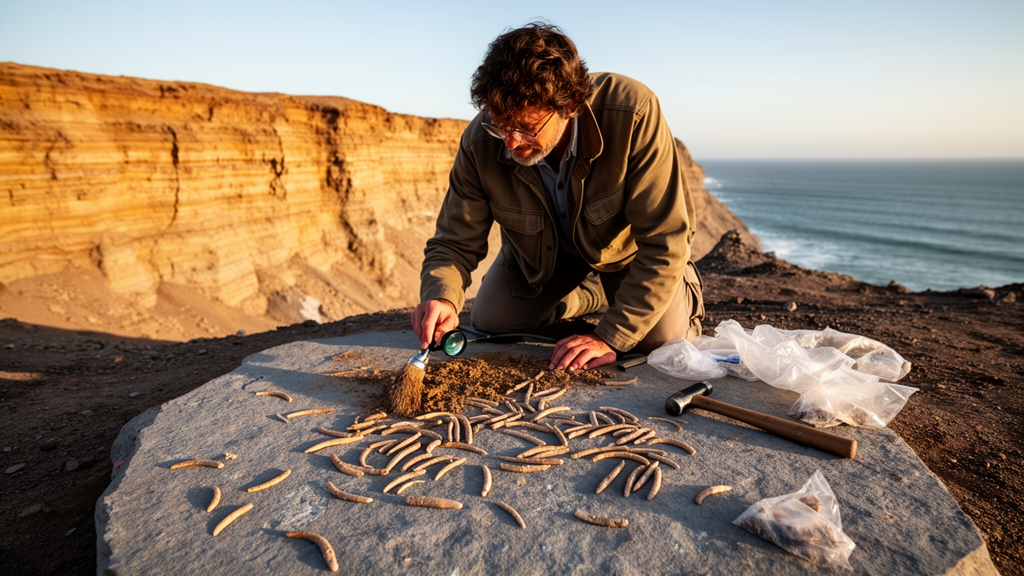
Deep beneath the Pacific seafloor off Chile, a group of molluscs so often overlooked that many researchers never encounter them alive has now taken center stage in a new study. Scaphopods, commonly known as tusk shells because of their elongated, curved, tubular form, are bilaterally symmetric marine animals that burrow within soft substrates. A comprehensive investigation of fossil scaphopods from the Miocene of Chile has now documented their diversity, abundance and biogeographic patterns across a latitudinal transect stretching from roughly 33 to 45 degrees south.
The study examined fossil scaphopods from four geological units: the Navidad Formation, the Lacui Formation, the Ranui Formation and the fossil beds of the Chiloe region. The Navidad Formation, located in central Chile, yielded the greatest number of individuals, with 708 specimens documented. The Chiloe fossil beds, situated further south, produced 1184 specimens, while the Ranui Formation yielded 708 individuals. The Lacui Formation, positioned between the Navidad and Ranui units, produced 708 specimens as well.
Across these units, the study documented a total of 2716 fossil individuals. The assemblage was dominated by a small number of species, with the most abundant taxon accounting for 1184 of the documented specimens. The second most abundant species contributed 708 individuals, while the remaining taxa were represented by far fewer specimens. This pattern of dominance by a few species, with many rare taxa, is a common feature of marine fossil assemblages.
The fossil scaphopods documented in the study belong to several genera, including Dentalium, Gadila, Cadulus, Polyschides and Dischides. The genus Dentalium, characterized by elongated, curved, tubular shells with a circular aperture, was the most abundant taxon in the assemblage. The genus Gadila, distinguished by a shell with the greatest diameter located immediately before the aperture, was the second most abundant. The genera Cadulus, Polyschides and Dischides, each with distinctive shell forms and apertural features, were represented by fewer specimens.
The study also documented the stratigraphic distribution of the fossil scaphopods across the four geological units. The Navidad Formation, the oldest unit, yielded the greatest diversity, with all five genera represented. The Chiloe fossil beds, the youngest unit, produced a similar diversity, with four genera documented. The Ranui and Lacui formations, positioned between the Navidad and Chiloe units, yielded intermediate diversity, with three genera each represented.
The biogeographic patterns documented in the study reveal a striking similarity between the fossil scaphopod assemblages of the four geological units. The assemblage of the Chiloe fossil beds, located furthest south, is remarkably similar to that of the Navidad Formation, located furthest north. The assemblages of the Ranui and Lacui formations, positioned between these two units, are intermediate in character. This pattern of similarity across a latitudinal transect stretching from roughly 33 to 45 degrees south suggests that the fossil scaphopods of the Miocene of Chile belonged to a single biogeographic province.
The study also documented the abundance patterns of the fossil scaphopods across the four geological units. The Navidad Formation yielded the greatest number of individuals, with 708 specimens documented. The Chiloe fossil beds produced 1184 specimens, while the Ranui Formation yielded 708 individuals. The Lacui Formation, positioned between the Navidad and Ranui units, produced 708 specimens as well.
The sedimentary environment documented in the study reveals that the fossil scaphopods of the Miocene of Chile burrowed within soft substrates in a bathyal setting. The assemblage was dominated by a small number of species, with the most abundant taxon accounting for 1184 of the documented specimens. The second most abundant species contributed 708 individuals, while the remaining taxa were represented by far fewer specimens.
The study concludes that the fossil scaphopods of the Miocene of Chile belonged to a single biogeographic province, with a striking similarity between the assemblages of the four geological units. The assemblage of the Chiloe fossil beds, located furthest south, is remarkably similar to that of the Navidad Formation, located furthest north. The assemblages of the Ranui and Lacui formations, positioned between these two units, are intermediate in character.
Scaphopods occupy a curious position in malacological research. Although the class includes both living and fossil species distributed across a remarkable depth range, from intertidal flats to abyssal settings exceeding 6000 meters, it remains the least diverse of the conchiferan molluscan classes, and this relative obscurity has translated into a comparatively sparse literature on their biology, ecology and systematics. The animals are selective micro-carnivores. They extend ciliated captacula, thread-like feeding tentacles that surround a head lacking eyes, into the sediment to seize prey, with foraminifera forming a principal food source, supplemented by detritus, juvenile bivalves, ostracods and diatoms. The tubular shell, typically white but ranging from yellowish to orange and in some species transparent, is held at a low angle of roughly 30 to 40 degrees relative to the substrate surface, with the concave side facing upward in living animals. Recent anatomical work has clarified the orientation of this arrangement, establishing that it is dorso-ventral, with the foot and the larger shell aperture positioned ventrally, the concave side anterior, and the smaller apical aperture dorsal.
The functional morphology of the tusk shell reflects a life spent almost entirely within the substrate. The larger opening accommodates the conical or vermiform burrowing foot, while the smaller apical opening intermittently protrudes above the sediment surface to serve respiration, excretion and the release of gametes. Growth proceeds through shell secretion at the ventral aperture, which increases both the diameter and the length of the tube to accommodate the enlarging soft tissues. A notable consequence of this growth pattern is that the original apex is preserved only in extremely young specimens; as the individual grows, the apex is truncated through shell resorption or natural degradation, which prevents complete closure of the dorsal aperture. These apical modifications tend to be constant within a genus, though they may be altered by breakage, erosion and repair over an individual’s lifetime.
The shell itself is composed exclusively of aragonite and is built of two to four layers depending on the taxon, though in most scaphopods three layers can be distinguished: an outer prismatic layer formed by elongated crystals arranged perpendicular to the longitudinal axis of the tube, a middle cross-lamellar layer, and an inner layer with a concentric structure. A periostracum has been described for two dentaliid species, while in gadilids this organic outer layer is generally absent. Such shell characteristics, including the strength of curvature, the rate at which the ventral aperture expands with growth, sculpture in the form of ribs and striae, transverse rings, apical features, aperture shape and coloration, form the diagnostic basis for identifying scaphopod taxa from the order level down to species.
The taxonomic framework within which the Chilean material was assessed is itself informative. Scaphopoda comprises 12 families distributed between two orders. Dentaliida, with eight families, encompasses species with moderately large shells that generally bear longitudinal sculpture, whereas Gadilida, with four families, contains medium to small and often smooth-shelled forms. Within Gadilida, the suborder Entalimorpha contains the family Entalinidae, characterized by a striated shell, while the suborder Gadilimorpha contains the remaining three families, which usually have smooth shells, the striated gadilid Striocadulus being an exception. Four families, Dentaliidae, Gadilinidae, Laevidentaliidae and Gadilidae, include at least one fossil genus alongside genera with living representatives, underscoring the deep evolutionary history of the group. Earlier compilations recorded 517 valid extant and 816 valid fossil taxa, figures that have since grown through subsequent descriptions. The largest known living species, Fissidentalium metivieri, reaches lengths of up to 18 centimeters, illustrating the size range that spans from a few millimeters to well over a decimeter.
The geological context of the Chilean assemblages adds depth to the paleobiological interpretation. Neogene deposits along the Chilean coast occur in isolated basins between Antofagasta and the Taitao Peninsula and reflect transgressive sequences. The Navidad Formation serves as the regional reference unit for the marine Lower Miocene of Chile, with equivalent units to the south, and the first published observations of these central to southern Neogene outcrops and their fossils were made by Charles Darwin during his voyage aboard the HMS Beagle. Subsequent research has concentrated largely on gastropods and bivalves, with foraminifera, ostracods, chondrichthyans and crustaceans receiving comparatively less attention, which helps explain why a dedicated treatment of scaphopods fills a genuine gap.
The depositional environments of these formations have been reconstructed through combined sedimentological, paleontological and ichnological evidence. Facies include massive sandstone, conglomerates, sandstone intercalated with mudstone, parallel-laminated sandstone, siltstone and altered deposits such as breccias, landslides and diamictites, recording a transition from shallow marine settings to the continental slope. In several localities the marine units overlie a fossiliferous basal conglomerate a few meters thick, formed of granitic clasts, schists and mafic basement. The Zoophycos ichnofacies in fine-grained sandstones and mudstones indicates deep-water conditions, occurring mainly as feeding structures and associated with low oxygen levels in slope or shelf environments during intervals of low sedimentation. Benthic foraminifera suggest depths of up to 2000 to 4000 meters for these Neogene units, and most recorded ostracod species live at depths greater than 500 meters, although mollusk and fish faunas indicate varied depth origins for different localities.
Age control for the Navidad Formation has a complicated history. Early work interpreted the unit as lower Miocene, particularly Burdigalian, but determinations based on planktonic foraminifera proved difficult and produced younger, Tortonian to Zanclean ages. Later studies applying strontium isotope stratigraphy, radiometric dating and biostratigraphy returned to a lower Miocene age, subsequently restricted to the middle Burdigalian biozone N6 by combining foraminiferal ranges from these units with the stratigraphic ranges of otolith taxa known from New Zealand. This chronological framework anchors the scaphopod fauna to a well-defined interval of the early Miocene, allowing the bathymetric distributions inferred from otolith associations, spanning shallow settings of 200 to 400 meters, mid-depth environments of 400 to 600 meters, and deeper settings beyond 600 meters, to be placed within a coherent temporal and paleoceanographic context for the southeastern Pacific of roughly 17 to 20 million years ago.
Subject of Research: Fossil scaphopods from the Miocene of Chile and their biogeographic patterns
Article Title: The lower Miocene Scaphopoda of Chile
Article References: Roco-Villablanca, J., Rivadeneira, M. M., & Nielsen, S. N. (2026). The lower Miocene Scaphopoda of Chile. Swiss Journal of Palaeontology, 145, 505-533. https://doi.org/10.3897/sjp.145.192061
Image Credits: AI Generated
Keywords: Scaphopoda, tusk shells, Miocene, Chile, biogeography, Navidad Formation, bathyal, molluscs, lower, scientific research
Cite Scienmag News
Gavin Prescott. (October 18, 2026). Tusk shells reveal a single bathyal mollusc province in Miocene Chile. Scienmag. https://scienmag.com/tusk-shells-reveal-a-single-bathyal-mollusc-province-in-miocene-chile/
Gavin Prescott. "Tusk shells reveal a single bathyal mollusc province in Miocene Chile." Scienmag, 18 October 2026, https://scienmag.com/tusk-shells-reveal-a-single-bathyal-mollusc-province-in-miocene-chile/. Accessed 18 October 2026.
Gavin Prescott. "Tusk shells reveal a single bathyal mollusc province in Miocene Chile." Scienmag. October 18, 2026. https://scienmag.com/tusk-shells-reveal-a-single-bathyal-mollusc-province-in-miocene-chile/


