


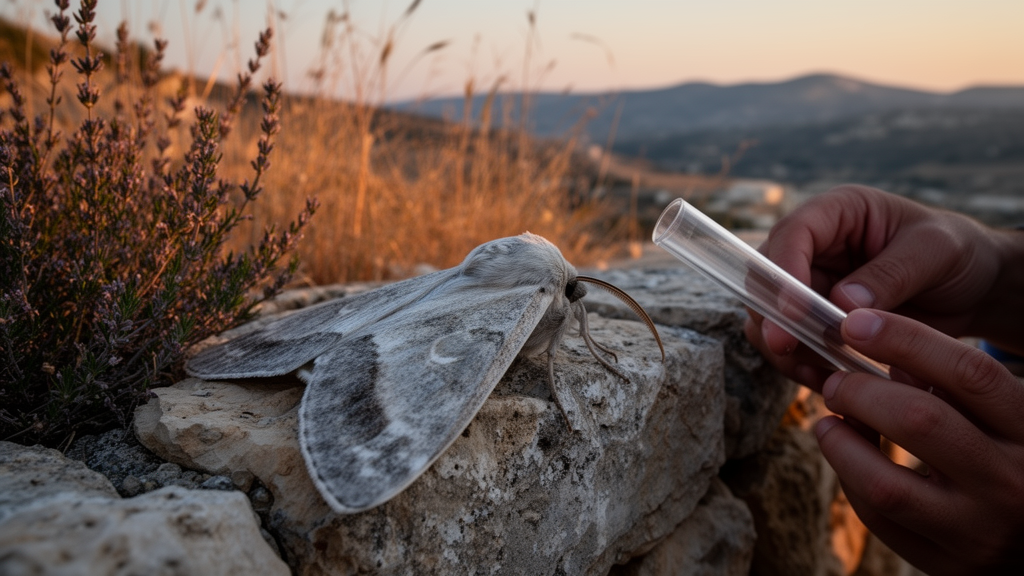
For seventy years, the presence of the Clarina syriaca hawk moth in Cyprus was defined by a single, isolated data point: a lone adult specimen collected in 1950. This solitary record, preserved in the Lepidoptera collection of the Natural History Museum in London, led researchers to classify the species as extremely rare or potentially extinct on the island. However, a recent study published in Nota Lepidopterologica has fundamentally altered this understanding, confirming that the moth not only survives in Cyprus but maintains a breeding population. The rediscovery provides critical insights into the biology of this elusive insect and highlights the role of isolated forest habitats as refugia for relict species in the western Palaearctic region.
The breakthrough occurred in the Paphos Forest, a protected area in central Cyprus known for its dense pine woodlands and scattered riparian zones. In 2020, researchers discovered a dead adult moth in a wine-trap set within a deep valley near the village of Tsakistra. This was the second confirmed adult found on the island in over half a century. The location was significant because it featured a riparian gallery forest, a narrow strip of lush vegetation lining a streambed, which stands in stark contrast to the surrounding dry, cultivated landscapes. This habitat type, dominated by oriental plane trees and alders, creates a microclimate of higher humidity and lower temperatures, conditions that are essential for the survival of this particular moth species.
The confirmation of a breeding population came the following year, in July 2021, when a second-instar larva was found feeding on wild grapevines at the same locality. The researchers successfully reared this larva to adulthood, with the moth emerging from its pupal case on August 18, 2021. This rearing process was crucial for definitive identification, as it allowed scientists to observe the full life cycle and confirm that the specimen was indeed Clarina syriaca. The timing of the larva’s discovery and subsequent emergence aligns with the species’ known bivoltine life cycle, indicating that the population in Cyprus follows the same seasonal patterns observed in southern Turkey and the Levant.
Clarina syriaca is a member of the Sphingidae family, commonly known as hawk moths, and belongs to the subfamily Macroglossinae. Its distribution has historically been centered in the Levant, including Syria, Lebanon, and Israel, extending northward into eastern Turkey. The species is closely related to Clarina kotschyi, which is found further east in Iran and Mesopotamia. Phylogenetic analyses suggest that these two species are sister taxa that diverged during the Pleistocene era. It is hypothesized that C. syriaca evolved in isolation in the Levant and spread north into Turkey after the last ice age, where it came into secondary contact with C. kotschyi. This contact has created a hybrid zone in southeastern Turkey, making taxonomic identification challenging in some regions.
The moth’s dependence on specific host plants is a key factor in its survival. Clarina syriaca relies primarily on Vitis vinifera, the grapevine, for larval development. In Cyprus, the wild ancestral grape, Vitis vinifera subsp. sylvestris, is indigenous to the island and thrives in thickets and wooded ravines with abundant water. This wild subspecies provides the ideal habitat for the moth, as it grows in shaded, humid environments rather than the open, sunny conditions of commercial vineyards. The researchers noted that the moth avoids agricultural vineyards, likely due to the use of pesticides and the lack of suitable microclimatic conditions. Instead, it favors wild or feral grapevines that grow along streambeds and over rocky slopes, where the humidity is higher and the temperature is moderated.
The elusiveness of Clarina syriaca has contributed to its perceived rarity. Unlike many other moth species, adults of C. syriaca are rarely attracted to light traps, a common method used by entomologists to sample nocturnal insects. In studies conducted in southern Turkey, researchers observed that while other hawk moths were drawn to mercury vapor light traps, C. syriaca adults remained hidden. Furthermore, the larvae are highly secretive, often resting stretched out along the midrib of leaves on the lower surface, exposing only their heads when feeding. This behavior, combined with the difficulty of finding eggs, has made the species hard to detect. The misconception of its rarity likely stems from these biological traits rather than an actual decline in population numbers.
The rediscovery in Cyprus underscores the importance of riparian gallery forests as isolated refugia for relict species. These narrow corridors of vegetation, surrounded by drier pine woodlands or cultivated land, act as islands of biodiversity in an otherwise inhospitable matrix. The presence of C. syriaca in these habitats suggests that the species is a monocentric Pleistocene relict, having survived in isolated ravines since the last ice age. The match between the moth’s habitat preferences and the distribution of wild grapevines in Cyprus supports the hypothesis that the two species have co-evolved in these specific microenvironments. This relationship highlights the vulnerability of such relict populations to habitat fragmentation and climate change, which could further isolate these refugia and reduce genetic diversity.
The study also provides detailed morphological descriptions of the different life stages of C. syriaca. Adults have a wingspan of 50 to 65 millimeters, with ground colors ranging from deep reddish-brown to pale grey. There is slight sexual dimorphism, with males being lighter and smaller than females. The larvae are typically sphingiform, with a series of inverted V-marks down the dorsal surface and a pale dorso-lateral line. They develop a brown or purple hue in the fifth instar. The pupa is 30 to 36 millimeters long, with translucent brown wings and dark brown dots marking the veins. These detailed observations are valuable for future taxonomic studies and for distinguishing C. syriaca from its close relative, C. kotschyi, which remains a subject of ongoing research.
Despite the confirmation of a resident population, the distribution of Clarina syriaca in Cyprus remains poorly understood. Only three specimens have been found in over seventy years, which may reflect the local nature of the populations and the difficulty of detection. Further investigations are needed to determine the full extent of the species’ range on the island and to assess the role of riparian forests in maintaining local biodiversity. Additionally, more studies are warranted to clarify the taxonomic status of C. syriaca and C. kotschyi, as previous attempts to hybridize them in captivity have failed, suggesting that they may be distinct species rather than subspecies. The rediscovery of this ghost moth serves as a reminder of the hidden biodiversity that persists in isolated habitats and the need for continued conservation efforts to protect these fragile ecosystems.
Subject of Research: Rediscovery of Clarina syriaca (Lederer, 1855) (Lepidoptera, Sphingidae, Macroglossinae) in Cyprus after 70 years; with notes on its biology and early life history from the Levant
Article Title: Rediscovery of Clarina syriaca (Lederer, 1855) ( Lepidoptera , Sphingidae , Macroglossinae ) in Cyprus after 70 years; with notes on its biology and early life history from the Levant
Article References: Aristophanous, M., Pittaway, A. R., & Aristophanous, A. (2022). Rediscovery of Clarina syriaca (Lederer, 1855) (Lepidoptera, Sphingidae, Macroglossinae) in Cyprus after 70 years; with notes on its biology and early life history from the Levant. Nota Lepidopterologica, 45, 305-314. https://doi.org/10.3897/nl.45.81819
Image Credits: AI Generated
DOI: 10.3897/nl.45.81819
Keywords: Rediscovery, Clarina, syriaca, Lederer, Lepidoptera, Sphingidae, Macroglossinae, Cyprus, years, notes, biology, early
Cite Scienmag News
Margaret Porter. (October 18, 2026). Ghost Hawk Moth Rediscovered in Cyprus After Seven Decades. Scienmag. https://scienmag.com/ghost-hawk-moth-rediscovered-in-cyprus-after-seven-decades/
Margaret Porter. "Ghost Hawk Moth Rediscovered in Cyprus After Seven Decades." Scienmag, 18 October 2026, https://scienmag.com/ghost-hawk-moth-rediscovered-in-cyprus-after-seven-decades/. Accessed 18 October 2026.
Margaret Porter. "Ghost Hawk Moth Rediscovered in Cyprus After Seven Decades." Scienmag. October 18, 2026. https://scienmag.com/ghost-hawk-moth-rediscovered-in-cyprus-after-seven-decades/


