


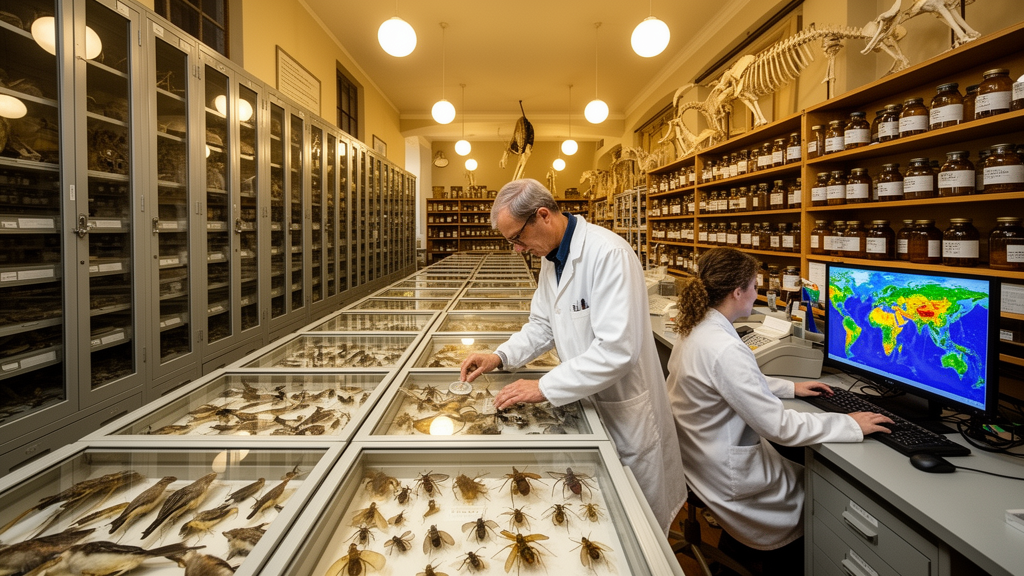
The vast repositories of natural history museums, which house billions of biological records spanning more than three centuries, represent some of the oldest continuously maintained scientific resources on Earth. As climate change and other human-driven transformations impact global biodiversity at an unprecedented speed, these collections are increasingly recognized as critical infrastructure for understanding the cascading effects on human livelihoods. However, the potential value of these collections remains largely untapped in modern research because the sheer scope of the holdings dwarfs current efforts at data mobilization. A new conceptual framework known as collectomics has emerged to address this gap, proposing a holistic approach that integrates all current and future data derived from specimens to tackle complex global challenges. This framework moves beyond traditional digitization efforts, aiming to create a seamless network of multidimensional specimen-based data that bridges the divide between natural sciences and humanities.
Collectomics is a term coined within discussions at the Senckenberg institution to describe digital frameworks that embrace the full spectrum of information available from collection objects. It expands upon the concept of museomics, which originally focused on molecular data generated from museum specimens, by incorporating metadata, images, traits, DNA, and future data types with yet unknown applications. Rooted in the concept of the extended specimen, collectomics connects biological data with environmental data and historical contextual information. This approach envisions the integration of evolutionary, ecosystem, and social sciences, including the human contributions of collectors, donors, and researchers from the past and future. By fostering interoperability among historical, artistic, ethnographic, and natural history collections, collectomics aims to generate the comprehensive knowledge necessary to address planetary-scale issues.
The urgency of this integration is highlighted by the current pace of digitization, which is struggling to keep up with the continuous expansion of global collections. An estimated 3 billion undigitized specimen records exist worldwide, a figure that underscores the magnitude of the challenge. A simple model constructed by researchers illustrates that, at the current rate of progress, global digitization will not be achieved until the late 21st century at the earliest. The model assumes a linear increase in collection objects from the late 1700s to 2020, projecting this growth into the future. In contrast, the growth of digital records, analyzed using data from the Global Biodiversity Information Facility, shows that even in the best-case scenarios, full digitization would not be completed before 2071. If digitization continues at a constant linear rate without acceleration, the gap between physical collections and digital records will actually widen, as collections grow faster than they are digitized.
The disparity between physical collections and digital databases is not merely a technical issue but a fundamental difference in how knowledge is organized and accessed. Physical collections are analogue storage systems with a human-centric organization, where specimens are arranged by systematics or stratigraphy in ways that make sense to people. This arrangement relies on human interpretation and physical space, which limits the feasibility of reorganization and requires material investment. In contrast, databases formalize relationships through predefined rules, allowing for dynamic dissection, cross-referencing, and reassembly. While physical browsing often yields serendipitous information from nearby comparative material, databases enable structured queries across categories, such as extracting all records from a specific geographical location. This difference highlights the need for robust digital infrastructure that can bridge the gap between the tangible evidence of physical specimens and the accessible, queryable nature of digital data.
Artificial intelligence and machine learning are expected to play a pivotal role in accelerating the digitization process and unlocking the full potential of these collections. Rapidly developing applications promise major advances in mobilizing specimen data, including computer-aided species identification and trait recognition. These technologies can help address the limitations of manual cataloguing and metadata creation, although human expertise remains a core requirement for ensuring data quality. The integration of AI with established data standards, such as Darwin Core and ABCD, can enhance the interoperability of biodiversity data, which is currently hindered by the storage of information in different formats and databases. By scaling up mass data retrieval and provisioning, researchers can keep pace with the ongoing growth of collections and capture the significant backlog of undigitized records, ensuring that representative digital coverage is achieved at a global scale.
Once digitized, the data must be linked to other massive species-based information hubs to create an environment for integrated research across temporal and spatial scales. Collectomics describes the multiple ways that voucher specimens can be harnessed for additional datasets and how these data interact synergistically with other research fields. Collections form the core data for biological and geological sciences, and digital information derived from research on collection objects feeds into interconnected research platforms that are accessible to science and society worldwide. The real added value of collection-based data lies not only in large-scale occurrence data over time and space but also in the fact that the information is tied to physical objects that validate the records and provide different dimensions for further study. This includes the potential for drug discovery, identifying emergent diseases, and developing trait-based models to capture the processes and functions of whole ecosystems.
The preservation of physical voucher specimens underpins the replicability of all collections-based research, ensuring that derived data are permanently connected to the original objects. This connection allows for an additive knowledge generation process, where knowledge can be deepened in an effective and structured way. The potential of the extended specimen is increasingly unlocked with rapidly advancing technologies, such as biogeochemical methods, genome sequencing, hyperspectral imaging, and X-ray tomography. Integrating multiple data dimensions of the genome and phenome of the digital extended specimen enables research centered on different levels of organization, from genes and traits to taxa, functions, ecosystems, and the Earth system. This multi-scale approach is crucial for understanding biodiversity dynamics and the consequences of biodiversity loss, bridging geo- and biosciences with social-ecological research.
However, the integration of specimen-based data across collections and disciplines is not without challenges, particularly regarding equity and access. Resources and contextual data are most needed in tropical countries of the Global South, yet the collections that underpin the understanding of global social-ecological systems are mainly located in Europe and North America. This geographic imbalance results in limited visibility and accessibility of information from the countries of origin, where collections are often undigitized and thus invisible to global audiences. In contrast, older collections in the Global North have higher visibility, exacerbating the gap between the two regions. To address this, there is a need for a global network of knowledge hubs that includes the Global South, ensuring that local researchers can study local biodiversity trends and that the contributions of local knowledge holders are recognized. The establishment of global registries and the adoption of FAIR and CARE principles are essential steps toward achieving equitable accessibility for science and society.
The vision of collectomics includes all types of specimen data, linking an object to descriptive metadata, images, sequences, and its history. This includes the historical and cultural context of the people who originally collected the specimen and later researchers who brought new approaches to its analysis. Making collections fully accessible, integrated, and visible to the broadest group of global users is crucial for protecting collections into the future. A fully digitized collections object is not just a species name, an image, and some coordinates, but a rich, complex, and ongoing history. By focusing on the centrality of specimen- and object-based data, collectomics provides a conceptual framework that supports the integration of information across traditional disciplines. This comprehensive picture of Anthropocene Earth as a social-ecological system is essential for developing effective solutions to the global challenges we face today.
Subject of Research: Integration of museum collections through the collectomics framework to address global biodiversity and ecological challenges.
Article Title: Collectomics – towards a new framework to integrate museum collections to address global challenges
Article References: Sigwart, J. D., Schleuning, M., Brandt, A., Pfenninger, M., Saeedi, H., Borsch, T., Häffner, E., Lücking, R., Güntsch, A., Trischler, H., Töpfer, T., Wesche, K., & Consortium, C. (2025). Collectomics – towards a new framework to integrate museum collections to address global challenges. Natural History Collections and Museomics, 2, 1-20. https://doi.org/10.3897/nhcm.2.148855
Image Credits: AI Generated
Keywords: collectomics, museum digitization, biodiversity data, natural history collections, global change, specimen data, FAIR data principles, interdisciplinary research, artificial intelligence, Global South equity, towards, framework
Cite Scienmag News
Margaret Porter. (October 18, 2026). Collectomics: Integrating Museum Data for Global Challenges. Scienmag. https://scienmag.com/collectomics-integrating-museum-data-for-global-challenges/
Margaret Porter. "Collectomics: Integrating Museum Data for Global Challenges." Scienmag, 18 October 2026, https://scienmag.com/collectomics-integrating-museum-data-for-global-challenges/. Accessed 18 October 2026.
Margaret Porter. "Collectomics: Integrating Museum Data for Global Challenges." Scienmag. October 18, 2026. https://scienmag.com/collectomics-integrating-museum-data-for-global-challenges/


