


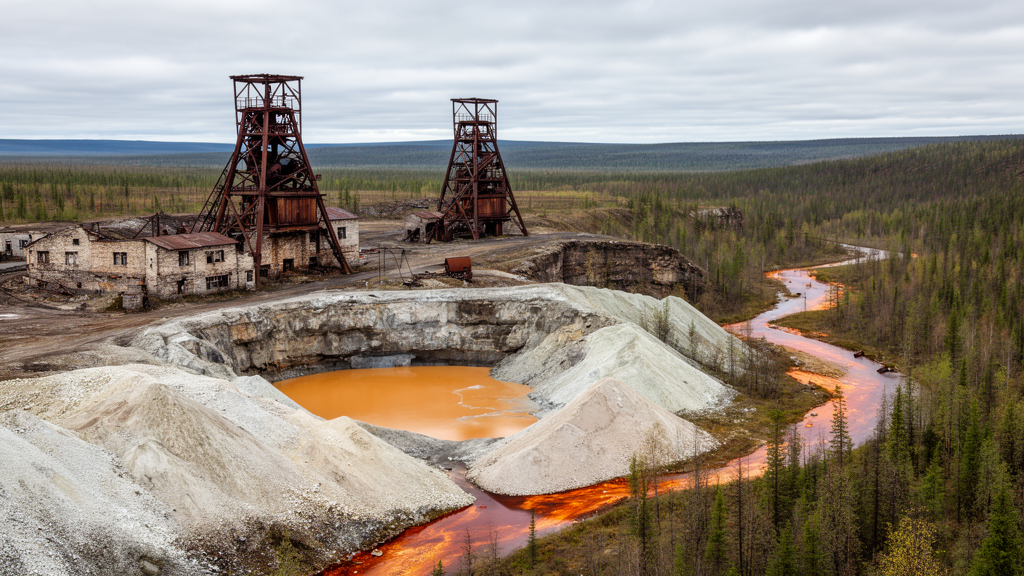
Deep in the mountains of Eastern Transbaikalia, where Russia borders Mongolia and China, abandoned tin and tungsten mines continue to poison water long after the last miners left. A new study published in Environmental Monitoring and Assessment by Larisa P. Chechel and Leonid V. Zamana of the Institute of Natural Resources, Ecology and Cryology, Siberian Branch of the Russian Academy of Sciences, provides one of the most detailed hydrogeochemical portraits yet of what happens to water chemistry when mining infrastructure is simply left behind. Sampling waters at the Dedovogorsk tungsten deposit and the Angatuy tin deposit, the researchers found that drainage from adits, open pits, and tailings storage facilities is polluted severely enough to be classified, under Russian federal criteria, as zones of ecological emergency and ecological disaster.
The scientific significance of the work lies in its ability to separate two overlapping chemical fingerprints in the same waters. The team identified a technogenic association of elements, one whose composition is dictated by mining activity, and a regional association that develops under purely natural conditions. The technogenic signature is dominated by elevated concentrations of cobalt, copper, zinc, and cadmium, while the regional background is characterized by the accumulation of rare earth elements alongside comparatively low heavy metal levels. Distinguishing these two associations matters because it allows regulators and scientists to determine how much of the contamination in any given water sample is attributable to human industry rather than to the geology of the region itself.
Chemically, the waters at both sites are far from the acidic nightmares often associated with abandoned mines. The authors report that the waters are predominantly sodium-calcium bicarbonate and sulfate-bicarbonate types, with total dissolved solids below 200 milligrams per liter and a neutral pH. Trace element concentrations generally range from single-digit values to hundreds of micrograms per liter. That combination of low salinity and near-neutral acidity might sound benign, but the study demonstrates that even modestly mineralized, pH-neutral waters can carry a dangerous cargo of heavy metals when the surrounding rock has been fractured, exposed, and dewatered by decades of mining.
The mechanism behind this quiet contamination is sulfide weathering. Tin and tungsten ores typically occur with accessory sulfide minerals such as pyrite, sphalerite, and galena. When mine workings and waste rock dumps expose these minerals to oxygen and water, they oxidize, releasing sulfate and metals into solution. Previous work cited by the authors, including cross-scale investigations of galena and sphalerite weathering in mine waste rock, has shown that molecular-scale oxidation reactions ultimately control field-scale mobilization of lead, zinc, and cadmium. In Eastern Transbaikalia, the neutral pH suggests that carbonate minerals in the host rock are buffering the acidity that sulfide oxidation generates, but buffering does not remove the dissolved metals; it simply keeps them in a form that travels through groundwater and surface water systems without the dramatic visual cue of orange, acidified runoff.
The sampling design captured the full gradient of mining influence. Water was collected directly from mine workings, including adit drainage that flows out of underground tunnels, from the flooded open pit, and from tailings storage facilities where finely ground ore waste has been deposited. These are the three hotspots where the environmental assessment revealed significant pollution. Because adit drainage represents groundwater that has circulated through fractured ore zones, it integrates the geochemistry of the entire disturbed system. Tailings facilities, meanwhile, present an enormous reactive surface area of crushed sulfide-bearing material, making them persistent sources of metals that can continue releasing contaminants for decades or even centuries after closure.
To translate concentrations into environmental meaning, the researchers compared measured values against Russian regulatory benchmarks, including water quality standards for aquatic objects of fishery importance established by the Ministry of Agriculture and hygienic norms under SanPiN 1.2.3685-21. They then applied the official Criteria for Assessing the Environmental Situation of Territories, approved in 1992 by the Ministry of Environmental Protection and Natural Resources of the Russian Federation, which defines thresholds for classifying territories as zones of ecological emergency or ecological disaster. By these standards, the waters draining from the adits, the open pit, and the tailings facilities crossed the thresholds that place them in the most severe categories of environmental degradation, a formal designation with real implications for land use and remediation priorities.
The rare earth element signal adds an intriguing geochemical dimension to the story. In the regional association, meaning waters shaped by natural processes rather than mining, rare earth elements accumulate while heavy metals remain depleted. This pattern is consistent with long-established observations in groundwater geochemistry, notably the classic work on rare elements in groundwater by S. R. Krainov, which showed that natural waters in certain geological provinces develop characteristic rare earth enrichments. The contrast between the two associations gives the authors a diagnostic tool: a water sample enriched in cobalt, copper, zinc, and cadmium points to mining influence, while one enriched in rare earths with low heavy metals reflects the natural regional background. This kind of fingerprinting is increasingly valuable as agencies worldwide grapple with attributing contamination at legacy mine sites.
Eastern Transbaikalia is no stranger to this problem. The region hosts a long history of rare-metal mining, including tungsten, molybdenum, tin, and tantalum operations, and Chechel’s earlier publications have documented ecological and hydrogeochemical consequences at tungsten and molybdenum deposits and the distribution of rare alkaline elements in mining waters across the area. Earlier studies of the Orlovskoe tantalum deposit and of the Modonkul River, which receives drainage from mining territories in southeastern Transbaikalia, have documented similar patterns of technogenic alteration of water chemistry. The new study extends this body of work by systematically comparing the two association types and by formally classifying the environmental status of the affected waters, connecting site-scale chemistry to the regulatory framework used to declare ecological emergencies.
The findings resonate far beyond Siberia. Abandoned and legacy mines are a global challenge, from the contaminated groundwater documented at historical mine sites in Japan to heavy metal pollution in water and soil around tin mining regions in Hunan Province, China, and arsenic-laden gold mining wastes in Ghana. Acid mine drainage remains one of the most studied and most stubborn environmental problems in the world, and the Transbaikalian case adds an important nuance: significant metal pollution can occur in waters that remain neutral and dilute, meaning that visual inspection or simple pH measurements are not sufficient to assess risk. Monitoring programs that focus only on acidity may dramatically underestimate the metal load reaching rivers, fishery waters, and drinking water supplies downstream of abandoned deposits.
For remediation planners, the study’s identification of the three most polluted water types, adit drainage, open-pit water, and tailings facility water, offers a practical roadmap. These are the points where intervention, whether through passive treatment systems, covering and isolation of tailings, or controlled drainage collection, would yield the greatest environmental return. The work was completed under a Russian state assignment focused on geoecological assessment of geosystem transformation in Transbaikalia under modern climate and technogenesis, reflecting a growing recognition that legacy mining landscapes must be understood quantitatively before they can be restored. As demand for tin and tungsten, both critical metals for modern electronics and technology, continues to drive new mining worldwide, the waters of Eastern Transbaikalia stand as a sobering reminder of what unmanaged mine closure leaves behind.
Subject of Research: Hydrogeochemical assessment of water pollution from abandoned tin-tungsten mines in Eastern Transbaikalia, Russia
Article Title: Environmental impact of tin-tungsten deposits mining (Eastern Transbaikalia, Russia)
Article References: Chechel, L. P., & Zamana, L. V. (2026). Environmental impact of tin-tungsten deposits mining (Eastern Transbaikalia, Russia). Environmental Monitoring and Assessment, 198(9), Article 1029. https://doi.org/10.1007/s10661-026-15764-6
Image Credits: AI Generated
DOI: 10.1007/s10661-026-15764-6
Keywords: abandoned mines, tin mining, tungsten mining, Eastern Transbaikalia, heavy metals, rare earth elements, acid mine drainage, tailings, water quality, hydrogeochemistry, ecological emergency, sulfide weathering
Cite Scienmag News
Violet Maxwell. (October 18, 2026). Abandoned Tin-Tungsten Mines in Russia Push Waters Into Ecological Emergency. Scienmag. https://scienmag.com/abandoned-tin-tungsten-mines-in-russia-push-waters-into-ecological-emergency/
Violet Maxwell. "Abandoned Tin-Tungsten Mines in Russia Push Waters Into Ecological Emergency." Scienmag, 18 October 2026, https://scienmag.com/abandoned-tin-tungsten-mines-in-russia-push-waters-into-ecological-emergency/. Accessed 18 October 2026.
Violet Maxwell. "Abandoned Tin-Tungsten Mines in Russia Push Waters Into Ecological Emergency." Scienmag. October 18, 2026. https://scienmag.com/abandoned-tin-tungsten-mines-in-russia-push-waters-into-ecological-emergency/


