


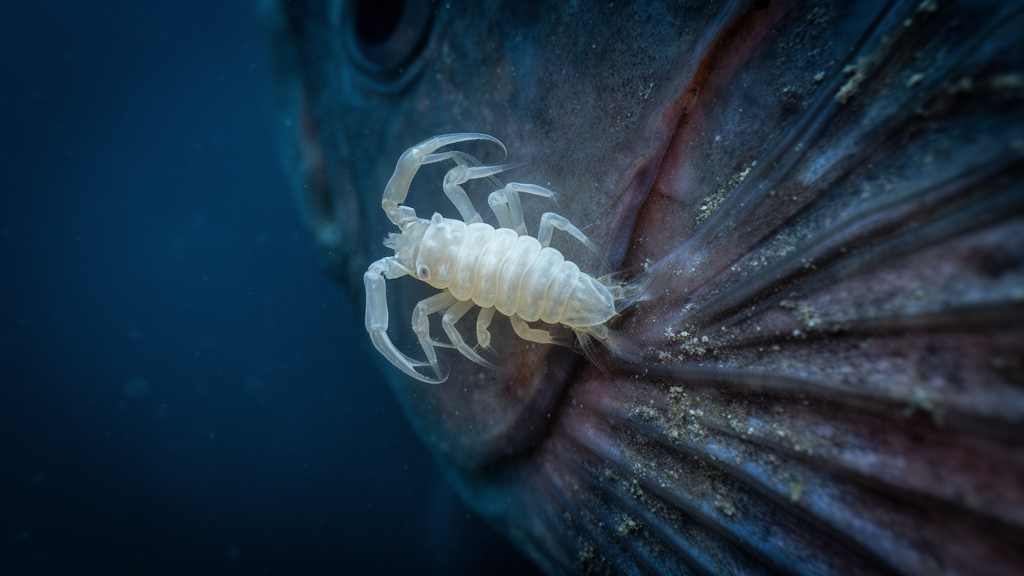
Deep in the cold waters off the Chilean coast, at depths between 1,000 and 2,200 meters, a small parasitic copepod has been quietly clinging to the gills of the bigeye grenadier, Macrourus holotrachys. For decades, specimens like these were assumed to belong to a well-known species called Clavella adunca, a parasite recorded from dozens of fish hosts across the world’s oceans. A new study combining detailed morphology with DNA sequencing has now overturned that assumption, revealing that the parasite is not only a new species but an entirely new genus, named Neoclavella holotrachia, described in the journal ZooKeys.
The discovery emerged from an unusual sampling opportunity. During 2015, researchers obtained 30 specimens of the bigeye grenadier as by-catch from the Patagonian toothfish fishery operating off northern and central Chile. The fish were frozen on board at minus 18 degrees Celsius and transported to the parasitological laboratory at the University of Antofagasta, where they were thawed and examined for parasitic copepods. The recovered parasites were fixed in 96 percent ethanol, preserving them for both morphological study and molecular analysis. In total, 16 of the 30 fish carried the new parasite, a prevalence of 53.3 percent, with a mean intensity of 3.7 parasites per infected host.
Under the microscope, the specimens showed the classic Clavella-like body plan of lernaeopodid copepods: a cylindrical cephalothorax slightly longer than the trunk, a pyriform trunk bearing a subrectangular genital process, and fused maxillae ending in a cup-shaped bulla, the anchor-like structure these parasites use to fasten themselves to their host’s gills. But several features did not match any known species. Most striking was the antenna. In Clavella adunca, the antenna is uniramous, meaning it has a single branch, with the exopod reduced or absent. In the Chilean specimens, the antenna is biramous, with both the endopod and exopod well developed and oriented perpendicular to the basal segment, the sympod.
That single character, the biramous antenna, has proven to be a critical dividing line within the Clavella branch of the family Lernaeopodidae. Recent revisions of the group have already moved species with biramous antennae out of Clavella and into the genera Praeclavella and Maxiclavella. The new genus adds a further twist: in Praeclavella and Maxiclavella, both antennal rami are aligned with the sympod, whereas in Neoclavella they stand perpendicular to it. Additional differences reinforce the split. The antennule of the new species lacks the terminal whip found in C. adunca, its armature elements are shorter and more widely spaced, the mandible lacks secondary teeth, the maxillule bears two setae instead of three, and the maxilliped carries a prominent convex projection armed with a row of denticles rather than a small denticulate pad.
Body proportions tell a similar story. The trunk of Neoclavella holotrachia reaches a maximum length of about 3,590 micrometers, roughly half the 7,000 micrometers recorded for C. adunca, and its shape is oval to oblong and narrowed toward the front rather than subquadrate. The dorsal shield is narrower, the cephalothorax is longer relative to the trunk, and the maxillae are of medium size rather than very short. Taken together, these traits separate the new species from C. adunca on every appendage and body region that taxonomists traditionally use to delimit lernaeopodid genera.
Molecular evidence independently confirmed the morphological case. The team amplified and sequenced two markers: the 28S ribosomal DNA gene, useful for resolving relationships among related species, and the mitochondrial cytochrome c oxidase subunit I gene, or COI, a standard barcode marker for delimiting species of parasitic copepods. Two 28S sequences of 699 and 703 base pairs were obtained for the new species, along with one 677-base-pair sequence from Clavellomimus macruri, a second lernaeopodid also recovered from the same fish. Bayesian phylogenetic analysis placed Neoclavella in a strongly supported clade with Maxiclavella simplex, an unidentified lernaeopodid, and C. adunca, with C. adunca emerging as the sister genus of the new taxon.
The genetic distances were decisive. Based on 28S rDNA, Neoclavella holotrachia differs from C. adunca by 4.1 to 4.7 percent, equivalent to 15 to 24 nucleotide differences, and from the unidentified lernaeopodid by 6.2 to 6.8 percent. On the faster-evolving COI marker, the divergence between the new genus and C. adunca reaches 18.0 to 18.2 percent, and 17.3 to 18.2 percent from another species, Clavella perfida. Distances of this magnitude between genera are consistent with patterns reported previously within the Clavella and Brachiella branches, supporting the establishment of a new genus rather than a new species within an existing one. Interestingly, Clavellomimus macruri, the other parasite found on the bigeye grenadier, showed much larger divergences from its closest relatives in the analysis, around 15 percent on 28S rDNA, though the corresponding nodes in the phylogeny were only weakly supported.
The findings carry broader implications for how scientists interpret one of the most widely reported parasitic copepods in the sea. Clavella adunca has a long and tangled taxonomic history, with numerous synonyms and records spanning multiple fish families, from cod and pollock in the North Atlantic to grenadiers in the Southern Ocean. The authors argue that many of these records are likely misidentifications, because distinguishing species requires careful examination of appendages such as the antenna and antennule, features that earlier descriptions often omitted or misinterpreted. As a concrete example, specimens previously reported from the Antarctic fishes Trematomus loennbergi and Macrourus whitsoni showed differences in mandibular dentition and trunk shape that cannot be explained by ordinary intraspecific variation.
For the bigeye grenadier specifically, the study raises two possibilities: either the fish was never truly host to C. adunca and previous reports were wrong, or it hosts both C. adunca and the new species side by side. Coexistence of two lernaeopodid species on a single host is well documented elsewhere, with pairs of Praeclavella species sharing the grenadier Nezumia pulchella and two different genera parasitizing the macrourid Coryphaenoides marginatus. Resolving which scenario applies will require additional material from other localities and hosts.
Beyond the taxonomy, the work illustrates how molecular tools are reshaping our understanding of deep-sea biodiversity, where sampling is difficult and specimens are often poorly preserved for genetic work. The type specimens have been deposited in the Museo Nacional de Historia Natural in Santiago, Chile, and the new DNA sequences are available in GenBank, giving future researchers the reference material needed to re-evaluate old records. As deep-sea fisheries continue to bring rare fish to the surface as by-catch, each haul may carry undiscovered parasites, and each new parasite may force a rewrite of what scientists thought they knew about species that have been on the books for more than 250 years.
Subject of Research: A new genus of lernaeopodid copepod parasite from deep-sea fish in the southeastern Pacific Ocean
Article Title: A new lernaeopodid genus ( Copepoda , Siphonostomatoida ) parasitizing Macrourus holotrachys ( Gadiformes ) from deep waters in the southeastern Pacific Ocean, based on molecular and morphological analyses
Article References: Castro-Romero, R., Montes, M. M., Ñacari, L. A., Sepulveda, F., & Oliva, M. E. (2026). A new lernaeopodid genus (Copepoda, Siphonostomatoida) parasitizing Macrourus holotrachys (Gadiformes) from deep waters in the southeastern Pacific Ocean, based on molecular and morphological analyses. ZooKeys, 1291, 171-194. https://doi.org/10.3897/zookeys.1291.195637
Image Credits: AI Generated
DOI: 10.3897/zookeys.1291.195637
Keywords: copepods, Lernaeopodidae, Neoclavella holotrachia, Macrourus holotrachys, deep-sea parasites, Chile, taxonomy, DNA barcoding, 28S rDNA, COI mtDNA, Clavella adunca, marine parasitology
Cite Scienmag News
Drew Townsend. (October 18, 2026). Deep-Sea Parasite Revealed as New Genus After Molecular and Morphological Analysis. Scienmag. https://scienmag.com/deep-sea-parasite-revealed-as-new-genus-after-molecular-and-morphological-analysis/
Drew Townsend. "Deep-Sea Parasite Revealed as New Genus After Molecular and Morphological Analysis." Scienmag, 18 October 2026, https://scienmag.com/deep-sea-parasite-revealed-as-new-genus-after-molecular-and-morphological-analysis/. Accessed 18 October 2026.
Drew Townsend. "Deep-Sea Parasite Revealed as New Genus After Molecular and Morphological Analysis." Scienmag. October 18, 2026. https://scienmag.com/deep-sea-parasite-revealed-as-new-genus-after-molecular-and-morphological-analysis/


