


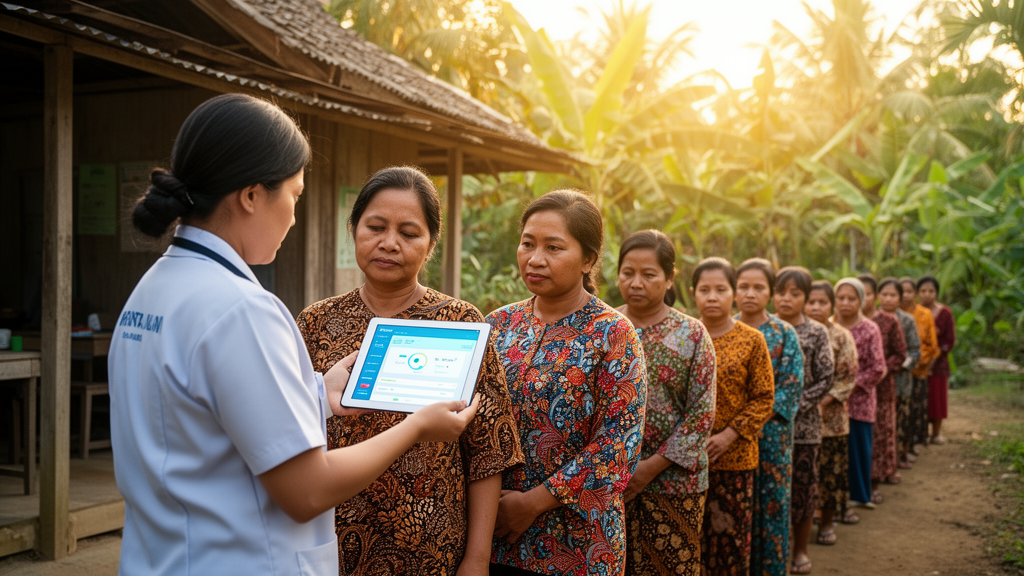
The scale of the dataset described in the study places Indonesia’s effort among the largest routine digital screening programmes documented to date in a low- or middle-income country. Between January 2023 and April 2024, the analysis captured more than 116 million screening visits covering over 75.8 million individuals, with reporting from 10,131 primary healthcare centres spanning all 38 provinces. For context, Indonesia’s population exceeds 270 million people spread across thousands of islands, which means that reaching three-quarters of that population with at least one recorded screening encounter within roughly sixteen months represents a logistical achievement that few national health systems have attempted, let alone documented in the peer-reviewed literature. The sheer volume of records also means that the findings are not drawn from a pilot site or a convenience sample but from the operational data of an entire national programme running in real time.
A central technical feature of the programme is the layering of three digital systems. Aplikasi Sehat IndonesiaKu, the mobile application through which screening encounters are recorded, sits alongside SATUSEHAT, the national digital health platform designed to serve as an interoperability backbone, and the legacy Sistem Informasi Penyakit Tidak Menular reporting system that preceded it. This architecture matters because fragmented health information systems have long been a barrier to population-scale non-communicable disease monitoring. When screening, clinical care, and reporting occur in disconnected silos, health authorities cannot easily track who has been screened, what was found, or whether follow-up occurred. By integrating these layers, Indonesia has created a pathway through which a blood pressure measurement taken in a village posyandu or a community health post can, in principle, contribute to a national picture of disease burden without manual re-entry or reconciliation.
The choice of which measurements to prioritise reveals much about how such programmes evolve. The study found that blood pressure and anthropometric measurements, such as height, weight, and waist circumference, were recorded substantially more often than cholesterol testing or cancer screening. This gradient is not surprising when the resource requirements of each test are considered. Blood pressure measurement requires only a sphygmomanometer and a trained operator, both of which are widely available in Indonesian primary care. Anthropometry requires even less. Cholesterol testing, by contrast, requires point-of-care lipid analysers, consumable test strips, and quality control procedures, while cancer screening demands specialised equipment, laboratory capacity, and referral pathways that many primary health centres lack. The data therefore function as a mirror of service readiness: the distribution of recorded measurements reflects what facilities are actually equipped and staffed to deliver, not merely what guidelines recommend.
The headline clinical findings give a snapshot of the non-communicable disease burden among screened individuals. Among participants with the relevant measurements, 27.98 percent met the screening definition for hypertension, 19.28 percent for obesity, and 32.18 percent for central obesity. These figures align with patterns previously reported in smaller Indonesian surveys and regional studies, which have documented rising hypertension prevalence and expanding waistlines associated with dietary transition and declining physical activity. Central obesity, measured through waist circumference, is particularly significant because abdominal adiposity is a stronger predictor of cardiometabolic risk than body mass index alone in many Asian populations. A screening definition threshold of nearly one in three participants flagged for central obesity underscores why population-level monitoring, rather than opportunistic clinical detection alone, has become a priority for the health ministry.
It is important to interpret these prevalence figures with care. They describe the proportion of screened individuals who met screening definitions, not necessarily the prevalence in the general population. People who come forward for screening may differ systematically from those who do not, in age, health awareness, access to facilities, or symptom status. The study itself notes that screening volume varied markedly across provinces and that recorded outcomes differed by age and sex, which signals uneven participation and potentially uneven case ascertainment. Provinces with denser health infrastructure and higher digital connectivity may contribute disproportionately to the record pool, while remote and underserved areas may be underrepresented. This is a familiar challenge in routine data-based epidemiology, and it is one reason the authors emphasise that equitable implementation depends on workforce, equipment, and service readiness rather than on digital infrastructure alone.
The age and sex differences in recorded outcomes carry practical implications for programme design. Hypertension and central obesity accumulate with age, so older participants would be expected to show higher proportions meeting screening definitions, and the data confirm such gradients. Sex differences may reflect both biological factors and differences in screening uptake, since in many Indonesian community settings women participate in health activities at higher rates than men, partly because maternal and child health services have historically served as entry points into the primary care system. Understanding these patterns allows programme managers to target outreach, for example by designing screening opportunities that reach working-age men who rarely visit health facilities, and to anticipate where the downstream burden of confirmatory testing and treatment will fall.
The distinction between screening and diagnosis is worth underscoring for readers unfamiliar with population health programmes. A screening definition for hypertension, typically based on recorded blood pressure readings above a threshold, identifies individuals who require confirmatory assessment and, if diagnosis is confirmed, ongoing management. Screening programmes generate a cascade of follow-up needs: confirmatory measurements, laboratory tests, clinical assessment, initiation of treatment, and long-term adherence support. Each step in that cascade is a point where people can be lost. The value of a digital system is that it makes the cascade visible, at least in principle, by recording who was flagged and enabling tracking of what happened next. Whether Indonesia’s system can close the loop from detection to controlled disease remains a critical question for subsequent evaluation.
The study’s publication in an open-access format, with supplementary materials detailing the screening data and criteria, a reporting summary, and a transparent peer review file, reflects a broader movement toward accountability in global health research. Making the operational criteria publicly available allows other countries contemplating similar programmes to examine exactly what was measured, how thresholds were applied, and how data flowed through the system. This matters because digital health implementations are often described only in high-level terms, leaving implementers elsewhere to guess at the practical details. The transparency here, including disclosure that several authors were affiliated with the Ministry of Health and contributed to the programme’s development and management, provides a model for how government-led digital health research can be documented while acknowledging the professional roles involved.
The funding landscape behind the analysis also illustrates the increasingly international character of digital health research. Support came from a national science and technology major project on non-communicable chronic diseases, a national key research and development programme, and a natural science foundation, alongside university-level cross-disciplinary funding, with the analysis team including collaborators based in Shanghai and at international research institutions. Collaborations of this kind bring analytical capacity and methodological expertise that may not be available domestically in the early stages of a programme, while the operational knowledge remains anchored in the ministry and its primary care workforce. The stated independence of the funding bodies from study design, data collection, and analysis decisions is a standard but important safeguard in such arrangements.
Placed in global context, Indonesia’s experience speaks directly to the strategic dilemma facing many low- and middle-income countries. Non-communicable diseases now account for the majority of deaths worldwide, and their modifiable risk factors, elevated blood pressure, overweight, harmful use of alcohol, tobacco use, and physical inactivity, are best addressed through population-wide approaches rather than clinic-based care alone. Yet the classic tools of population screening, paper registers and periodic surveys, are slow, expensive, and quickly outdated. Digital screening embedded in routine primary care offers a way to generate continuous, granular surveillance data at marginal additional cost, since the data are a by-product of service delivery. Indonesia’s demonstration that this can operate at the scale of tens of millions of visits provides an existence proof that other large, geographically dispersed health systems may find instructive.
At the same time, the study’s caveats about equity deserve emphasis. Digital infrastructure is a necessary but not sufficient condition for equitable screening. A health centre may be connected to the national platform yet lack a functioning blood pressure device, a trained nurse, or adequate community outreach, and in such settings the digital record will simply document absence of service. Conversely, well-resourced facilities may generate dense records that dominate the national dataset. The authors’ framing, that interoperable digital infrastructure can support population-scale monitoring but that equitable implementation also depends on workforce, equipment, and service readiness, is a measured conclusion that resists technological determinism. It suggests that the next phase of evaluation should examine not only what the platform records but where the gaps in recording correspond to gaps in actual service provision.
Finally, the timeline of the research illustrates the pace at which national digital health evidence is now being produced and reviewed. The manuscript was received in late March 2026, accepted in September, and published in October, drawing on data collected over the preceding sixteen months. This rapid cycle, from live programme operation to peer-reviewed national analysis, was largely unthinkable in the era of paper-based reporting, where national datasets might take years to compile and clean. The study is also published as an early version subject to further edits, a practice that trades some editorial polish for speed of access. For policymakers in Indonesia and beyond, the practical takeaway is that digital screening systems can shorten the feedback loop between programme implementation and evidence, enabling course corrections on the basis of data rather than anecdote, provided that the analytical capacity to interpret the incoming stream of records keeps pace with the data collection itself.
Subject of Research: Nationwide implementation of digital non-communicable diseases screening in Indonesia’s primary care system
Article Title: Nationwide implementation of digital non-communicable diseases screening in Indonesia’s primary care system
Article References: Aisyah, D. N., Setiawan, A. H., Faradiba, N., Lokopessy, A. F., Hamid, N. A., Jonathan, W., Ratih, T. S. D., Kozlakidis, Z., Cheong, I. H., & Wang, H. (2026). Nationwide implementation of digital non-communicable diseases screening in Indonesia’s primary care system. Nature Communications. https://doi.org/10.1038/s41467-026-78301-6
Image Credits: AI Generated
DOI: 10.1038/s41467-026-78301-6
Keywords: Nationwide, implementation, digital, non-communicable, diseases, screening, Indonesia, primary, care, system, scientific research
Cite Scienmag News
Ophelia Keating. (October 18, 2026). Indonesia’s digital health screening reaches 75 million people. Scienmag. https://scienmag.com/indonesias-digital-health-screening-reaches-75-million-people/
Ophelia Keating. "Indonesia’s digital health screening reaches 75 million people." Scienmag, 18 October 2026, https://scienmag.com/indonesias-digital-health-screening-reaches-75-million-people/. Accessed 18 October 2026.
Ophelia Keating. "Indonesia’s digital health screening reaches 75 million people." Scienmag. October 18, 2026. https://scienmag.com/indonesias-digital-health-screening-reaches-75-million-people/


