


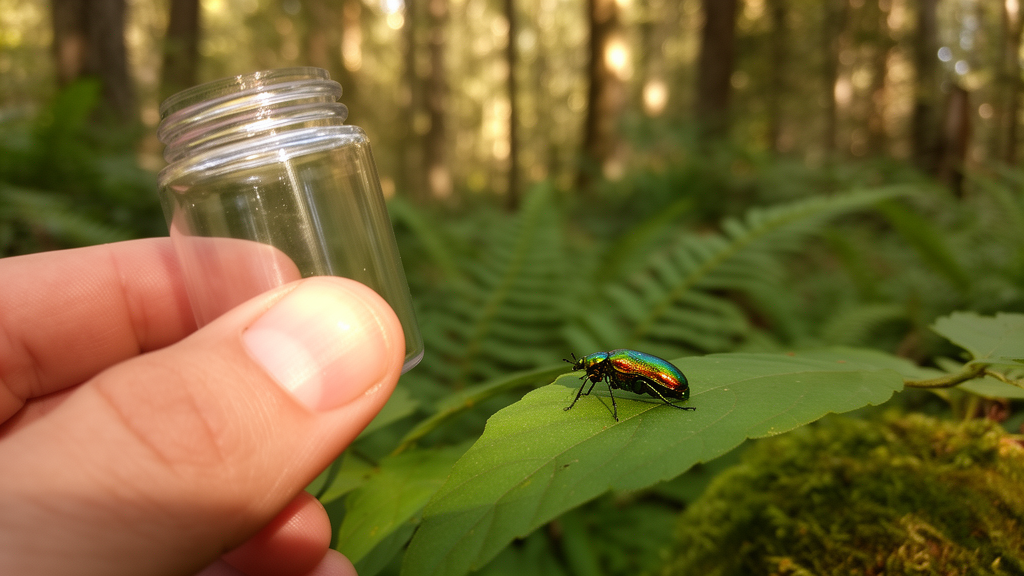
Entomologists have confirmed the presence of a rare cicada-parasitising beetle in Georgia for the first time, adding both a new species and an entirely new beetle family to the country’s known fauna. The species, Arrhaphipterus schelkownikoffi Reitter, 1893, belongs to the family Rhipiceridae, a group of wedge-shaped beetles whose members are among the most secretive and seldom collected insects in the Western Palearctic. The discovery, published in the journal Caucasiana, was made by Polish researchers working in collaboration with Georgian institutions during a series of expeditions to the arid landscapes of south-eastern Georgia.
The first specimens were caught almost entirely by accident. Polish entomologists from the Upper Silesian Museum in Bytom, the Poznań University of Life Sciences, the Polish Entomological Society, and the Silesian Entomological Society, cooperating with the Institute of Entomology at the Agricultural University of Georgia, had been running light traps and UV lamps at several protected areas in the Kakheti region. In recent years, a total of 22 specimens of A. schelkownikoffi have been collected in south-eastern Georgia, with records spanning from 2015 to 2023.
Most of the trapping sites lie within Vashlovani National Park, a mosaic of deserts, semi-deserts, steppes, and forest steppes crossed by river valleys where alluvial forests and luxuriant herbaceous vegetation flourish. Specimens were taken at the park’s visitor centre, at Mijniskure, and in the Pantishara canyon, at elevations ranging from 100 to 392 metres above sea level. Additional individuals were caught in Chachuna National Park. Trapping methods varied between UV traps, light and netting traps, and simple night-time UV lamp sessions, suggesting that the beetles are mainly active at dusk and after dark.
Arrhaphipterus schelkownikoffi was originally described in 1893 by the renowned coleopterist Edmund Reitter on the basis of a series of specimens collected by A. Schelkownikoff on Tamarix perennials on the Jewlach steppes near Elisabethpol, the present-day Gandja in Azerbaijan. Until now, the species was known from Azerbaijan, Armenia, Turkey, Turkmenistan, and Iran. The Azerbaijani localities where Reitter’s type series was collected lie no more than 50 to 60 kilometres from the Georgian border, so the researchers note that it was merely a question of time before the beetle was also found in Georgia.
According to the Catalogue of Palaearctic Coleoptera, the genus Arrhaphipterus, which has a Western Palearctic distribution encompassing south-eastern Europe, the Middle East, and North Africa, contains eight species. It has long been questioned, however, whether two of these, A. larclausei and A. dioni, are in fact separate species, with doubts raised as far back as 1914 and repeated by multiple later authors. All species of the genus are extremely rare, leading secretive lifestyles and usually being trapped only incidentally, either during the day or at night.
Remarkably little is known about the biology of these beetles. To date, there is no knowledge of their younger developmental stages, and what little is known relates only to the localities where adult imagoes were trapped. The natural history of A. schelkownikoffi itself is unknown. But by comparison with a related species studied in China, the researchers consider it not improbable that the larvae could be ectoparasites of cicada larvae, a lifestyle documented for other rhipicerids. This hypothesis is further suggested by the Georgian localities, where cicadas are abundant.
The new paper provides detailed photographs of the male and female habitus, the male genitalia, and the terminal segments of the male abdomen, images that have hardly been available before, appearing only in Jacobson’s catalogue from 1913 and on the Atlas of Beetles of Russia website. An important diagnostic character of the genus is the shape of the empodium, the structure between the claws of the tarsus, which in A. schelkownikoffi characteristically ends in two small protuberances, each armed with a few long bristles.
The fact that the team trapped fourteen specimens at a number of different localities suggests that A. schelkownikoffi is not as rare on the steppe and semi-desert areas of Georgia and Azerbaijan as at first thought. A female photographed in Dagestan, Russia, measuring 19.5 millimetres, indicates that the species is also the most widely distributed member of the genus. As in the case of the related A. larclausei, the apparent rarity of A. schelkownikoffi can probably be put down to several factors: low numbers and scattered populations; poor detectability because of the adult’s mainly crepuscular and nocturnal activity; a phenology and habitat not conducive to wide-ranging coleopterological studies; and an unknown life cycle, habits, and larval developmental stages.
Georgia has become a favoured destination for entomological research expeditions in recent times, and the new record underlines how much remains to be discovered in the country’s semi-arid south-east. The finding brings the number of beetle families recorded in Georgia higher and highlights the value of systematic light-trapping surveys in little-studied habitats. For a beetle whose larvae may turn out to be parasites of cicadas, and whose adults vanish between traps, the semi-deserts of the Caucasus may yet hold further surprises for the entomologists willing to spend their nights beside a UV lamp.
Subject of Research: First record of the rare rhipicerid beetle Arrhaphipterus schelkownikoffi in Georgia
Article Title: A new species and family of beetle for Georgia (Sakartvelo): Arrhaphipterus schelkownikoffi Reitter, 1893 ( Coleoptera : Rhipiceridae )
Article References: Greń, C., Dobosz, R., Bunalski, M., Lasoń, A., Lubecki, K., Wąsala, R., & Japoshvili, G. (2023). A new species and family of beetle for Georgia (Sakartvelo): Arrhaphipterus schelkownikoffi Reitter, 1893 (Coleoptera: Rhipiceridae). Caucasiana, 2, 165-169. https://doi.org/10.3897/caucasiana.2.e110290
Image Credits: AI Generated
DOI: 10.3897/caucasiana.2.e110290
Keywords: Arrhaphipterus schelkownikoffi, Rhipiceridae, Coleoptera, Georgia, Vashlovani National Park, Chachuna National Park, beetle fauna, cicada parasites, UV light trapping, Caucasus entomology, new family record, semi-desert habitats
Cite Scienmag News
Margaret Porter. (October 18, 2026). Beetle family recorded in Georgia for the first time. Scienmag. https://scienmag.com/beetle-family-recorded-in-georgia-for-the-first-time/
Margaret Porter. "Beetle family recorded in Georgia for the first time." Scienmag, 18 October 2026, https://scienmag.com/beetle-family-recorded-in-georgia-for-the-first-time/. Accessed 18 October 2026.
Margaret Porter. "Beetle family recorded in Georgia for the first time." Scienmag. October 18, 2026. https://scienmag.com/beetle-family-recorded-in-georgia-for-the-first-time/


