


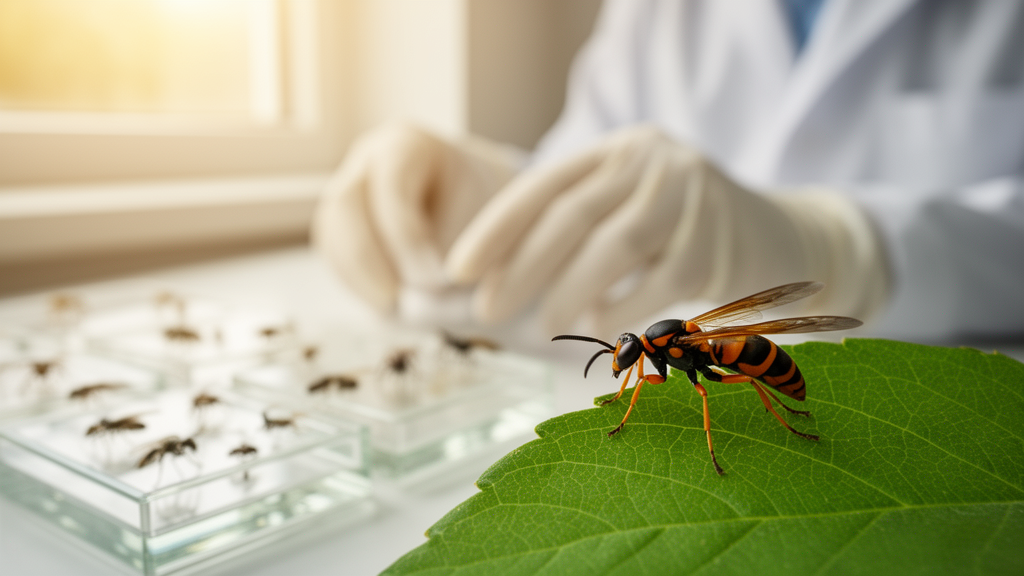
Deep inside the developing eggs of a group of insects that most people have never heard of, a Russian researcher has been counting chromosomes — and the numbers he found are rewriting what we know about one of the largest sawfly genera on Earth. The genus Arge Schrank, 1802 belongs to the family Argidae, the second largest group among sawflies (Symphyta), and currently includes more than 400 described species, with about 180 members occurring in the Palaearctic. Yet despite this impressive diversity, chromosomal data for the entire family were known only for ten Arge species before this study. Now, a new paper published in Comparative Cytogenetics reviews the chromosomes of 12 sawfly species of the genus Arge, including new data on the karyotypes of A. ciliaris (Linnaeus, 1767) and A. enodis (Linnaeus, 1767), both with a haploid chromosome number of n = 10. Moreover, the same chromosome number was unexpectedly found in A. ustulata (Linnaeus, 1758), for which n = 8 was previously reported, while n = 8 was confirmed in A. gracilicornis (Klug, 1814). The results are discussed in the light of phylogeny and taxonomy of these insects.
The study was carried out by Vladimir E. Gokhman of the Zoological Museum of Moscow State University, who collected adult female sawflies in the wild, mostly on the flowers of umbelliferous plants (Apiaceae) in Ozhigovo, Moscow, Russia (55°28’N, 36°52’E) in 2022–2023. The sawflies were initially identified by the author, and the identifications were then checked by Sergey A. Basov of the Zoological Institute, Russian Academy of Sciences, St. Petersburg. Voucher specimens are deposited in the collection of the Zoological Museum of Moscow State University.
Chromosomal preparations were obtained from embryos forming inside the developing eggs, generally following the protocols used by Naito (1982) and Imai et al. (1988) with a few modifications. Specifically, mature eggs were extracted from adult females and put inside small Petri dishes on a filter paper soaked with distilled water. These eggs were kept for about three days at room temperature, during which time sawfly embryos developed inside them. These embryos were first dissected in 0.5% hypotonic sodium citrate solution containing 0.005% colchicine, and then transferred to a fresh portion of hypotonic solution and incubated for 30 minutes at room temperature. After that, the material was transferred onto a pre-cleaned microscope slide using a Pasteur pipette and then gently flushed with Fixative I (glacial acetic acid: absolute ethanol: distilled water 3:3:4). The tissues were disrupted using dissecting needles in an additional drop of Fixative I. Another drop of Fixative II (glacial acetic acid: absolute ethanol 1:1) was applied to the center of the area, and the more aqueous phase was blotted off the edges of the slide. The same procedure was then performed with Fixative III (glacial acetic acid). The slides were dried for approximately half an hour and stored at room temperature, and the preparations were stained overnight with a freshly prepared 3% Giemsa solution.
Haploid mitotic divisions were studied and photographed using an optic microscope Zeiss Axioskop 40 FL fitted with a digital camera Axiocam 208 color (Carl Zeiss, Germany). To produce illustrations, the resulting images were handled with image processing programs ZEN version 3.0 (blue edition) and GIMP version 2.10. Chromosomes were measured on ten metaphase plates of all studied species using KaryoType software version 2.0 and then classified according to the guidelines provided by Levan et al. (1964), i.e., as metacentrics (M), submetacentrics (SM), subtelocentrics (ST) and acrocentrics (A).
The results reveal considerable karyotypic diversity within the genus. In A. gracilicornis (n = 8), seventeen embryos obtained from four females were examined. Most chromosomes are metacentric/submetacentric, but the shortest one is an acrocentric. The first chromosome is very large, about twice as long as the second one, which is, in turn, more than twice as long as the last acrocentric. All chromosomes, except the largest and the smallest, form a continuous gradation in length. In A. enodis (n = 10), two embryos obtained from a single female were examined. All chromosomes are obviously biarmed, either metacentric or submetacentric. However, unlike the karyotype of the previous species, the length of the first chromosome only slightly exceeds that of the second one, and the remaining chromosomes gradually decrease in size.
In A. ciliaris (n = 10), ten embryos, also obtained from a single female, were examined. As in the previous species, all chromosomes are clearly biarmed, either metacentric or submetacentric. Similarly to A. gracilicornis, the first chromosome is very large, about four times longer than the last one. In turn, the second chromosome is approximately 1.8 times shorter than the preceding one, with all other elements more or less gradually decreasing in length. On most metaphase plates, a secondary constriction can be clearly seen in the pericentromeric region of the longer arm of the second chromosome. In A. ustulata (n = 10), seven embryos obtained from four females were studied. The karyotype generally resembles that of A. ciliaris. As in the previous species, most chromosomes, except for the first and second ones, form a continuous gradation in size, but the fifth chromosome is visibly longer than the remaining elements.
Up to now, karyotypes of 12 members of the genus Arge have been studied. In these sawflies, haploid chromosome numbers of n = 8, 10, 11 and 13 were found. Among these species, n = 8 appeared to be the most frequent chromosome number, followed by n = 10. Within chromosome sets of Arge species, metacentrics and submetacentrics usually predominate, although most members of the genus with the same n values differ by their karyotype structure. For example, n = 10 is characteristic of both A. ciliaris and A. enodis, but the chromosome set of the former species contains a very large metacentric, which is absent from the karyotype of A. enodis. Analogously, A. gracilicornis and A. nigronodosa both have chromosome sets with n = 8, again with a large first metacentric, but the second metacentric/submetacentric chromosome of the latter species is substantially longer than that of A. gracilicornis.
Moreover, Westendorff and Taeger (2002) identified the last chromosome of A. gracilicornis as a subtelocentric, which can also be clearly seen on their figure, but a shorter arm of an analogous acrocentric chromosome of apparently the same species is not visible in the present study. However, it is unclear at the moment whether this feature represents an intraspecific chromosomal polymorphism or indicates the presence of cryptic species within the A. gracilicornis complex. In A. ustulata, a common European species, possible involvement of cryptic taxa is also supposed. Specifically, n = 8 and 2n = 16 were reported in the 1930s for this sawfly species in the United Kingdom (Greenshields, 1937), whereas material from central European Russia clearly shows n = 10. Nevertheless, wrong identification of the British material cannot be completely ruled out as well.
Given the relatively high karyotypic diversity of the genus Arge, it is difficult to understand what the initial karyotype for the group might look like. Judging from the most frequent chromosome numbers, the ancestral n value could be close to 8 or 10. Both these numbers fall within the range of putative initial values for the superfamily Tenthredinoidea and Argidae in particular, i.e., n = 7 to 10 (Gokhman, 2023). Moreover, n = 8 is the only chromosome number found in different subfamilies of Pergidae, a sister group to Argidae (Boevé et al., 2018; Gokhman, 2023). Nevertheless, n = 8 and 10 alternatively predominate in two apparent Arge clades (Boevé et al., 2018), but the ancestral chromosome number for this group may also be substantially higher. In addition, karyotypes of various members of the genus Arge contain the very large first metacentric chromosome, e.g., A. ciliaris, A. gracilicornis, A. melanochra, A. pagana and A. ustulata (Westendorff and Taeger, 2002; present study). However, whether this chromosome represents an ancestral character state for the genus remains an open question. Analogously, little can be said at present about the possible chromosomal rearrangements underlying the process of karyotypic change within this genus. Similarly to other sawflies and Hymenoptera in general, differences between karyotypes of related Arge species could be explained by chromosomal fusions/fissions, deletions/duplications of the constitutive heterochromatin, translocations and/or inversions (Gokhman, 2009, 2023).
Nevertheless, karyotype analysis can be successfully used in further taxonomic and phylogenetic studies of the genus Arge due to its high chromosomal diversity. The results together with published karyotypic data collectively suggest that chromosome sets of most species of this group can be easily distinguished without a detailed morphometric analysis. On the other hand, this kind of analysis can be important at least in some cases, which can be judged from an example of A. ciliaris and A. ustulata. This situation is generally similar to the pattern observed in other studied sawfly families, e.g., Tenthredinidae (Westendorff, 2006; Gokhman, 2023). The study thus opens a new window into the hidden chromosomal diversity of one of the most speciose sawfly genera, and demonstrates that even well-known groups of insects can still surprise us with unexpected cytogenetic findings.
Subject of Research: New chromosome data and review of karyotypes in sawfly species of the genus Arge
Article Title: Chromosomes of the genus Arge Schrank, 1802 ( Hymenoptera , Argidae ): new data and review
Article References: Gokhman, V. E. (2023). Chromosomes of the genus Arge Schrank, 1802 (Hymenoptera, Argidae): new data and review. Comparative Cytogenetics, 17, 327-333. https://doi.org/10.3897/compcytogen.17.115485
Image Credits: AI Generated
DOI: 10.3897/compcytogen.17.115485
Keywords: Chromosomes, genus, Arge, Schrank, Hymenoptera, Argidae, data, review, scientific research
Cite Scienmag News
Gavin Prescott. (October 18, 2026). Sawfly chromosomes reveal hidden diversity in the genus Arge. Scienmag. https://scienmag.com/sawfly-chromosomes-reveal-hidden-diversity-in-the-genus-arge/
Gavin Prescott. "Sawfly chromosomes reveal hidden diversity in the genus Arge." Scienmag, 18 October 2026, https://scienmag.com/sawfly-chromosomes-reveal-hidden-diversity-in-the-genus-arge/. Accessed 18 October 2026.
Gavin Prescott. "Sawfly chromosomes reveal hidden diversity in the genus Arge." Scienmag. October 18, 2026. https://scienmag.com/sawfly-chromosomes-reveal-hidden-diversity-in-the-genus-arge/


