


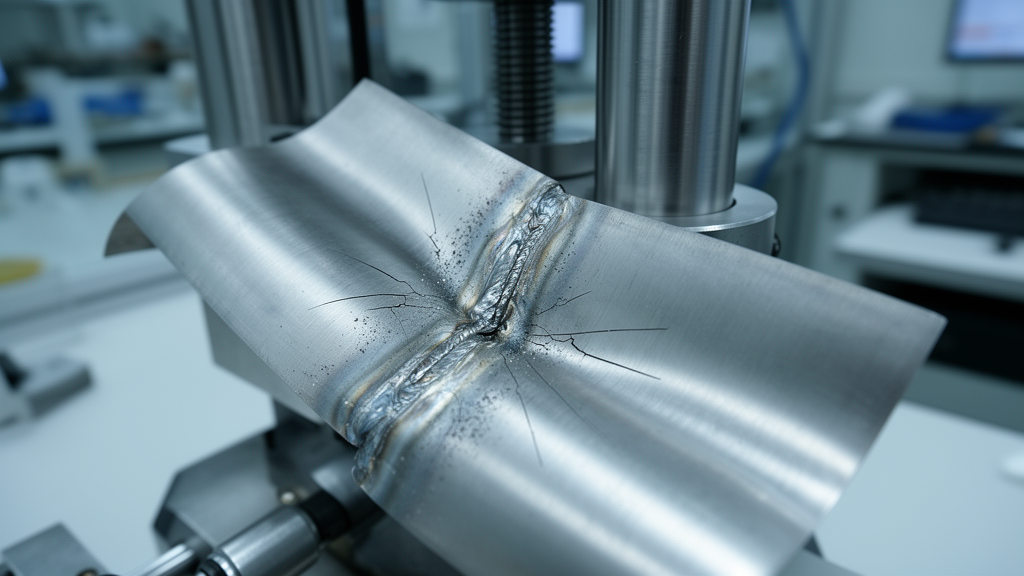
Clinching is a cold-forming process that joins sheets by locally drawing and plastically deforming them into an interlocking button without any fastener or filler material. Because it avoids the heat and distortion associated with welding, it has become attractive for dissimilar metal combinations such as commercially pure titanium TA1 and the aluminum alloy Al6061, materials that are difficult to fuse directly. Yet the same interlock that makes clinching useful also concentrates stress in a tiny contact zone, and under cyclic loading that zone becomes the scene of a slow, hidden failure process known as fretting fatigue.
A team led by Yue Zhang, Shengqiang Ning and Ruitao Peng at Xiangtan University, working with colleagues at the University of Huddersfield and Jiangxi Hongdu Aviation Industry Group, has now mapped that failure process in detail for TA1-Al6061 clinched joints. Their study, published in the Journal of Materials Science, combines tensile-tensile fatigue experiments, scanning electron microscopy of fracture surfaces, dynamic wear simulation based on the Archard wear model, critical-plane crack initiation life prediction, and a three-dimensional crack propagation model built with the fracture mechanics software FRANC3D. The result is a complete wear-initiation-propagation framework for predicting the fatigue life of clinched joints made of dissimilar materials.
Fretting arises whenever two contacting surfaces experience very small relative displacements while under load. In a clinched joint, the lower sheet is bent around the neck of the interlock, and the contact area at the neck of the lower plate experiences micro-slip each time the joint is cycled. The researchers carried out tensile-tensile fatigue tests at low, medium and high loads and found that failure always occurred in the contact area of the neck of the lower plate, regardless of load level. Scanning electron microscopy of the fracture surfaces revealed typical fatigue striations and wear debris, the classic fingerprints of fretting-assisted fatigue cracking.
The striations tell a quantitative story. Fatigue striations are ridges left on a fracture surface by each successive advance of the crack tip, and their spacing reflects how far the crack grew per cycle. Wear debris, meanwhile, is material removed from the contact interface by repeated micro-slip, oxidized and ground between the surfaces. Together these features confirm that the crack did not start at a random microstructural weak point but at the fretting contact itself, where cyclic contact stress, tangential friction stress and wear damage combine to nucleate fatigue cracks far earlier than plain fatigue would allow.
To capture this experimentally observed behavior numerically, the team first built a finite element model of the clinched joint and implemented dynamic wear of the contact interface using the Archard wear model with the Umeshmotion subroutine. Archard’s law states that wear volume is proportional to normal load, sliding distance and a dimensionless wear coefficient divided by the hardness of the softer material. By invoking the subroutine at each analysis increment, the simulation progressively removed material from the contact surfaces, changing the contact geometry and stress distribution as wear accumulated, exactly as happens in the real joint.
The evolving stress field from the wear simulation then fed into crack initiation life prediction using the critical plane method. In this approach, the analyst searches the material for the plane on which a combination of stress amplitudes is most damaging, and evaluates a damage parameter on that plane. The team compared three damage parameters: the BM parameter, a fretting-related damage parameter developed specifically for fretting fatigue, and the SWT and Morrow parameters, which are widely used critical-plane parameters for conventional fatigue. At low stress levels the BM parameter model predicted crack initiation life with an error below 15 percent, significantly better than the SWT and Morrow models, which do not account for the special stress gradients of fretting contacts.
Crack initiation, however, is only part of the life. The researchers further developed a three-dimensional crack propagation model in FRANC3D to reveal how the fretting-induced crack grows in the opening mode. The model inserts an initial crack into the finite element mesh, computes the stress intensity factors along the crack front, and advances the crack according to fracture mechanics growth laws. The accuracy of the simulation model in the crack propagation stage proved better than that of theoretical calculation results, because the numerical model captures the true three-dimensional geometry of the joint, the evolving contact conditions and the actual crack front shape, none of which idealized analytical solutions can represent.
The significance of the work lies in the coupling. Wear and fatigue are usually studied separately, yet in a clinched joint they compete and cooperate: wear removes material and redistributes stress, which can either retard or accelerate crack nucleation depending on the load regime, while the growing crack alters the contact mechanics in return. Earlier studies of fretting fatigue in press-fitted railway axles, aluminum conductors, titanium alloys and spline couplings have documented similar interactions, but the present study is among the first to build a sequential wear-initiation-propagation prediction chain specifically for clinched joints of dissimilar titanium and aluminum sheets.
Clinched joints are increasingly used in automotive body structures, battery enclosures and aerospace secondary structures, where mixed titanium-aluminum assemblies appear in weight-critical applications. Because the failure of such joints under cyclic loading is governed by fretting at the interlock neck, design engineers cannot rely on nominal fatigue data for the parent materials. The framework of Zhang and colleagues gives them a physics-based tool: simulate the wear of the contact interface, predict when and where a crack will initiate using a fretting-appropriate damage parameter, and then propagate that crack numerically to estimate total life.
The authors note that the whole life prediction framework of wear, initiation and propagation proposed in their study provides a theoretical basis for the design of clinched joints of dissimilar materials and for fatigue life prediction. As electric vehicles and lightweight airframes push dissimilar metal joining into new territory, understanding how a few micrometers of micro-slip can quietly destroy an interlock becomes not a materials curiosity but a safety-critical design requirement. The hidden enemy of the clinched joint, it turns out, is the very contact that holds it together.
Subject of Research: Mechanism of fatigue crack initiation and propagation induced by fretting wear in TA1-Al6061 clinched joints
Article Title: Mechanism of fatigue crack initiation and propagation induced by fretting wear in TA1-Al6061 clinched joints
Article References: Zhang, Y., Ning, S., Peng, R., Shi, T., Liao, C., Wang, X., He, X., & Li, L. (2026). Mechanism of fatigue crack initiation and propagation induced by fretting wear in TA1-Al6061 clinched joints. Journal of Materials Science, 61(41), 31805-31828. https://doi.org/10.1007/s10853-026-13297-4
Image Credits: AI Generated
DOI: 10.1007/s10853-026-13297-4
Keywords: Mechanism, fatigue, crack, initiation, propagation, induced, fretting, wear, TA1-Al6061, clinched, joints, scientific research
Cite Scienmag News
Denise Maddox. (October 18, 2026). Fretting wear quietly cracks titanium-aluminum clinched joints, new study reveals. Scienmag. https://scienmag.com/fretting-wear-quietly-cracks-titanium-aluminum-clinched-joints-new-study-reveals/
Denise Maddox. "Fretting wear quietly cracks titanium-aluminum clinched joints, new study reveals." Scienmag, 18 October 2026, https://scienmag.com/fretting-wear-quietly-cracks-titanium-aluminum-clinched-joints-new-study-reveals/. Accessed 18 October 2026.
Denise Maddox. "Fretting wear quietly cracks titanium-aluminum clinched joints, new study reveals." Scienmag. October 18, 2026. https://scienmag.com/fretting-wear-quietly-cracks-titanium-aluminum-clinched-joints-new-study-reveals/


