


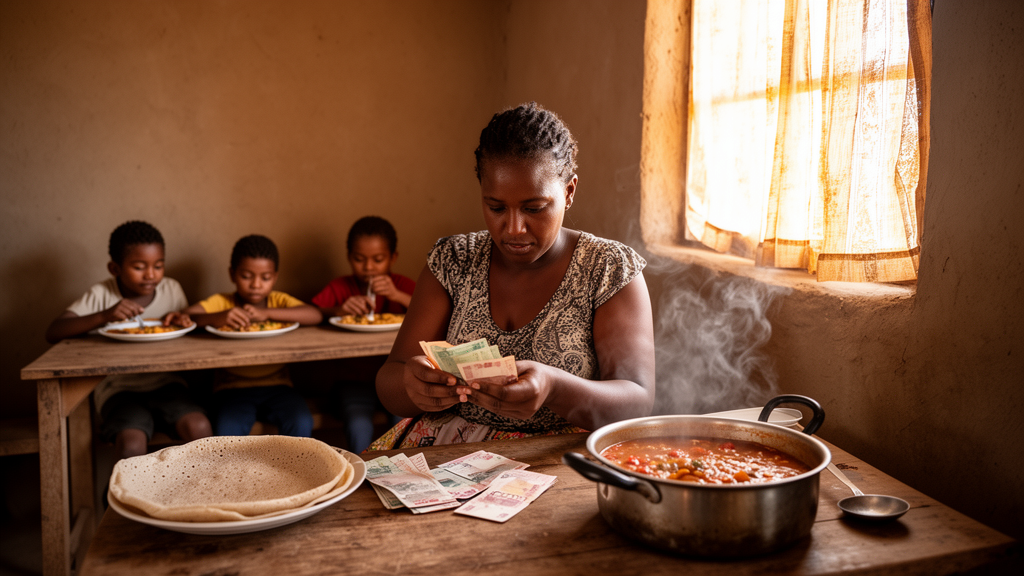
More than seventy percent of urban households in Ethiopia’s Tigray region are struggling with severe or moderate food insecurity in the aftermath of conflict, and the money sent home by migrants has become the single most important shield keeping many of them fed. That is the central finding of a new study by researchers at Mekelle University, published in Discover Sustainability, which examined how migration and remittances shape household food security across five urban towns in a region still recovering from one of the most devastating conflicts of recent years. The results challenge a widespread assumption that sending family members abroad is itself a reliable route out of hunger, and they reveal a troubling shift in the economic role of remittances in post-conflict settings.
The research team, led by Girma Nigusse Woldegebriel with colleagues Alemseged Gerezgiher Hailu and Zbelo Tesfamariam, all from Mekelle University’s Department of Geography and Population Studies, designed the study to capture both the statistical patterns and the lived experience of food insecurity in post-conflict urban Tigray. They used a cross-sectional mixed-methods convergent parallel design, meaning quantitative and qualitative data were collected at the same time and analyzed independently before being integrated. The quantitative backbone was a survey of 420 randomly selected households, of which 139 were migrant-sending and 281 were non-migrant-sending, spread across Edaga Hamusee, Atsebi, the Hawlity sub-city of Mekelle, Abi Adi, and Degua Tembein. On the qualitative side, the researchers conducted 12 focus group discussions and 15 key informant interviews, allowing them to probe the mechanisms behind the numbers.
To measure food security rigorously rather than relying on a single indicator, the team constructed a Food Security Index using Principal Component Analysis, a statistical technique that combines multiple related measures into a composite score. The index drew on variables including household dietary diversity, food consumption patterns, literacy, average monthly income, asset ownership, and exposure to shocks. The statistical quality of the index was verified using the Kaiser-Meyer-Olkin measure of sampling adequacy, which reached 0.631, above the 0.60 threshold for acceptable sampling adequacy, and Bartlett’s test of sphericity was highly significant. Collinearity diagnostics confirmed that the predictor variables used in the regression models were statistically independent enough to be interpreted separately, with a mean variance inflation factor of 1.82.
The picture that emerged from the data was stark. Over seventy percent of surveyed households experienced severe or moderate food insecurity, characterized by limited dietary diversity and reduced consumption of nutrient-rich foods such as animal products, fruits, and vegetables. The qualitative interviews echoed this finding, with participants describing diets narrowed to staple cereals and the progressive sale of household assets to buy food. In a region where urban households typically depend on markets rather than their own production, the conflict had disrupted incomes, services, and supply chains simultaneously, leaving families with few buffers against hunger.
One of the study’s most consequential findings concerns migration itself. When the researchers applied a generalized ordered logistic regression, a model suited to outcomes with multiple ordered categories of severity, migration status was not a significant predictor of severe or moderate food insecurity, with a p-value of 0.417. Chi-square tests and analysis of variance confirmed only a weak association between migration status and food security outcomes. The team also used propensity score matching, a technique that attempts to isolate the effect of migration by comparing migrant-sending households with statistically similar non-migrant-sending households, and the results reinforced the conclusion that simply having a family member abroad does not meaningfully change a household’s food security position in this post-conflict context.
Remittances, by contrast, emerged as a key protective factor. Households receiving money from abroad used it to support consumption, prevent the liquidation of assets, enhance resilience to shocks, and improve access to credit. The qualitative data illuminated how this worked in practice: remittance-receiving families could buy food during price spikes, avoid selling housing or livestock, and borrow against the expectation of future transfers. But the interviews also revealed a profound change in the economic function of these transfers. In normal times, remittances in Tigray were often invested in education, housing, or business ventures. In the post-conflict context, they have shifted from investment to survival, a transition the researchers interpret as a signal of declining household resilience rather than a sustainable livelihood strategy.
The generalized ordered logit model identified the broader drivers of food insecurity with technical precision. Family size, education, asset ownership, income, and formal employment all positively influenced food security, confirming that human capital and economic buffers remain the foundations of household resilience. On the other side of the ledger, reduced humanitarian aid, inflation, increased service costs, and political instability significantly undermined food security. These structural pressures, rather than the presence or absence of a migrant family member, were the dominant forces determining whether households could feed themselves. The study recommends coordinated interventions that address both immediate needs and underlying structural causes rather than relying solely on international migration as a livelihood solution.
The researchers lay out a set of priority actions grounded in their empirical findings. They call for strengthening household assets through education, housing, and income generation; restoring financial services and stabilizing markets; maintaining humanitarian assistance for vulnerable groups; and controlling inflation to improve urban food access. They also emphasize targeting disadvantaged populations, including persons with disabilities, unemployed youth, lactating women, and children, who were identified as facing the greatest risks. The recommendation to maintain aid is particularly significant given that reduced assistance was statistically associated with worsening food insecurity, suggesting that abrupt withdrawal of humanitarian support in fragile post-conflict settings can push households over the edge.
Methodologically, the study demonstrates the value of convergent parallel designs in post-conflict research, where statistical associations alone cannot capture the mechanisms of survival. The thematic analysis of focus groups and key informant interviews provided the interpretive depth that explained why remittances protect consumption but no longer build assets, and why formal employment and education remain the strongest predictors of food security even amid economic collapse. The study received ethical approval from Mekelle University’s College of Health Sciences Institutional Review Board and was conducted in accordance with the Helsinki Declaration, with informed consent obtained from all participants and no personally identifying information reported.
The findings carry implications well beyond Tigray. Migration is widely recognized as a livelihood strategy across Africa and other less-developed regions, yet empirical evidence on the links between migration, remittances, and household food security has been limited, particularly in post-conflict urban settings. This study shows that in the aftermath of conflict, remittances can function as a lifeline that prevents hunger without resolving the structural conditions that produce it. For policymakers, the message is that international migration cannot substitute for restoring education, employment, financial services, and market stability. For households, the money arriving from abroad is keeping families fed today, but the shift from investment to survival suggests that without coordinated structural intervention, the resilience of post-conflict urban communities will continue to erode.
Subject of Research: Sustainability
Article Title: Migration, remittances, and drivers of household food security in a post-conflict urban Tigray, Ethiopia
Article References: Woldegebriel, G. N., Hailu, A. G., & Tesfamariam, Z. (2026). Migration, remittances, and drivers of household food security in a post-conflict urban Tigray, Ethiopia. Discover Sustainability. https://doi.org/10.1007/s43621-026-04996-8
Image Credits: AI Generated
DOI: 10.1007/s43621-026-04996-8
Keywords: Migration, remittances, drivers, household, food, security, post-conflict, urban, Tigray, Ethiopia, scientific research
Cite Scienmag News
Violet Maxwell. (October 18, 2026). Remittances, Not Migration, Shield Post-Conflict Urban Households From Hunger in Tigray. Scienmag. https://scienmag.com/remittances-not-migration-shield-post-conflict-urban-households-from-hunger-in-tigray/
Violet Maxwell. "Remittances, Not Migration, Shield Post-Conflict Urban Households From Hunger in Tigray." Scienmag, 18 October 2026, https://scienmag.com/remittances-not-migration-shield-post-conflict-urban-households-from-hunger-in-tigray/. Accessed 18 October 2026.
Violet Maxwell. "Remittances, Not Migration, Shield Post-Conflict Urban Households From Hunger in Tigray." Scienmag. October 18, 2026. https://scienmag.com/remittances-not-migration-shield-post-conflict-urban-households-from-hunger-in-tigray/


