


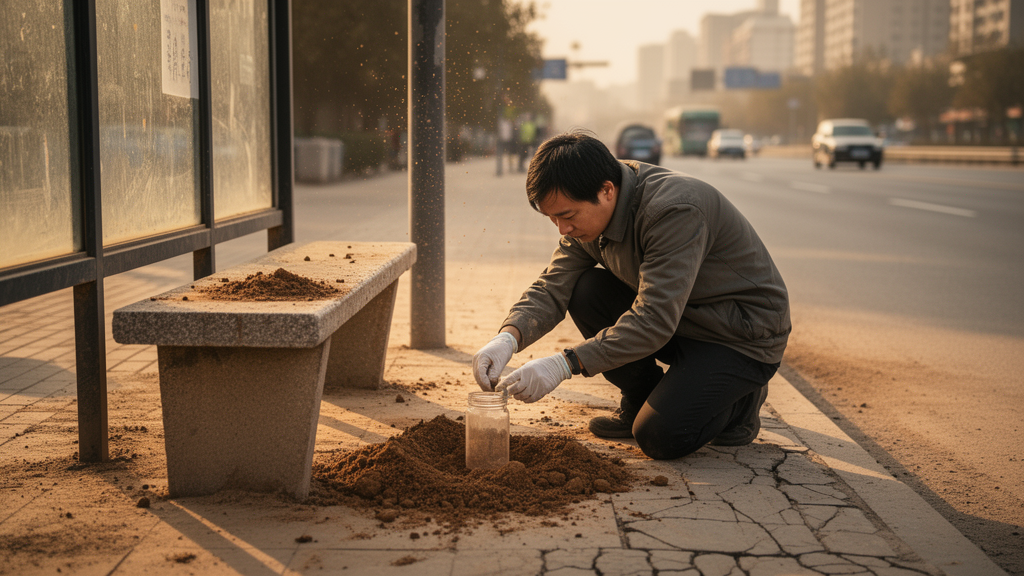
Every bus stop in a busy city is more than a place to wait for a ride. It is a small environmental sampling station, constantly collecting particles shed by brakes, tires, industry, and the surrounding soil. A new study from Xi’an, China, has turned these unassuming transit points into a laboratory for answering a question that has long troubled environmental scientists: when heavy metals accumulate in street dust and in soil, are the two reservoirs independent, or are they actively exchanging their chemical burdens? The answer, published in Environmental Monitoring and Assessment, is that dust and soil are locked in a measurable, two-way conversation.
The research team, led by Xi Wang and colleagues at Shaanxi University of Science and Technology, collected 52 paired samples of surface dust and soil from bus stops across Weiyang District in Xi’an, yielding 104 individual samples for analysis. Their targets were six heavy metals with well-documented toxicological profiles: chromium, manganese, copper, zinc, arsenic, and lead. These elements are staples of urban pollution studies because they are emitted by traffic, industry, and natural weathering alike, and because once deposited they persist for decades in the environments where people live, walk, and wait for buses.
To quantify how contaminated the sites were, the researchers deployed two of the most widely used tools in environmental geochemistry. The first was the geo-accumulation index, a metric introduced by German geochemist Gerhard Müller in 1969, which compares measured concentrations against regional background values and assigns pollution classes ranging from unpolluted to extremely polluted. The second was the Nemerow Comprehensive Pollution Index, which aggregates multiple contaminants into a single score that reflects the worst-case burden at a site. Together, these indices allowed the team to translate raw concentration data into a standardized picture of pollution severity across the district.
The results painted a chemically distinctive portrait of Weiyang District. Average concentrations of most of the six metals in both dust and soil exceeded the established background values for soils in Shaanxi Province, with the telling exceptions of arsenic and manganese. This pattern is significant because arsenic and manganese are typically dominated by natural geological sources, whereas elements like lead, zinc, copper, and chromium are classic fingerprints of human activity, particularly vehicular traffic and industrial processes. In other words, the bus stops of Xi’an are carrying an anthropogenic metal signature superimposed on the region’s natural geochemistry.
Just as striking was the spatial structure the team uncovered. Heavy metal concentrations in dust rose toward the east of the district and fell toward the west, while in soil the pattern was reversed, with higher values in the south and lower values in the north. Such opposing gradients are exactly what one would expect if the two media were being fed by different combinations of local sources, wind patterns, and land uses, rather than simply mirroring one another. The finding underscores a point that has become increasingly clear in urban pollution research: dust and soil are not interchangeable proxies for each other, and treating them as such can obscure the true geography of contamination.
To probe the relationship between the two media more rigorously, the researchers borrowed a mathematical framework from systems science known as coupling coordination analysis. Originally developed to evaluate how well paired systems, such as regional economies and their environments, evolve in harmony, the method computes a coordination degree that ranges from disorder to high synchronization. Applied here for what the authors describe as the first time to heavy metal concentrations in dust and soil, the analysis produced a moderate coordination value, indicating that the metal burdens in the two media are neither fully independent nor perfectly matched.
That moderate coupling carries a substantive interpretation. It suggests that heavy metals are actively migrating between surface dust and underlying soil, moving through processes such as wet and dry deposition, particle resuspension by wind and traffic turbulence, and rain-driven leaching from dust into the ground. The practical consequence is that pollution sources affecting one medium are likely to be similar to those affecting the other, which means remediation strategies that target only dust or only soil will miss part of the problem. The authors argue that their findings provide a reference framework for building both single-medium and multi-medium heavy metal migration models, a step toward treating urban contamination as a connected system rather than a collection of isolated compartments.
The study also quantified who is most at risk from the contamination it documented. Using standard exposure models aligned with guidance from the United States Environmental Protection Agency and China’s Ministry of Environmental Protection, the team evaluated three principal exposure pathways: hand-to-mouth ingestion of particles, inhalation of resuspended dust, and dermal contact with contaminated surfaces. For both adults and children, ingestion emerged as the dominant route of exposure, a finding consistent with the behavior of particles in the size ranges typical of street dust, which adhere readily to hands and are easily transferred to the mouth during eating, touching the face, or handling objects.
The health risk calculations revealed a familiar but sobering hierarchy. Non-carcinogenic risk, expressed as a hazard index comparing estimated intake against reference doses, was higher for children than for adults at every stage of the analysis. Children are more vulnerable for well-understood reasons: they ingest more material per unit of body weight, they spend more time in contact with ground-level surfaces, and their developing physiology is more sensitive to toxic insult. While the study did not report carcinogenic risk exceeding acceptable thresholds, the elevated hazard indices for children reinforce a message that urban planners and public health officials have been internalizing for years, namely that the populations most exposed to street-level contamination are often the least equipped to tolerate it.
Source apportionment, the process of tracing contaminants back to their origins, identified three principal contributors to the metal burden at Xi’an’s bus stops: traffic, natural sources, and industrial activity. This tripartite signature is common in rapidly developing cities, where vehicle fleets, construction, manufacturing, and the underlying geology all leave overlapping chemical traces. The identification of traffic as a leading source is particularly relevant to the study’s setting, since bus stops concentrate idling vehicles, frequent braking, and pedestrian activity in small areas, creating localized hotspots of metal deposition that would be diluted in citywide averages.
Beyond its specific findings for Weiyang District, the study represents a methodological contribution with potentially wide reach. Coupling coordination analysis has been applied to problems ranging from regional sustainability to healthcare resource allocation, but its adaptation to paired environmental media is new. By demonstrating that the technique can detect and quantify the degree of interaction between dust and soil metal reservoirs, the authors have opened a pathway for researchers in other cities to test whether similar migration dynamics hold elsewhere. If the moderate coupling observed in Xi’an proves to be a general feature of urban environments, it would justify a shift in how heavy metal monitoring is designed, moving from single-medium snapshots toward integrated assessments that track contaminants as they cycle between the ground and the air at the scale of a city block.
For the millions of people who wait at bus stops every day, the study offers a reminder that the dust settling on benches, pavement, and clothing is not inert. It is part of an active exchange with the soil beneath, driven by the same traffic and industry that make urban air difficult to breathe. Understanding that exchange, the authors suggest, is a prerequisite for designing interventions, whether more frequent street cleaning, greener transit infrastructure, or targeted soil remediation, that actually reduce the metal loads to which urban residents, and especially children, are exposed.
Subject of Research: Heavy metal pollution and dust-soil migration at urban bus stops in Xi'an, China
Article Title: Interactive migration of heavy metals between dust and soil demonstrated by the coupling coordination analysis
Article References: Wang, X., Li, S., Liu, P., Xu, Y., Cao, X., Wu, Z., Miao, Z., & Guo, J. (2026). Interactive migration of heavy metals between dust and soil demonstrated by the coupling coordination analysis. Environmental Monitoring and Assessment, 198(9), Article 1031. https://doi.org/10.1007/s10661-026-15820-1
Image Credits: AI Generated
DOI: 10.1007/s10661-026-15820-1
Keywords: heavy metals, street dust, soil pollution, coupling coordination analysis, bus stops, Xi'an, health risk assessment, geo-accumulation index, Nemerow pollution index, traffic pollution, source apportionment, children's health
Cite Scienmag News
Violet Maxwell. (October 18, 2026). Bus Stop Dust and Soil Reveal Two-Way Migration of Heavy Metals in Xi’an Study. Scienmag. https://scienmag.com/bus-stop-dust-and-soil-reveal-two-way-migration-of-heavy-metals-in-xian-study/
Violet Maxwell. "Bus Stop Dust and Soil Reveal Two-Way Migration of Heavy Metals in Xi’an Study." Scienmag, 18 October 2026, https://scienmag.com/bus-stop-dust-and-soil-reveal-two-way-migration-of-heavy-metals-in-xian-study/. Accessed 18 October 2026.
Violet Maxwell. "Bus Stop Dust and Soil Reveal Two-Way Migration of Heavy Metals in Xi’an Study." Scienmag. October 18, 2026. https://scienmag.com/bus-stop-dust-and-soil-reveal-two-way-migration-of-heavy-metals-in-xian-study/


