


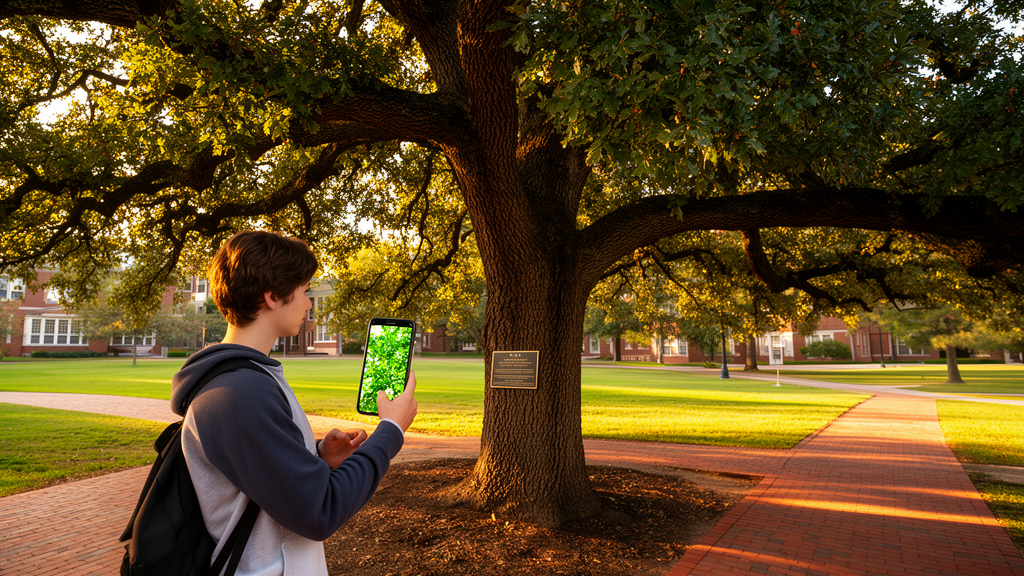
Walk across the campus of Desh Bhagat University in Mandi Gobindgarh, Punjab, and the trees around you are no longer silent. Each labelled specimen now carries a small laminated nameplate bearing a QR code, and a single scan with a smartphone pulls up a full botanical dossier: scientific name, family, growth habit, morphological traits, ecological role, and medicinal or economic importance, presented in English, Hindi, or Punjabi. The system, described in the open-access journal Discover Plants, documents 67 plant species from 45 families and links every one of them to a unique digital profile hosted on the university’s E-Agro Bloom web platform. It is a deceptively simple piece of technology that its developers argue could reshape how academic institutions catalogue and communicate their own biodiversity.
The project began with a problem familiar to anyone who has read a conventional botanical nameplate. Static labels typically offer little more than a scientific and common name, leaving out the morphological detail, ethnobotanical significance, and conservation context that make a species genuinely understandable. They also degrade physically, require regular maintenance, and cannot be updated without reprinting. The research team, led by Preeti Bhandari with Avinash Kumar Bhatia as corresponding author, set out to replace this one-way flow of information with something dynamic, multilingual, and cheap to maintain, using Quick Response codes as the bridge between a physical plant and a curated digital repository.
The technical workflow behind the system is worth unpacking, because it combines classical field taxonomy with modern data curation. The team conducted a comprehensive floristic survey across the 35-acre campus, timed primarily during the monsoon season when vegetative growth and reproductive structures are most active. Field visits covered landscaped gardens, avenue plantations, open green spaces, and semi-natural vegetation patches to ensure representative coverage. For every species encountered, the researchers captured geo-referenced photographs using GPS-enabled devices, taking multiple images of diagnostic features such as leaves, stems, flowers, fruits, and bark. Field notes on habitat conditions, phenological stage, and distribution patterns accompanied the visual records. Crucially, the entire documentation was non-destructive: no voucher specimens were collected, no endangered or protected species were harmed, and identification relied entirely on in situ observation.
Species identification followed a layered verification protocol. The team examined leaf architecture, venation patterns, inflorescence structure, floral morphology, and overall growth habit, cross-referencing their observations against the Forest Division Management Plan of Fatehgarh Sahib district, standard regional floras, and dichotomous taxonomic keys. Scientific names were then verified through Plants of the World Online, the nomenclatural database maintained by the Royal Botanic Gardens, Kew, ensuring that every digital record rests on internationally accepted taxonomic principles. Where ambiguity persisted, the researchers consulted qualified taxonomists to confirm identities. This matters because a QR-linked database is only as credible as the taxonomy behind it; a misidentified species would propagate its error to every smartphone that scans its code.
Once identified, each species received a structured digital dataset hosted through the university’s official web platform. The records include botanical name, family, common name, growth habit, morphological characteristics, and economic or medicinal importance, alongside the geo-referenced images and field observations. Each digital record sits at a dedicated URL, and high-resolution QR codes encoding those URLs were generated using tools such as QR Code Monkey, QR Stuff, TQRCG, and ME QR code generator. The codes were then printed on durable material, laminated, and integrated into nameplates displaying both scientific and common names, installed on or near the corresponding plants without damaging any plant structure. Strategic placement along frequently accessed pathways and academic zones was designed to maximize encounters with the technology.
The floristic inventory itself reveals a moderately diverse campus ecosystem. The survey recorded 67 species across 45 families, with a life-form distribution of 41 trees (61.19 percent), 15 shrubs (22.39 percent), 6 herbs (8.96 percent), and 5 climbers (7.46 percent), a structurally heterogeneous pattern typical of managed institutional landscapes in subtropical regions. Dominant families included Fabaceae, Poaceae, Asteraceae, and Euphorbiaceae, groups whose ecological adaptability and species richness make them widespread across tropical and subtropical environments. The composition mixes ornamental, medicinal, native, and exotic taxa, reflecting both the ecological stability and the functional diversity that managed campus vegetation can support. The study area sits in the Indo-Gangetic alluvial plains under a Köppen-Geiger Cwa subtropical climate, with summer temperatures frequently exceeding 40 degrees Celsius, a monsoon-dominated precipitation regime, and cool winters that occasionally drop below 10 degrees Celsius, conditions that shape plant phenology across the campus.
Validation of the QR system was systematic rather than anecdotal. All 67 generated codes were tested for scanning and redirection performance using available smartphone devices under both indoor and outdoor conditions, including normal daylight. A code was considered successfully validated only if it met three criteria: correct recognition by the scanning device, successful access to the QR-linked digital file containing species-specific information, and accessibility of the associated plant information after the file opened. Every code met these criteria under the test conditions, demonstrating reliable functionality despite real-world variables such as internet connectivity, smartphone camera performance, scanning distance, lighting conditions, and webpage accessibility. The researchers note minor limitations related to environmental factors affecting scanning, and they recommend durable printing materials, appropriate placement, and periodic functionality checks for long-term field application.
User engagement was assessed through on-campus interaction rather than a formal questionnaire. Students, faculty, and visitors scanned the displayed codes with their smartphones and accessed the corresponding digital files, and informal verbal feedback focused on the ease of accessing plant information, clarity of content, educational usefulness, and technical accessibility. The researchers are careful to present this feedback qualitatively, making no statistical claims, but the observations demonstrate the practical applicability of the system as a tool for interactive, self-directed learning and biodiversity awareness. The multilingual provision in English, Hindi, and Punjabi was specifically incorporated to widen accessibility for the campus’s diverse user population, a consideration that distinguishes this implementation from earlier QR-based plant identification projects that operated in a single language.
From a sustainability standpoint, the system reduces reliance on printed materials and aligns with global initiatives for education for sustainable development and digital transformation. The digital nature of the QR-linked database allows continuous updates without physical replacement of labels, keeping information current and scientifically accurate. The integration of geo-referenced data within the repository also opens a path toward spatial analysis: the researchers suggest the platform could expand into GIS-based biodiversity monitoring frameworks, supporting the broader objectives of biodiversity informatics. They further propose that a dedicated mobile application with offline accessibility could enhance usability in areas with limited internet connectivity, addressing one of the system’s few practical constraints.
The larger significance of the project lies in its replicability. The researchers describe the framework as scalable, cost-effective, and interactive, with strong potential for adoption by other academic institutions and green spaces seeking to modernize biodiversity documentation. India, a megadiverse country supporting exceptional floral and faunal richness within roughly 2.4 percent of the global land area and hosting two of the world’s 38 biodiversity hotspots in the Eastern Himalayas and Western Ghats, faces substantial conservation pressures that make accessible documentation tools increasingly valuable. By bridging traditional taxonomy with contemporary information technology, the Desh Bhagat University team has shown that the humble QR code, a two-dimensional barcode invented for industrial logistics, can become a genuine instrument of environmental education, turning every labelled tree on a campus into an entry point for ecological literacy.
Subject of Research: Digital documentation and dissemination of campus flora using QR codes at Desh Bhagat University Punjab India
Article Title: Digital documentation and dissemination of campus flora using QR codes at Desh Bhagat University Punjab India
Article References: Bhandari, P., Sidhu, H. K., Bhatia, A. K., & Sood, S. (2026). Digital documentation and dissemination of campus flora using QR codes at Desh Bhagat University Punjab India. Discover Plants, 3(1), 471. https://doi.org/10.1007/s44372-026-00964-8
Image Credits: AI Generated
DOI: 10.1007/s44372-026-00964-8
Keywords: Digital, documentation, dissemination, campus, flora, codes, Desh, Bhagat, University, Punjab, India, scientific research
Cite Scienmag News
Margaret Porter. (October 18, 2026). Campus trees get QR codes that turn smartphones into botanical field guides. Scienmag. https://scienmag.com/campus-trees-get-qr-codes-that-turn-smartphones-into-botanical-field-guides/
Margaret Porter. "Campus trees get QR codes that turn smartphones into botanical field guides." Scienmag, 18 October 2026, https://scienmag.com/campus-trees-get-qr-codes-that-turn-smartphones-into-botanical-field-guides/. Accessed 18 October 2026.
Margaret Porter. "Campus trees get QR codes that turn smartphones into botanical field guides." Scienmag. October 18, 2026. https://scienmag.com/campus-trees-get-qr-codes-that-turn-smartphones-into-botanical-field-guides/


