


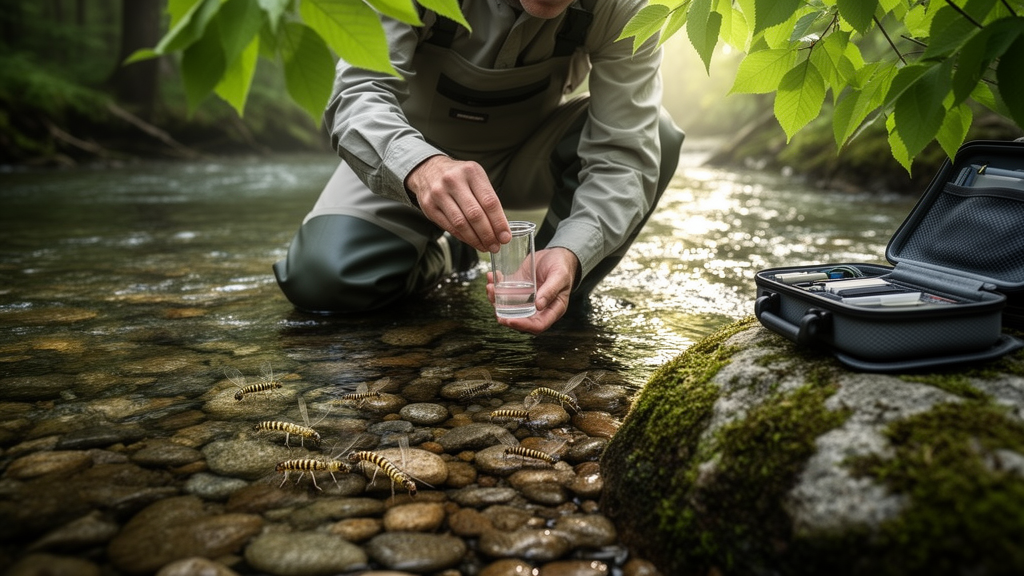
For more than two decades, Europe has graded the health of its rivers the way teachers grade exams: collect the students, identify them, and score the class. Under the Water Framework Directive, the European Union’s landmark water legislation adopted in 2000, more than 110,000 surface water bodies are assessed on a six-year cycle, and the workhorses of that assessment are benthic macroinvertebrates, the insect larvae, worms, snails and crustaceans that live on stream bottoms and betray pollution through their presence or absence. A new study from Slovakia, published in the journal Metabarcoding and Metagenomics, suggests that the way we’ve been counting these creatures has been missing a remarkable share of what actually lives there, and that a molecular shortcut could reshape how an entire continent monitors its fresh water.
The research team, working at 17 long-term monitoring sites across Slovakia’s Western Carpathian streams, put DNA metabarcoding head-to-head with the conventional morphological approach that has underpinned national biomonitoring for decades. The conventional method is exactly what it sounds like: kick-net the stream bed, sort the animals under a microscope, and identify each one by eye, a process that demands scarce taxonomic expertise and, in Slovakia’s case, typically examines only about 20 percent of each collected sample. The molecular alternative reads the same material differently, extracting DNA from the sample and matching genetic barcodes against reference databases to produce a species list without anyone peering down a microscope.
The headline result is striking. DNA metabarcoding detected roughly 30 percent more species than fifteen years of conventional monitoring had accumulated at the same sites, spanning records from 2007 to 2022. At one site on the Morava River, thirteen conventional samples collected over many years had yielded between 12 and 30 species per sampling event; a single metabarcoding sample recorded 82 species. At the Rimava River, where both methods were applied simultaneously, the molecular approach outdetected morphology by 37 species. In total, 40 percent of all species captured across both approaches were found exclusively by metabarcoding, while only about 27 percent were exclusive to the conventional method.
The study also compared three ways of feeding DNA to the sequencer, and the verdict was clear. Bulk samples, meaning the entire preserved mass of collected invertebrates homogenised and extracted whole, captured on average 85 percent of all species detected at each site. Environmental DNA filtered from the water column managed only about 30 percent, and sediment eDNA just under 14 percent. Yet the eDNA samples were not useless: they uniquely recorded entire classes of animals, including rotifers, sponges and other soft-bodied organisms that bulk sampling misses entirely, hinting that a combined strategy could deliver the fullest picture of stream life.
Behind those percentages lies a deeper story about hidden biodiversity. The metabarcoding data revealed cryptic diversity, cases where one named species actually comprises several genetically distinct lineages, in 87 of the 463 species detected. The midge family Chironomidae, notorious among taxonomists for its difficulty, was the richest example: 23 recognised species resolved into 51 genetic units. Groups that morphologists struggle with, such as flies, worms and mayflies, were precisely where the molecular method pulled furthest ahead, with Diptera species detected at more than double the rate of conventional identification.
The crucial question, of course, is whether all this extra detection actually changes the regulatory verdict. Under the Water Framework Directive, species lists feed into multimetric indices that produce an Ecological Quality Ratio, which places each water body into one of five status classes ranging from high to bad. Slovakia’s system uses between six and eleven metrics per stream type, some depending on species abundances and others simply on which species are present. If metabarcoding produced wildly different scores, regulators could not adopt it without rewriting the rulebook.
Encouragingly, the answer was mostly reassuring. For abundance-dependent metrics such as the Saprobic Index, where the researchers used sequencing read counts as a proxy for how many individuals of each species were present, the two approaches agreed closely, typically within a single ecological quality class. The real divergence appeared in presence-absence metrics such as EPT taxa, the BMWP score and the number of families, which are sensitive to every additional species detected. Because metabarcoding simply sees more species, these metrics often scored higher, sometimes shifting the assessment by two or even three quality classes, and generally in the direction of a better grade.
That pattern played out in the final status assessments too. At ten of the seventeen localities, the molecular approach assigned a higher ecological class than the conventional record: four sites moved from moderate to good status, and six improved from good to high. Seven sites were unchanged. The researchers attribute much of this inflation not to flattery but to calibration: the reference thresholds that define each class were originally derived from morphology-based data, so a method that detects more species will inevitably overshoot thresholds built for a blunter instrument. Recalibrating those thresholds for molecular data, they argue, would likely close most of the gap.
None of this means metabarcoding is a finished product. The technique has well-documented weaknesses, from false positives caused by nuclear copies of mitochondrial genes to errors and gaps in reference databases, and read counts remain an imperfect stand-in for true abundance since they can be skewed by PCR bias and do not distinguish life stages. The team mitigated these problems by filtering low-confidence matches, verifying species against Slovak freshwater checklists, and drawing on the growing regional barcode library AquaBOL.SK. Molluscs, notably, were detected less well by DNA than by morphology, a reminder that the two methods each have blind spots the other partially fills.
Still, the implications for Europe’s rivers are hard to ignore. Routine biomonitoring is expensive, slow and increasingly constrained by the shrinking pool of experts able to identify larvae by eye, and the study demonstrates that metabarcoding under real field conditions, at real regulatory sites, can deliver assessments that are faster, broader and largely consistent with the legacy method. With reference databases improving every year and thresholds awaiting recalibration, the authors conclude that DNA-based monitoring is already a viable alternative rather than a distant promise. For the invertebrates quietly grading Europe’s streams, and for the agencies charged with protecting them, the microscope may finally be getting a molecular assistant.
Subject of Research: DNA metabarcoding for assessing ecological status of streams under the EU Water Framework Directive
Article Title: Evaluating the potential of DNA metabarcoding for ecological status assessment under the Water Framework Directive: A case study on benthic invertebrates from Western Carpathian streams
Article References: Šamulková, M., Beracko, P., Macko, P., Vargovčík, O., Tuhrinová, K., Čiamporová-Zaťovičová, Z., Lešťáková, M., Mišíková Elexová, E., & Čiampor Jr, F. (2025). Evaluating the potential of DNA metabarcoding for ecological status assessment under the Water Framework Directive: A case study on benthic invertebrates from Western Carpathian streams. Metabarcoding and Metagenomics, 9, Article e163640. https://doi.org/10.3897/mbmg.9.163640
Image Credits: AI Generated
Keywords: DNA metabarcoding, Water Framework Directive, benthic macroinvertebrates, ecological status, environmental DNA, biomonitoring, freshwater ecosystems, Slovakia, Carpathian streams, multimetric index, cryptic species, bulk samples
Cite Scienmag News
Gavin Prescott. (October 18, 2026). DNA From Stream Bugs Finds 30% More Species Than 15 Years of Monitoring. Scienmag. https://scienmag.com/dna-from-stream-bugs-finds-30-more-species-than-15-years-of-monitoring/
Gavin Prescott. "DNA From Stream Bugs Finds 30% More Species Than 15 Years of Monitoring." Scienmag, 18 October 2026, https://scienmag.com/dna-from-stream-bugs-finds-30-more-species-than-15-years-of-monitoring/. Accessed 18 October 2026.
Gavin Prescott. "DNA From Stream Bugs Finds 30% More Species Than 15 Years of Monitoring." Scienmag. October 18, 2026. https://scienmag.com/dna-from-stream-bugs-finds-30-more-species-than-15-years-of-monitoring/


