


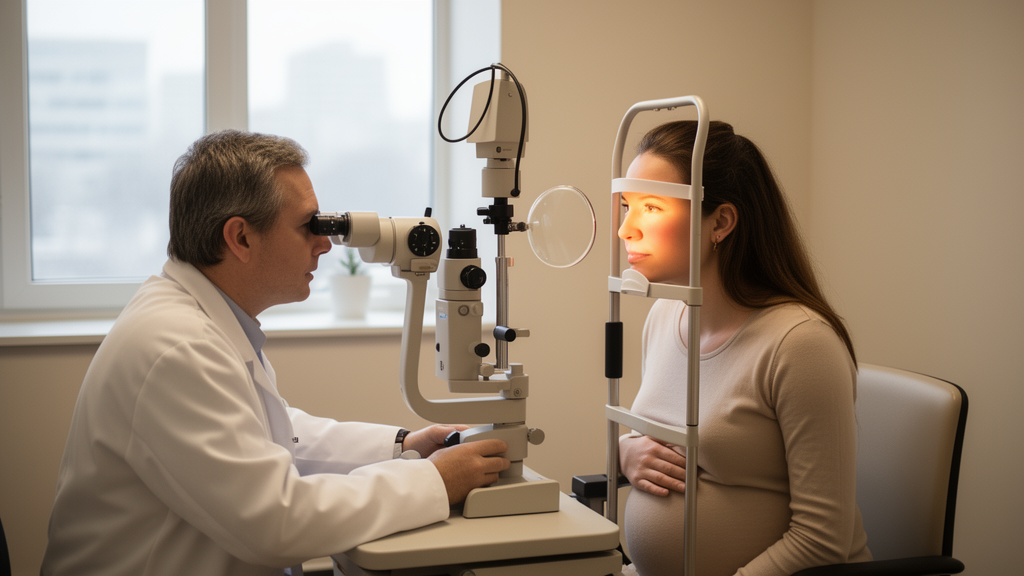
Managing elevated intraocular pressure during pregnancy and lactation has long been one of the most delicate balancing acts in ophthalmology. Every antiglaucoma eye drop carries the theoretical potential to cross the placenta or pass into breast milk, yet untreated pressure spikes threaten the optic nerve with irreversible damage. A new clinical report published in the journal Pharmacia now offers compelling evidence that a well-established laser procedure, selective laser trabeculoplasty, can eliminate the need for pressure-lowering medications entirely in pregnant and breastfeeding patients with ocular hypertension, achieving sustained pressure control without a single systemic side effect.
The report presents two clinical cases in which women with ocular hypertension underwent selective laser trabeculoplasty during pregnancy, lactation, or both. In both patients, the procedure produced a significant and durable reduction in intraocular pressure, and in both cases topical antiglaucoma therapy was discontinued completely for the entire follow-up period. No complications related to the laser treatment were observed. The findings arrive at a moment when clinicians have few good options, because no antiglaucoma medication is officially approved for use during pregnancy or breastfeeding, and the understandable absence of randomized clinical trials in this population leaves physicians without a universally accepted management protocol.
Glaucoma remains the most common cause of irreversible blindness worldwide, responsible for an estimated 11 to 14 percent of all cases of global blindness. The disease encompasses a group of disorders characterized by degenerative optic neuropathy, defined by pathological structural changes in the optic nerve head and specific functional alterations in the visual field. At the cellular level, the condition involves apoptosis of retinal ganglion cells, atrophy of their axons, and damage to the retinal nerve fiber layer. Elevated intraocular pressure is considered one of the main risk factors for the development and progression of these glaucomatous changes, and reducing pressure remains the only proven means of preserving visual function. Ocular hypertension, the condition addressed in the new report, is defined as persistently elevated intraocular pressure above 21 mmHg in the absence of the structural and functional changes typical of glaucoma. Approximately 10 percent of untreated patients with ocular hypertension eventually develop glaucoma, which makes monitoring and, when necessary, treatment essential.
The precise prevalence of glaucoma during pregnancy and lactation remains unknown, but epidemiological studies suggest that among women of childbearing age the prevalence of all glaucoma types may be roughly 1 percent, with primary open-angle glaucoma accounting for about 0.5 percent. Interestingly, pregnancy itself exerts a physiological pressure-lowering effect. Hormonal shifts involving human chorionic gonadotropin, progesterone, estrogen, and other placental hormones generally reduce intraocular pressure by approximately 10 percent, an effect evident from the first through the third trimester that may persist for one to three months after delivery. The mechanism involves increased aqueous humor outflow, primarily through enhanced uveoscleral drainage and decreased episcleral venous pressure. Relaxin, upregulated by high estrogen levels, induces elastic changes in collagen that soften the corneoscleral shell, Schlemm’s canal, and the trabecular meshwork, while progesterone counteracts the ocular hypertensive effect of endogenous corticosteroids. Estrogen contributes vasodilatory effects through mediators such as nitric oxide and prostacyclins, further reducing aqueous humor production.
Yet this physiological adaptation is not reliable enough to protect every patient. Despite the hormonal pressure reduction, approximately 70 to 85 percent of patients with ocular hypertension or glaucoma still require medical treatment during pregnancy, and roughly 10 percent may experience pressure elevation, inadequate control, or progression of glaucomatous damage. This unpredictability forces a difficult choice, because medications administered during pregnancy and lactation may adversely affect the course of pregnancy, the fetus, or the newborn. Exposure to various medications is estimated to increase the risk of congenital anomalies, preterm birth, and low birth weight by approximately 1 to 3 percent. Drugs with high potential for placental transfer or excretion into breast milk are typically nonionized, lipid-soluble, poorly bound to plasma proteins, and of low molecular weight. Most pressure-lowering medications have molecular weights between 90 and 400 Daltons, can cross the placenta, and may be excreted into breast milk, where basic compounds may become slightly more concentrated because of the milk’s lower pH.
Two periods of pregnancy are particularly critical from a pharmacological standpoint. The first trimester corresponds to organogenesis, the phase of highest susceptibility to teratogenic effects, particularly between weeks 3 and 8, when many women may not yet know they are pregnant. The final months before delivery represent the second critical window, because medications crossing the placenta can affect the fetal cardiovascular, respiratory, and neurological systems, with exposure within the final 45 days before delivery directly associated with increased neonatal complications. Compounding the concern, approximately 35 to 80 percent of a topically instilled ophthalmic drug may enter the systemic circulation through nasolacrimal drainage and conjunctival absorption, partially bypassing hepatic first-pass metabolism, and unmetabolized active compounds may be excreted into breast milk and ingested by the nursing infant.
Under the United States Food and Drug Administration classification system for medication safety during pregnancy, no antiglaucoma medication falls into category A, the safest tier. Brimonidine, a selective alpha-2-adrenoceptor agonist, is the only pressure-lowering agent classified as category B, and it may serve as a first-line option during pregnancy, though it should be discontinued at least 45 days before delivery because of the risk of central nervous system and cardiac depression in the newborn. All other antiglaucoma medications, including prostaglandin analogs, beta-blockers, carbonic anhydrase inhibitors, and ROCK inhibitors, are classified as category C and should be avoided unless the benefit to the mother clearly outweighs the risk to the fetus. Clinical evidence remains limited but generally reassuring. A large retrospective cohort study using a Japanese healthcare database found no increased risk of adverse neonatal outcomes among 91 pregnant women exposed to pressure-lowering medications, while a population-based study of 244 treated pregnancies suggested that topical beta-blockers may have the most favorable safety profile. However, beta-blockers have been linked to fetal bradycardia, hypoglycemia, and apnea, and a multicenter survey identified a significant association between alpha-agonist use during the third trimester and neonatal intensive care unit admission. The preservative benzalkonium chloride, common in eye drops, adds a further potential toxicity, making preservative-free formulations preferable for pregnant and lactating patients.
Selective laser trabeculoplasty sidesteps these pharmacological concerns entirely. The procedure employs a low-energy, Q-switched, frequency-doubled Nd laser with a wavelength of 532 nm, operating in pulsed mode with a pulse duration of approximately 3 nanoseconds. These characteristics mean the thermal load on ocular tissues is minimal and does not cause coagulative tissue damage. During the procedure, the anterior chamber angle is targeted with predominant treatment of the trabecular meshwork, inducing microstructural alterations within the trabecular architecture that improve aqueous humor outflow and reduce intraocular pressure. The technique carries an excellent safety profile, with an extremely low incidence of clinically significant local and systemic adverse events, and it is well tolerated with minimal discomfort. It can also be safely repeated when clinically indicated, a feature that proved important in the second case of the new report.
In the first case, a 27-year-old woman diagnosed with ocular hypertension seven years earlier, with baseline pressures of 27 mmHg in both eyes and a family history of glaucoma, presented 30 days after delivery with pressures back at 27 mmHg despite having stopped her medications during pregnancy. Selective laser trabeculoplasty was performed in both eyes at a 30-day interval, treating the trabecular meshwork over 360 degrees with single-pulse energy between 0.6 and 0.9 mJ and 95 to 110 laser spots per eye, titrated until small vaporization bubbles appeared. Within 24 hours, pressures had fallen to 14 and 16 mmHg, and at 12 months they remained at 17 and 16 mmHg without any medication. In the second case, a 36-year-old woman with pressures between 25 and 27 mmHg who reported uncomfortable dryness and foreign-body sensation from her eye drops underwent the procedure in one session during pregnancy at 6 weeks of gestation, when pressures measured 25 and 24 mmHg. Pressures fell to 18 and 17 mmHg within 24 hours and stayed controlled through 6 months. Approximately 20 days after delivery, pressures rose to 24 mmHg in both eyes, and the procedure was successfully repeated using the same protocol, restoring control to 18 and 16 mmHg at 12 months.
The authors emphasize that selective laser trabeculoplasty is not appropriate for every patient. It is primarily effective in open-angle variants of glaucoma and ocular hypertension, with limited or no role in angle-closure glaucoma, refractory secondary glaucomas, and congenital or pediatric variants. Its maximal pressure-lowering effect typically appears between 2 and 4 weeks after the procedure, so it may not suit cases of markedly elevated pressure requiring rapid reduction. In patients with advanced glaucoma receiving multiple medications, the procedure alone is generally insufficient to eliminate all eye drops, though it may allow discontinuation of one or more agents and simplify the regimen. Nevertheless, for women with open-angle glaucoma or ocular hypertension who are planning pregnancy or already pregnant, the evidence supports considering the procedure as a first-line treatment, particularly in early to moderate disease stages or in patients receiving one or two medications. By achieving an individualized balance between the risks and benefits of each treatment modality, clinicians can now offer many expectant and nursing mothers something previously out of reach: effective pressure control throughout pregnancy and lactation without exposing the fetus or newborn to any pharmacological risk.
Subject of Research: Therapeutic approach to ocular hypertension during pregnancy and lactation – clinical cases
Article Title: Therapeutic approach to ocular hypertension during pregnancy and lactation – clinical cases
Article References: Kostova, S., Belcheva, K., Veleva-Krasteva, N., & Dakov, N. (2026). Therapeutic approach to ocular hypertension during pregnancy and lactation – clinical cases. Pharmacia, 73, Article e205995. https://doi.org/10.3897/pharmacia.73.e205995
Image Credits: AI Generated
DOI: 10.3897/pharmacia.73.e205995
Keywords: ophthalmology, glaucoma, pregnancy, lactation, selective laser trabeculoplasty, ocular hypertension, intraocular pressure, drug safety, Therapeutic, approach, ocular, hypertension
Cite Scienmag News
Harold Sullivan. (October 18, 2026). Laser Treatment Offers Drug-Free Eye Pressure Control During Pregnancy. Scienmag. https://scienmag.com/laser-treatment-offers-drug-free-eye-pressure-control-during-pregnancy/
Harold Sullivan. "Laser Treatment Offers Drug-Free Eye Pressure Control During Pregnancy." Scienmag, 18 October 2026, https://scienmag.com/laser-treatment-offers-drug-free-eye-pressure-control-during-pregnancy/. Accessed 18 October 2026.
Harold Sullivan. "Laser Treatment Offers Drug-Free Eye Pressure Control During Pregnancy." Scienmag. October 18, 2026. https://scienmag.com/laser-treatment-offers-drug-free-eye-pressure-control-during-pregnancy/


