


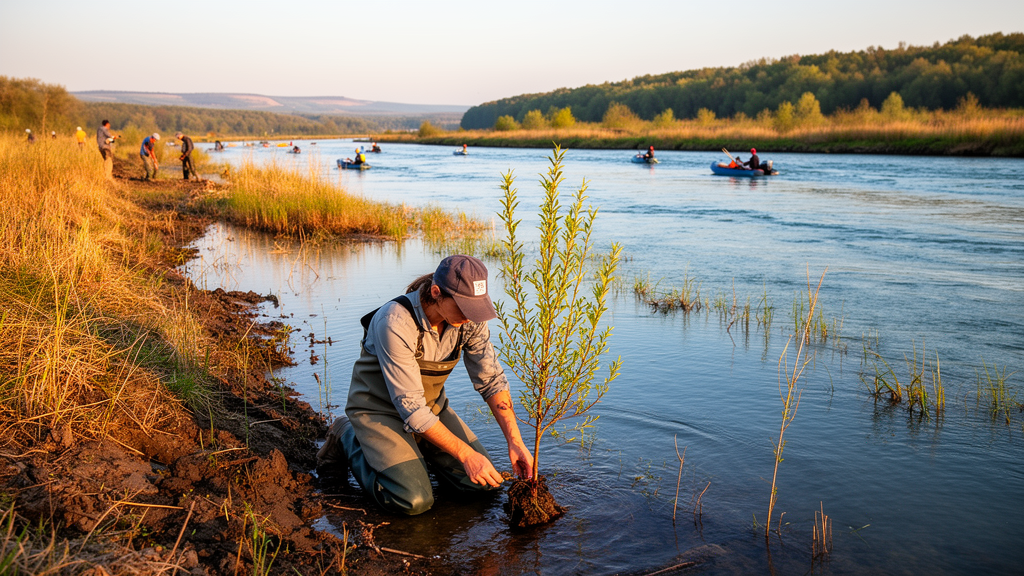
The Danube River carries more than water. It carries the ecological memory of a continent, linking more biogeographic regions than any other river in Europe and supporting the continent’s most species-rich river system, with roughly 2,000 vascular plant species and more than 5,000 animal species, including around 100 fish species and 180 breeding birds. Yet the same river that binds Central Europe to the Black Sea has been carved up by empires, ideologies and engineering for two centuries. A new study published in the journal Nature Conservation traces how a grassroots alliance of protected area managers, born from personal friendships and shared frustration, grew into one of Europe’s most remarkable experiments in transnational conservation governance: the DANUBEPARKS network.
The pressures on the Danube are staggering in their technical scope. Under the EU Water Framework Directive, 56 percent of the river’s entire course is classified as heavily modified, a formal designation acknowledging how profoundly dams, embankments and channelization have altered its hydromorphology. Upstream, the banks are 100 percent artificially structured, with barely three free-flowing sections remaining. Nearly 90 percent of the former floodplain forests along the Austrian stretch alone have vanished over the past 200 years. The threats vary along the river’s three sub-regions: the Upper Danube suffers most from fragmentation caused by hydropower and navigation dams, water quality and sediment disruption plague the Middle and Lower sections, and invasive species spread aggressively in the lower reaches. All the classic pressures on riparian ecosystems are present at once: flow alteration, pollution, habitat degradation, overexploitation, disrupted connectivity and biological invasion.
What makes the Danube politically unique is that it is the world’s most international river, touching 10 countries and a basin of roughly 79 million people who depend on it for drinking water, irrigation, energy and transport. Formal cooperation along the waterway dates to the Peace Treaty of Paris in 1856, which established navigation commissions but also divided the river into spheres of influence. The Cold War froze the river into the only major European waterway connecting the two blocs, and post-war transformation accelerated exploitation driven by rising energy demand. Scientific collaboration finally gained a foothold with the International Association for Danube Research in 1956, followed by the International Commission for the Protection of the Danube River in 1998, which now carries the transboundary obligations of the EU Water Framework Directive. But a critical gap remained: nine of the ICPDR member states belong to the European Union while five do not, meaning EU nature conservation legislation alone cannot provide sufficient incentive or obligation for basin-wide cooperation.
The 1990s saw a boom in formally managed protected areas along the entire river, from Germany to Bulgaria, each with its own administrative structures and devoted staff. Managers quickly realized that preserving a shared resource in isolation was impossible. Despite extreme differences in political priorities, capacity and resources, and despite working across seven different languages, bilateral communication based on private contacts and shared passion for nature began as early as the 1990s. A milestone came with the Danube Regional Project of UNDP/GEF, which culminated in the signing of the Declaration of Tulcea in 2007 by representatives of eight countries spanning the entire river. The document launched the Danube River Network of Protected Areas, recognizing the role of protected areas in conserving European natural heritage under the Convention on Wetlands and the Danube River Protection Convention.
That declaration led to the first systematic attempt to address common challenges at Danube scale: the DANUBEPARKS project funded by the EU’s European Territorial Cooperation programme from 2009 to 2012. It began with the Declaration of Vienna, which identified shared challenges including habitat fragmentation and hydromorphological alteration, and pledged formal establishment of the network. The project relied on a three-step approach of knowledge exchange, development of strategic documents of Danube-wide relevance, and pilot conservation measures. A survey completed by the University of the West England revealed something counterintuitive: partners valued communication and cooperation even more than practical conservation outcomes, and strongly preferred face-to-face and task force meetings. The opportunity to visit restoration sites just across borders that had previously been completely inaccessible for political reasons allowed partners to share innovative approaches to river restoration that had once seemed impossible.
The second project phase expanded the consortium to 20 members and produced the decisive structural step: in September 2014, the DANUBEPARKS Association was formally established as an Austrian-based non-governmental organization with headquarters hosted by the Donau-Auen National Park. The governance architecture was deliberately designed for balance. The General Assembly serves as the primary decision-making body comprising legal representatives from all member organizations. The Management Board functions as the operational body founded on principles of trust, equality and fairness, with balanced representation across the Upper, Middle and Lower Danube regions, elected through transparent processes with three-year mandates. Participation is voluntary and unpaid. An Audit Commission monitors compliance with the Statutes and conducts internal financial audits, while day-to-day operations are supported by a Secretary General and full-time staff. Membership fees are individually adjusted to national average income and the size of each protected area, ensuring sufficient commitment while respecting each partner’s specific circumstances.
The network’s flagship scientific achievement is the WILDisland concept, which reframes river islands as critical indicators of riparian ecosystem health. As part of the DANUBEparksCONNECTED INTERREG project from 2017 to 2019, the first-ever comprehensive inventory of all Danube islands was conducted, revealing a corridor of approximately 900 islands covering more than 138,000 hectares. Among them, 385 islands were classified as near-natural, with 147 islands spanning 14,000 hectares remaining largely untouched by human activity. Most islands lie in Hungary, with 254, and Romania, with 167. Historically around 2,000 islands existed along the Austrian stretch alone, but today only 83 remain following river regulation. The ecological significance is measurable: surveys in 2011 and 2013 confirmed that nearly 80 percent of the Danube population of the Little Ringed Plover nests on vegetation-free gravel and sand islands. These islands also support some of the most pristine alluvial forests in Europe, a habitat of continental conservation concern.
The WILDisland concept then made the leap from practice to policy. The initiative received formal recognition from the EU Forum of Nature and Biodiversity Directors for strengthening the coherence of Natura 2000 sites, and its relevance extends across the EU Biodiversity Strategy 2030, the Green Infrastructure Strategy, the Water Framework Directive, the Floods Directive and ultimately the European Green Deal. To bind these targets into a permanent structure with political recognition, the network turned to the Ramsar Convention on Wetlands, ratified by every country along the Danube. A Communique signed by all Danube countries in May 2022 at an unprecedented kick-off meeting in Vienna, attended by ambassadors and attachés, set the stage. The team presented the idea at the Ramsar CoP14 in Geneva in 2023, then secured National Support Letters from all ten invited member states from Germany to Ukraine. The International Commission for the Protection of the Danube River accepted patronage and formally submitted the application, and the Danube WILDisland Ramsar Regional Initiative was adopted at the 63rd meeting of the Ramsar Standing Committee in June 2024, with funding from Germany secured for 2024 to 2027.
The success factors read like a manual for bottom-up transnational governance. Years of systematic networking built on personal contacts developed mutual trust and understanding. The methodical development of the concept with clear messages, concrete steps and pilot projects proved feasibility. Decisively, the network volunteered to develop all application documentation without placing administrative burden on member states, and no strict financial obligations stemmed from membership, while clear opportunities existed to contribute to national wetland conservation goals. The approach deliberately translated the initiative’s significance for each stakeholder’s specific agenda, from member states to the ICPDR to the Ramsar Secretariat, stressing cross-policy synergies.
Challenges remain substantial. The Association currently operates with 19 active partners and 5 Observers, but there is no member from Ukraine due to technical reasons exacerbated by the ongoing military conflict. Staff turnover within member institutions means continuity depends on a relatively small core of committed individuals. Membership restricted to protected area managers excludes key sectors such as navigation, hydropower and agriculture, so in cases of major conflicts like the proposed Turnu Măgurele–Nikopol hydropower facility affecting Persina Nature Park, the Association can currently only act as a watchdog, flagging concerns without the political strength to halt developments. The Ramsar Convention itself lacks strong enforcement tools, relying on diplomatic pressure and reputational rather than legal consequences. Yet the model is already replicating: a 2024 internship mapped 179 islands along the Rhine, and active exchange continues with the UNESCO Mura-Drava-Danube Biosphere Reserve. Positioned at the crossroads between the Alps and the Carpathians, DANUBEPARKS demonstrates that locally driven networks, built on trust and equitable participation, can grow into established regional actors capable of anchoring conservation policy across one of the world’s most politically fragmented rivers.
Subject of Research: Transnational conservation governance on the Danube River
Article Title: Bridging protected areas along the Danube
Article References: Kmetova-Biro, E., Rožac, V., Frank, G., Marušić, M., & Lagutov, V. (2026). Bridging protected areas along the Danube. Nature Conservation, 62, 217-236. https://doi.org/10.3897/natureconservation.62.160887
Image Credits: AI Generated
DOI: 10.3897/natureconservation.62.160887
Keywords: Danube River, DANUBEPARKS, WILDisland, Ramsar Convention, ecological connectivity, protected areas, river restoration, transboundary conservation, Bridging, protected, areas, along
Cite Scienmag News
Margaret Porter. (October 18, 2026). How a grassroots network is stitching Europe’s Danube back together. Scienmag. https://scienmag.com/how-a-grassroots-network-is-stitching-europes-danube-back-together/
Margaret Porter. "How a grassroots network is stitching Europe’s Danube back together." Scienmag, 18 October 2026, https://scienmag.com/how-a-grassroots-network-is-stitching-europes-danube-back-together/. Accessed 18 October 2026.
Margaret Porter. "How a grassroots network is stitching Europe’s Danube back together." Scienmag. October 18, 2026. https://scienmag.com/how-a-grassroots-network-is-stitching-europes-danube-back-together/


