


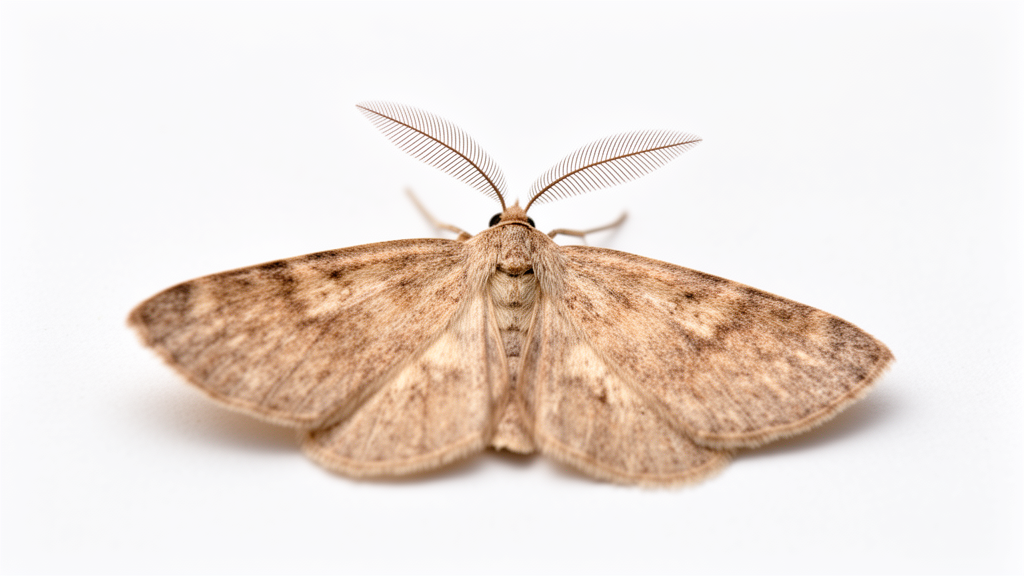
A moth that has carried the wrong scientific name for more than a century has finally been put in its proper place. A new study published in Nota Lepidopterologica shows that the African geometrid species described in 1915 as Nychiodes tyttha does not belong in the genus Nychiodes at all, but is instead a member of the entirely African genus Aphilopota. The finding, based on both DNA evidence and a detailed re-examination of the insect’s anatomy, formally renames the species Aphilopota tyttha and resolves a long-standing puzzle in the classification of the Geometridae, the family of inchworm moths.
The story begins with the British entomologist Louis Beethoven Prout, one of the great cataloguers of the world’s geometrid moths. In 1915, Prout described a small African species under the name tyttha and placed it in the genus Nychiodes, a group of mostly Palaearctic moths ranging from western Europe and North Africa to Iran, Afghanistan and Pakistan. Even in his original description, Prout had doubts. He noted that his new species was much smaller than other Nychiodes and showed slight differences in wing venation. He placed it in Nychiodes anyway, apparently judging the differences too minor to justify a separate genus.
Size, as later taxonomists would emphasise, is a notoriously unreliable character. The amount of available nutrition during larval development can strongly influence how large an adult moth grows, so body dimensions vary with environmental conditions and make a poor basis for classification. Wing venation, by contrast, is widely used in the Geometridae for distinguishing genera, because the pattern of veins is stable and reflects deep evolutionary relationships. Prout himself had flagged venation differences, and these would eventually prove decisive, but the species remained in limbo for decades because no molecular data were available to test its affinities.
Meanwhile, the genus Nychiodes underwent intensive integrative taxonomic revisions in recent years, combining morphology with molecular phylogenetics. Those revisions confirmed that the genus contains 25 species distributed across the Palaearctic region. Nychiodes tyttha stood out as the only species outside that range, occurring in central and southern Africa, from Eritrea, Ethiopia and Kenya in the east to Namibia in the south-west and South Africa in the south. Morphological examination during the earlier revisions strongly suggested that the African species should be excluded from Nychiodes, but without DNA from the type specimen, no suitable genus could be identified and the species remained an orphan in the classification.
The breakthrough came when the researchers succeeded in extracting DNA from the holotype, the single male specimen collected in Eritrea in 1905 by N. Beccari and deposited in the Natural History Museum in London. Because museum specimens of that age yield only degraded DNA, the team used a next-generation-sequencing protocol for old museum material at the Canadian Centre for DNA Barcoding in Guelph, within the Lepidoptera Campaign of the international Barcode of Life program. This recovered the 658 base-pair DNA barcode fragment of the mitochondrial cytochrome-c oxidase subunit I gene from the holotype itself, anchoring the molecular analysis to the very specimen on which Prout based the name.
With the barcode in hand, the team ran three complementary analyses. Comparing the COI fragments of the holotype and two additional specimens against the Barcode of Life Datasystems identification engine suggested that the genetically nearest neighbours were genera such as Jankowskia, Tephronia and Peribatodes, with genetic distances of 6.4 to 7.9 percent. A neighbour-joining tree built from the holotype sequence and 99 related samples revealed an Australian species, Aeolochroma sp., separating the African moth from those genera at 8.33 percent divergence. Most tellingly, the minimum p-distance between the African species and Nychiodes dalmatina, a true member of the genus, was 10.4 percent, a gap far too large for the two to be congeneric.
The decisive evidence came from a multigene phylogenetic analysis. The researchers amplified and sequenced five of eleven target gene regions from a non-type specimen: two fragments of COI, wingless, Ca-ATPase and Nex9. These were combined with sequences from 300 boarmiine taxa retrieved from earlier work, with two geometroid species serving as outgroups. The final dataset spanned 7662 base pairs, partitioned by gene and codon position, and was analysed under maximum likelihood in IQ-TREE with best-fitting substitution models selected for each partition and node supports evaluated with ultrafast bootstrap approximations and the SH-like approximate likelihood ratio test. The result placed the African species as sister to other species of Aphilopota with strong support, a bootstrap value of 97 percent.
Morphology told the same story. A detailed comparison with the type species of both genera revealed that the African moth carries the diagnostic characters of Aphilopota, not Nychiodes. In Aphilopota tyttha the labial palpi are thin, about two thirds of the diameter of the eye, whereas in both Aphilopota interpellans and Nychiodes obscuraria they are thick, about one eye diameter. In the forewing venation, vein R1 arises from the cell without reaching the costa and R2 is fused with R1, matching A. interpellans, while in N. obscuraria R1 and R2 share a common stalk. In the male genitalia, the valva is thin and lacks the two main processes, the ampulla and harpe, that characterise Nychiodes, and the juxta is forked and straight rather than anchor-shaped. The aedeagus is thin and tapered with one long sclerotized cornutus, and in the female genitalia the ovipositor is telescopic and strongly elongated with an arched, tube-like corpus bursae and no signum, again matching Aphilopota rather than Nychiodes, whose females have a short ovipositor, a round membranous corpus bursae and a stellate signum.
On the combined molecular and morphological evidence, the authors formally transferred the species to Aphilopota as Aphilopota tyttha, comb. nov., and provided a full re-description supported by illustrations of the external and internal characters. The re-description documents a wingspan of 21 to 25 millimetres in males and 28 millimetres in the single measured female, bipectinate antennae in both sexes, a reduced proboscis, and a beige-brown wing pattern with dark brown to black transverse lines. Adults have been observed from November to May, and the examined specimens were collected at elevations from 220 to 1300 metres in dry savanna ecoregions. The biology of the species remains unknown.
The study also highlights how much work remains in African geometrid taxonomy. The genus Aphilopota currently comprises 44 species distributed exclusively in Africa and Madagascar, but the authors note that it urgently needs taxonomic revision based on a broad integrative approach. The classification of the African species as sister to Aphilopota may not hold once more species of the genus are added to molecular datasets, and the authors acknowledge that a monotypic genus would have been an alternative reading of the phylogeny. For now, the detailed morphological investigation supports the combination with Aphilopota, giving a moth first collected in Eritrea in 1905 a genus that finally matches its geography, its genes and its anatomy.
Subject of Research: The African endemic species “ Nychiodes” tyttha Prout, 1915 (Lepidoptera, Geometridae, Ennominae) belongs to the genus Aphilopota Warren, 1899
Article Title: The African endemic species “ Nychiodes ” tyttha Prout, 1915 ( Lepidoptera , Geometridae , Ennominae ) belongs to the genus Aphilopota Warren, 1899
Article References: Wanke, D., Hausmann, A., Lees, D. C., Lee, K. M., Martin, G., Sihvonen, P., Staude, H., & Rajaei, H. (2023). The African endemic species “ Nychiodes” tyttha Prout, 1915 (Lepidoptera, Geometridae, Ennominae) belongs to the genus Aphilopota Warren, 1899. Nota Lepidopterologica, 46, 1-17. https://doi.org/10.3897/nl.46.94940
Image Credits: AI Generated
DOI: 10.3897/nl.46.94940
Keywords: African, endemic, species, Nychiodes, tyttha, Prout, Lepidoptera, Geometridae, Ennominae, belongs, genus, Aphilopota
Cite Scienmag News
Gavin Prescott. (October 18, 2026). African moth long mislabelled Nychiodes is actually an Aphilopota species. Scienmag. https://scienmag.com/african-moth-long-mislabelled-nychiodes-is-actually-an-aphilopota-species/
Gavin Prescott. "African moth long mislabelled Nychiodes is actually an Aphilopota species." Scienmag, 18 October 2026, https://scienmag.com/african-moth-long-mislabelled-nychiodes-is-actually-an-aphilopota-species/. Accessed 18 October 2026.
Gavin Prescott. "African moth long mislabelled Nychiodes is actually an Aphilopota species." Scienmag. October 18, 2026. https://scienmag.com/african-moth-long-mislabelled-nychiodes-is-actually-an-aphilopota-species/


