


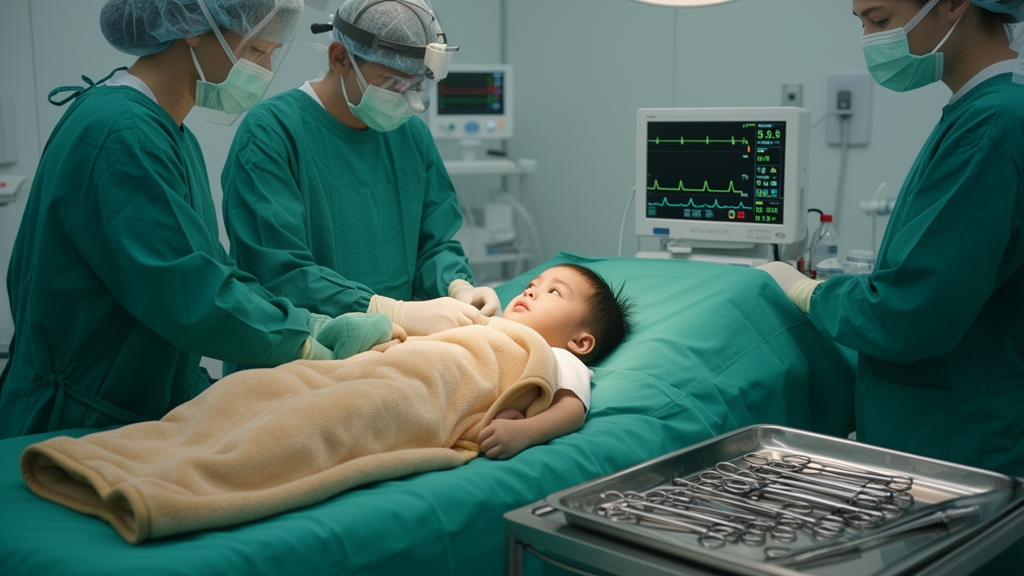
Every year, millions of children break an arm or a leg, and a substantial fraction of them end up on an operating table to have the fracture pinned, plated, or wired back together. While surgeons and anesthesiologists focus on the airway, the blood loss, and the precision of the repair, a quieter danger unfolds at the level of the skin: the child’s core temperature can slip, degree by degree, into territory that complicates recovery. A new study from the Children’s Hospital of Nanjing Medical University, published in BMC Pediatrics, has now quantified exactly how often this happens during limb fracture surgery in children, identified the factors that drive it, and built a simple bedside scoring tool that could flag vulnerable patients before the first incision is made.
The condition at issue is intraoperative hypothermia, defined as a fall in core body temperature below 36 degrees Celsius while the patient is under anesthesia. It is one of the most common perioperative complications in pediatric surgery, and it is far from benign. Hypothermia slows the metabolism of anesthetic drugs, prolonging recovery and delaying awakening. It impairs platelet function and coagulation, increasing surgical bleeding. It constricts peripheral blood vessels, reduces oxygen delivery to healing tissues, and raises the risk of surgical site infection. In children, all of these effects are amplified by a fundamental piece of physiology: young bodies have a high surface-area-to-mass ratio, thin layers of insulating subcutaneous fat, and limited ability to generate heat through shivering, particularly when anesthetics suppress the shivering reflex altogether.
Extremity fracture surgery carries its own set of thermal hazards that make it a particularly interesting case study. The operative limb is often exposed and prepped with cold antiseptic solutions. Fracture repair can involve copious irrigation of the wound, and if that irrigation fluid is stored at room temperature rather than warmed to body temperature, each liter of unheated saline can strip a surprising amount of heat from the child’s core. Blood loss adds a further thermal drain, because shed blood carries heat away with it and replacement fluids are typically administered cool. Long operations compound all of these losses, and general anesthesia itself disables the thermoregulatory defenses that would normally kick in to hold body temperature steady.
To measure the scale of the problem, Yunpeng Wu and Jianming Xiao, both based in the hospital’s operating room, conducted a retrospective analysis of 266 children who underwent extremity fracture surgery between August 2023 and August 2025. The children ranged in age from toddlers to adolescents, and all had fractures of the limbs repaired under anesthesia. The researchers reviewed intraoperative temperature records, anesthetic charts, and nursing documentation to determine how many children experienced a core temperature drop below 36 degrees Celsius during the procedure, and then cross-referenced those cases with a detailed set of patient and procedural variables to identify what distinguished the children who cooled from those who did not.
The headline finding was that 18 percent of the children, 48 out of 266, developed intraoperative hypothermia. That is nearly one in five young fracture patients, a figure that the authors argue justifies routine rather than selective thermal monitoring in this population. But the raw incidence is only part of the story. When the researchers ran the data through univariate correlation analysis followed by multivariate logistic regression, a statistical technique that isolates the effect of each variable while holding all others constant, five independent risk factors emerged, each with a highly significant association with hypothermia.
Age was the first of these. Children aged seven years or younger had roughly three and a quarter times the odds of developing hypothermia compared with older children, reflecting the fact that smaller bodies lose heat faster and have less thermal reserve to draw upon. Body mass index was the second factor: children with a BMI of 17 kilograms per square meter or less, indicating a lean build with minimal insulating fat, had nearly three times the odds of cooling. The third factor was operation duration. Procedures lasting 90 minutes or longer carried four and a half times the odds of hypothermia compared with shorter operations, a dose-response relationship that makes intuitive sense, since every additional minute on the table is another minute of ongoing heat loss.
The fourth and fifth factors were the most striking, and both relate directly to what happens in the wound itself. Intraoperative blood loss exceeding 100 milliliters was associated with more than five times the odds of hypothermia, and the use of unheated irrigation fluid was the single strongest predictor of all, with more than six times the odds. These two findings point to a clear and actionable conclusion: a substantial share of the thermal burden in pediatric fracture surgery comes not from the child’s inherent vulnerability but from the temperature of the fluids that surgeons and nurses introduce into the operative field. Warm the irrigation, the data suggest, and a large fraction of the risk disappears.
With these five factors in hand, the researchers constructed a predictive model in the form of a simple scoring system, assigning points to each risk factor so that the total score ranges from zero to ten. The model’s performance was evaluated using receiver operating characteristic curve analysis, a standard technique for measuring how well a diagnostic or predictive tool separates true positives from false positives across all possible cutoff values. The area under the curve came out at 0.876, with a 95 percent confidence interval of 0.823 to 0.929, a figure that places the tool in the range of good clinical discrimination. At a cutoff of six points or more, the score caught 81.3 percent of children who actually developed hypothermia while correctly clearing 78.6 percent of those who did not. At a stricter cutoff of eight points or more, the sensitivity dropped to 62.5 percent but the specificity rose to 92.8 percent, meaning the tool becomes highly reliable at identifying children at very high risk when the stakes of a false alarm are low.
The clinical implications of the work are straightforward, and the authors lay them out as a set of targeted nursing countermeasures rather than as abstract statistical findings. Preoperative risk assessment using the ten-point score could identify high-risk children before surgery begins, allowing operating room teams to apply warming blankets from the outset, heat all irrigation fluids to body temperature, and implement standardized temperature monitoring protocols rather than relying on intermittent spot checks. For children who score in the highest range, the data suggest that aggressive thermal management should be treated as a routine part of the surgical plan, not an optional add-on. Because the score is built from variables that are already known before or during the early stages of surgery, it requires no additional testing, no specialized equipment, and no change to the surgical technique itself.
The study is not without limitations. It is retrospective, drawn from a single institution, and relies on the accuracy of existing intraoperative records rather than on prospectively collected data. The scoring system has not yet been validated in an independent cohort, and the specific cutoff values may need adjustment in settings with different patient populations or surgical practices. Still, the work adds to a growing body of evidence that perioperative hypothermia in children is both predictable and preventable, and it offers operating room teams a practical tool for acting on that evidence. As pediatric orthopedic surgery continues to grow in volume worldwide, the message from Nanjing is clear: the temperature of a child on the operating table is a variable that can be measured, modeled, and managed, and the tools for doing so are already within reach of any surgical team willing to use them.
Subject of Research: Intraoperative hypothermia in children undergoing extremity fracture surgery: incidence, risk factors, predictive model, and clinical implications
Article Title: Intraoperative hypothermia in children undergoing extremity fracture surgery: incidence, risk factors, predictive model, and clinical implications
Article References: Wu, Y., & Xiao, J. (2026). Intraoperative hypothermia in children undergoing extremity fracture surgery: incidence, risk factors, predictive model, and clinical implications. BMC Pediatrics. https://doi.org/10.1186/s12887-026-07065-1
Image Credits: AI Generated
DOI: 10.1186/s12887-026-07065-1
Keywords: Intraoperative, hypothermia, children, undergoing, extremity, fracture, surgery, incidence, risk, factors, predictive, model
Cite Scienmag News
Ophelia Keating. (October 18, 2026). Simple 10-point score predicts dangerous body cooling in children during fracture surgery. Scienmag. https://scienmag.com/simple-10-point-score-predicts-dangerous-body-cooling-in-children-during-fracture-surgery/
Ophelia Keating. "Simple 10-point score predicts dangerous body cooling in children during fracture surgery." Scienmag, 18 October 2026, https://scienmag.com/simple-10-point-score-predicts-dangerous-body-cooling-in-children-during-fracture-surgery/. Accessed 18 October 2026.
Ophelia Keating. "Simple 10-point score predicts dangerous body cooling in children during fracture surgery." Scienmag. October 18, 2026. https://scienmag.com/simple-10-point-score-predicts-dangerous-body-cooling-in-children-during-fracture-surgery/


