


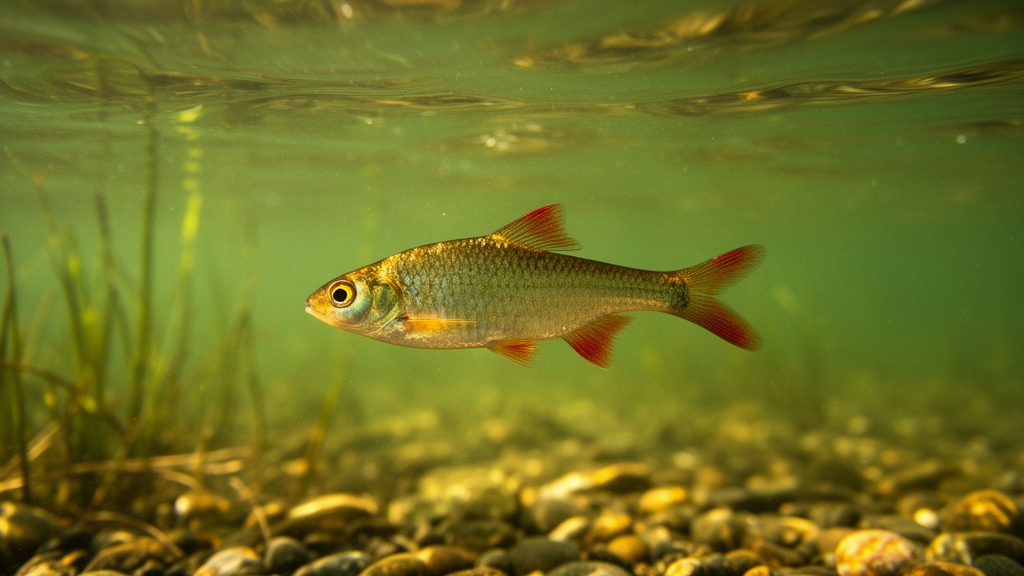
A small silvery fish with a peculiar name has just rewritten the ichthyological map of Bulgaria. The cactus roach, Rutilus virgo, a cyprinid endemic to the Danube River system, has been documented for the first time in the Bulgarian stretch of the Lower Danube, according to a study published in November 2025 in the journal Acta Ichthyologica et Piscatoria. Five adult specimens were collected in April 2025 from the westernmost section of the Bulgarian Danube, between river kilometers 769 and 844, during the period of spring high waters. The finding is the first confirmed and documented record of the species anywhere downstream of the Iron Gate dam, a massive barrier that has long been assumed to mark the downstream limit of its range.
The cactus roach owes its common name to the breeding males, whose heads and front bodies become studded with rows of hard tubercles during the spawning season, giving them a cactus-like appearance. The species was originally described by Heckel in 1852 after the Danubian population was separated from Rutilus pigus, a closely related roach that inhabits lakes in northern Italy. Although a detailed morphological survey by Mišík in 1957 found no significant differences between the two taxa, Kottelat in 1997 recognized them as distinct species, an interpretation later fully supported by phylogenetic analysis of Mediterranean and Central European roaches published by Ketmaier and colleagues in 2008. The cactus roach is thus an endemic species of the Danube drainage, widespread in the larger rivers of Germany, Austria, Slovakia, Hungary, Croatia, Slovenia, Serbia, Bosnia and Herzegovina, and Montenegro, yet surprisingly rare or even absent in much of the Lower Danube.
The specimens that now anchor the Bulgarian record were caught by local fishermen using bottom-floating gillnets in the main channel of the Danube River. A male of 332 millimeters total length, a female of 360 millimeters, and a female of 305 millimeters were taken on 15 April near Kudelin; a male of 359 millimeters was caught on 17 April near Novo Selo; and a male of 338 millimeters was landed on 7 April near Archar. Three more individuals were recorded near Vrav and Gomotartsi, where they were caught and photographed but not preserved. All five preserved specimens were frozen immediately after capture, subsequently fixed in 4 percent formalin, and deposited in the ichthyological collection of the National Museum of Natural History in Sofia, where they await inventory.
Every collected specimen exhibited the diagnostic features characteristic of Rutilus virgo, including an inferior mouth, a silvery iris, 45 to 47 lateral-line scales, 10 to 11 branched anal-fin rays, and 10 branched dorsal-fin rays. In females, the peritoneum was uniformly black. The males displayed two horizontal rows of cephalic tubercles located above the eyes, with additional tubercles distributed along the flanks, which detached post mortem. All specimens were in a potential spawning condition, exhibiting mature gonads, and the males showed well-developed tubercles on the head and front part of the body, a clear sign that the fish were preparing to reproduce.
The measurements revealed an intriguing morphological signal. The Bulgarian specimens differed in certain body proportions compared with those from the Slovakian section of the Danube and from the Tisza basin in Ukraine. The most pronounced distinction was the mean least depth of the caudal peduncle, expressed as a percentage of standard length, which measured 13.5 in the Bulgarian Danube, compared with 9.9 in the Slovakian Danube and 10.1 in the Tisza basin. The observed ranges also differed substantially, from 12.9 to 13.9 in the Bulgarian fish versus 8.4 to 11.3 in the Slovakian Danube and 9.1 to 10.7 in the Tisza basin, indicating a clear hiatus between the Lower Danube population and the others. However, the authors caution that this difference may reflect the limited sample size or methodological variation in measurements, and morphological data from only five individuals are insufficient to support conclusions regarding taxonomic distinctiveness. All examined meristic characters, including scale counts and fin-ray numbers, were largely consistent across populations.
The historical literature adds a layer of mystery to the new record. The species was first mentioned in Bulgarian ichthyological literature by Kovatcheff in 1923, who listed Leuciscus virgo as distributed throughout the entire Danube basin and, by implication, in Bulgaria. Subsequently, Drensky in 1948 reported the occurrence of the cactus roach near Lom, at river kilometer 744, but provided no supporting material or evidence. In his later monograph on the fishes of Bulgaria, Drensky did not include Rutilus virgo; instead, he listed Rutilus frisii meidingeri, stating its presence in the Danube near Svishtov. Marinov in 1978 had already questioned the occurrence of that species in the Bulgarian Danube, since it is restricted to the upper Danube and some subalpine Austrian lakes, and subsequent surveys have never confirmed its presence in Bulgaria. It is possible that historical records of male roaches, heavily covered in breeding tubercles, were misidentified by Drensky as the meidingeri roach, whereas they may in fact have been cactus roach. No specimens or documented records exist to support this assumption, and both taxa have been absent from the Bulgarian ichthyological literature for more than 50 years.
The timing of the captures offers a compelling explanation for the sudden appearance of the species. All specimens were caught during the spring high-water period in April 2025, and it is possible that their presence was facilitated by washing with the peak waters downstream. The cactus roach is a potamodromous species known for its upstream spawning migrations, typically triggered when water temperatures reach 10 to 14 degrees Celsius. During the period of 7 to 17 April, when the five specimens were collected, water temperatures in the Danube ranged between 10.6 and 12.2 degrees Celsius, conditions suitable for the initiation of spawning migrations. The authors exclude the possibility that the origin of the specimens is related to a potential introduction or translocation. Although the fish were in very good condition and fully mature, reproduction of the species in the Lower Danube can only be hypothesized at this stage.
The biological parameters of the collected fish paint a picture of a healthy, mature population segment. The specimens were aged between 5+ and 6+ years, and fecundity estimates for the two females were 16,704 and 6,260 eggs respectively, obtained using the gravimetric method. The largest female, from Kudelin, measured 360 millimeters total length and weighed 670 grams, with gonads weighing 206.80 grams. As in other congeners, Rutilus virgo is a shoaling species, and it is therefore highly probable that additional individuals will be encountered in this part of the river. Because the species is rare in the Lower Danube, the construction of an effective fish passage serving multiple migratory taxa would be vital for ensuring its persistence in this section of the river, given that the Iron Gates Dam represents a critical barrier obstructing upstream movement and potentially restricting access to suitable spawning habitats.
The conservation implications are significant. Rutilus virgo is a species protected under the EU Habitat Directive, listed in Annexes II and IV, and carries the Natura 2000 species code 5345. To date, six EU Member States, namely Germany, Slovakia, Austria, Slovenia, Croatia, and Hungary, have designated a total of 70 Natura 2000 sites for the conservation of this species. The new record confirms the presence of the cactus roach in at least three Natura 2000 sites along the Bulgarian stretch of the Danube: Novo Selo, Ostrov Bliznatsi, and Archar. The authors recommend that the species be included in Annex 2 of the Bulgarian Biodiversity Act, and propose the implementation of systematic monitoring of its population status within the relevant sites, with subsequent reporting in accordance with Articles 11 and 17 of the Habitat Directive.
Rutilus virgo should now be regarded as a confirmed component of the ichthyofauna of Bulgaria, closing a gap that has persisted for over a century. Further investigations are required to clarify its distribution, population status, and biological traits in the Lower Danube, with particular attention to its reproductive ecology and conservation needs. Given the species’ rarity in this section of the river and the potential impact of migration barriers, targeted conservation measures and improved longitudinal connectivity are essential to ensure the long-term persistence of the cactus roach in the Lower Danube. For a fish that has spent decades hidden in plain sight, the cactus roach may finally be getting the attention it deserves.
Subject of Research: First confirmed record of the cactus roach Rutilus virgo in the Bulgarian Lower Danube, documenting five adult specimens collected in April 2025 and discussing morphology, spawning condition, historical misidentifications, and conservation implications under the EU Habitat Directive.
Article Title: First record of Rutilus virgo ( Actinopterygii , Cypriniformes , Leuciscidae ) from the Lower Danube in Bulgaria
Article References: Stefanov, T., Pandakov, P., & Kodzhabashev, N. (2025). First record of Rutilus virgo (Actinopterygii, Cypriniformes, Leuciscidae) from the Lower Danube in Bulgaria. Acta Ichthyologica et Piscatoria, 55, 357-362. https://doi.org/10.3897/aiep.55.170510
Image Credits: AI Generated
Keywords: Rutilus virgo, cactus roach, Lower Danube, Bulgaria, Ichthyology, Fish migration, Iron Gate dam, Natura 2000, Conservation, Acta Ichthyologica et Piscatoria, First, record
Cite Scienmag News
Violet Maxwell. (October 18, 2026). Cactus roach surfaces in Bulgarian Danube for the first time, rewriting a century of fish records. Scienmag. https://scienmag.com/cactus-roach-surfaces-in-bulgarian-danube-for-the-first-time-rewriting-a-century-of-fish-records/
Violet Maxwell. "Cactus roach surfaces in Bulgarian Danube for the first time, rewriting a century of fish records." Scienmag, 18 October 2026, https://scienmag.com/cactus-roach-surfaces-in-bulgarian-danube-for-the-first-time-rewriting-a-century-of-fish-records/. Accessed 18 October 2026.
Violet Maxwell. "Cactus roach surfaces in Bulgarian Danube for the first time, rewriting a century of fish records." Scienmag. October 18, 2026. https://scienmag.com/cactus-roach-surfaces-in-bulgarian-danube-for-the-first-time-rewriting-a-century-of-fish-records/


