


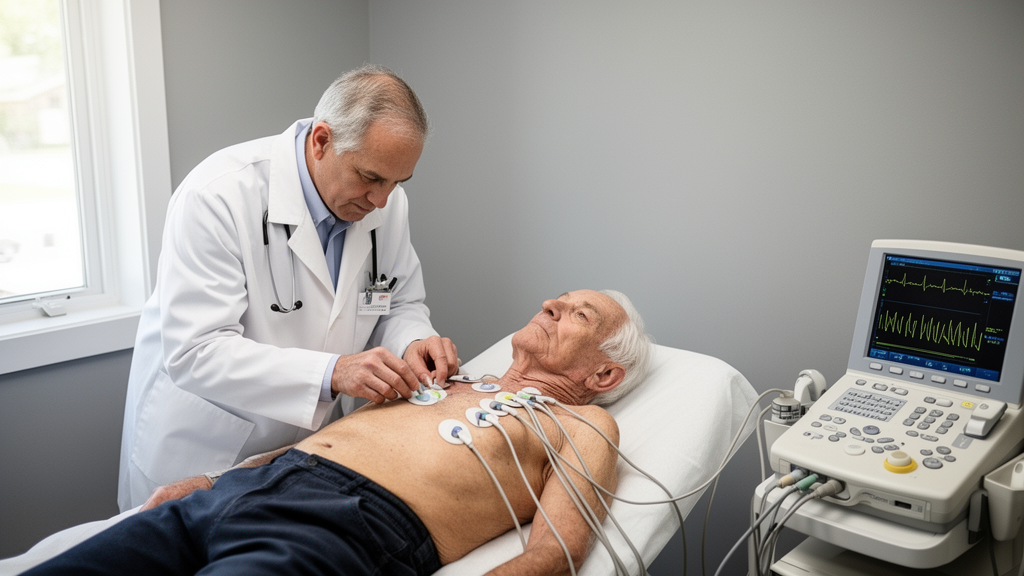
Every year, millions of older adults arrive at hospitals short of breath, their legs swollen, their lungs filling with fluid. Many of them have a particularly slippery form of heart failure: the heart’s pumping strength looks normal on an echocardiogram, yet the organ has failed all the same. Now a research team in China reports that a quick, painless electrical measurement of the body’s water may help unmask this condition before it spirals into a crisis, offering clinicians a bedside tool that requires nothing more than electrodes and a few minutes of a patient’s time.
The condition in question is acute decompensated heart failure with preserved ejection fraction, abbreviated ADHFpEF. In this disorder, the heart muscle becomes stiff and cannot relax properly between beats, so blood backs up into the lungs and tissues even though the heart’s ejection fraction, the percentage of blood pumped out with each contraction, remains above normal thresholds. Because the pumping numbers look reassuring, emergency physicians and geriatricians frequently miss the diagnosis, especially in elderly patients whose symptoms overlap with common complaints of aging such as fatigue, mild breathlessness, and generalized swelling. Delayed recognition means delayed treatment, and in older adults that delay can be measured in lost function and lost independence.
Researchers at the Third People’s Hospital of Yunnan Province, part of the Second Affiliated Hospital of Dali University in Kunming, turned to bioelectrical impedance analysis, or BIA, as a possible solution. The technique exploits a simple physical principle: lean tissue and water conduct electrical current well, while fat resists it. By passing a weak, harmless alternating current through the body and measuring how it is impeded, multifrequency BIA devices can estimate how much water the body holds and, crucially, where that water sits. The method is already familiar from nutrition clinics and dialysis units, but its value for flagging acute heart failure in elderly hospital populations had not been systematically tested until now.
Two numbers lie at the heart of the new study. The first is the ratio of extracellular water to total body water, written ECW/TBW. In healthy people, most of the body’s water resides inside cells, with only a controlled fraction circulating in the spaces between cells and in blood plasma. When the heart cannot keep up, pressure rises in the capillaries and fluid leaks outward, inflating the extracellular compartment. A rising ECW/TBW ratio therefore acts as a fingerprint of congestion. The second number is the phase angle, a measure derived from the resistance and reactance of body tissues. A healthy cell membrane behaves like a tiny capacitor, storing charge and delaying the electrical signal; intact, hydrated cells with robust membranes produce a larger phase angle, while damaged, depleted cells let current pass more freely, shrinking the number. Low phase angle has long been linked to malnutrition, inflammation, and poor outcomes across many diseases.
To see whether these electrical signatures could distinguish ADHFpEF, the team enrolled 377 older hospitalized patients with an average age of 74.9 years, about 57 percent of them women. Thirty-three of the participants, or 8.8 percent, had been diagnosed with acute decompensated heart failure with preserved ejection fraction. Each patient underwent multifrequency BIA measurements at the whole body, trunk, and leg levels, allowing the researchers to map fluid distribution across different anatomical regions rather than relying on a single global reading. The team then applied a battery of statistical tools, including logistic regression, a restricted cubic spline model, and receiver operating characteristic analysis, to quantify how strongly the BIA parameters tracked with the diagnosis.
The results were strikingly consistent. Higher ECW/TBW ratios at the whole body, trunk, and leg levels all predicted ADHFpEF, with odds ratios ranging from 3.02 to 3.61 and every association reaching statistical significance. In practical terms, patients whose extracellular water fraction was elevated had roughly three times the odds of having the condition for each step up the scale. Phase angle told the opposite story: whole body and leg phase angles were negatively associated with ADHFpEF, with odds ratios of about 0.18 to 0.19, meaning that lower values, reflecting weaker cell membranes and greater cellular distress, strongly marked the disease. Intriguingly, trunk phase angle showed no significant association, suggesting that the trunk, which houses most of the congestion in heart failure, may be better characterized by its water ratio than by its electrical phase.
Perhaps the most thought-provoking finding came from the nonlinear analysis. Using a restricted cubic spline model, the researchers discovered a J-shaped relationship between whole body and trunk ECW/TBW and the likelihood of ADHFpEF, with inflection points at 39.5 percent and 39.7 percent respectively. Below those thresholds, rising extracellular water fractions carried relatively little added risk; above them, the probability of the condition climbed steeply. This kind of tipping-point behavior fits the physiology of decompensation, in which the body compensates for fluid overload until a critical level is crossed and symptoms erupt. If the finding holds in future studies, the roughly 39.5 percent mark could serve as a practical alert threshold for clinicians scanning BIA printouts at the bedside.
The team did not stop at individual markers. They built a basic clinical model from conventional patient information and then tested whether adding BIA parameters improved its diagnostic power. The winning combination incorporated trunk ECW/TBW, pushing the area under the receiver operating characteristic curve, a standard gauge of diagnostic accuracy, to 0.904. An AUC of 0.904 sits well above the 0.5 that represents random guessing and approaches the range where a test becomes genuinely useful for clinical decision-making. In other words, a single trunk measurement of fluid distribution, layered onto routine clinical data, allowed the model to separate patients with ADHFpEF from those without it with impressive reliability.
For a condition that is notoriously difficult to catch early, the implications are considerable. Echocardiography, the current mainstay, requires expensive equipment, trained sonographers, and interpretation by specialists, and it can be inconclusive in the acute setting when volume status is shifting. Natriuretic peptide blood tests help but are influenced by age, kidney function, obesity, and other factors common in the elderly. BIA, by contrast, is non-invasive, radiation-free, and fast enough to repeat daily, making it plausible as a monitoring tool that could track a patient’s fluid trajectory through a hospital stay and flag deterioration before symptoms demand attention. The study’s authors suggest that elevated ECW/TBW and reduced phase angle may help identify older patients with a higher likelihood of ADHFpEF, positioning the measurements as adjunctive bedside markers rather than standalone diagnoses.
Caveats remain, as they do with any cross-sectional study. The research captured a snapshot in time at a single Chinese hospital, and the number of patients with ADHFpEF, 33 in total, was modest, which limits how precisely the thresholds and performance figures can be generalized. The published version is an early-release, citable article carrying a permanent DOI, subject to further editorial refinement before the final version of record appears. Prospective studies following patients over time, and validation in other populations and healthcare systems, will be needed before BIA parameters earn a place in formal diagnostic guidelines. Still, the core message is hard to ignore: the electrical whisper of shifting water in an aging body may carry enough information to reveal one of medicine’s most commonly missed diagnoses, using a device that costs a fraction of an echocardiogram and fits beside a hospital bed.
Subject of Research: Water distribution and phase angle based on bioelectrical impedance analysis: a convenient approach for identifying acute decompensated heart failure with preserved ejection fraction in older adults
Article Title: Water distribution and phase angle based on bioelectrical impedance analysis: a convenient approach for identifying acute decompensated heart failure with preserved ejection fraction in older adults
Article References: Yang, H., Yang, H., Yuan, J., Li, H., Huang, Y., Chen, S., Cao, F., Chen, W., & Duan, Z. (2026). Water distribution and phase angle based on bioelectrical impedance analysis: a convenient approach for identifying acute decompensated heart failure with preserved ejection fraction in older adults. BMC Geriatrics. https://doi.org/10.1186/s12877-026-08337-2
Image Credits: AI Generated
DOI: 10.1186/s12877-026-08337-2
Keywords: Water, distribution, phase, angle, based, bioelectrical, impedance, analysis, convenient, approach, identifying, acute
Cite Scienmag News
Ophelia Keating. (October 18, 2026). Simple electrical test could spot hidden heart failure in older adults. Scienmag. https://scienmag.com/simple-electrical-test-could-spot-hidden-heart-failure-in-older-adults/
Ophelia Keating. "Simple electrical test could spot hidden heart failure in older adults." Scienmag, 18 October 2026, https://scienmag.com/simple-electrical-test-could-spot-hidden-heart-failure-in-older-adults/. Accessed 18 October 2026.
Ophelia Keating. "Simple electrical test could spot hidden heart failure in older adults." Scienmag. October 18, 2026. https://scienmag.com/simple-electrical-test-could-spot-hidden-heart-failure-in-older-adults/


