


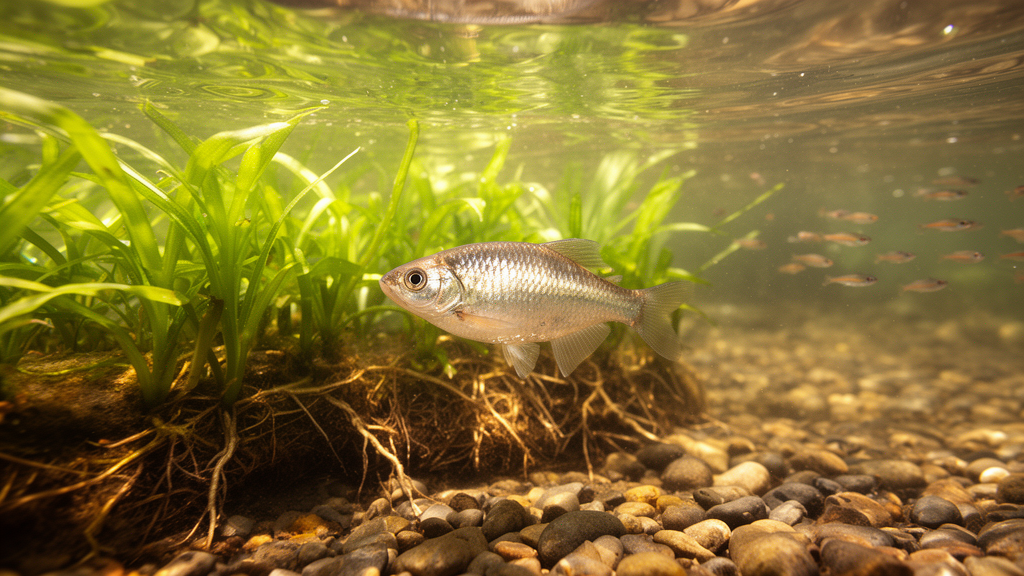
Deep in the highlands of central Mexico, a small viviparous fish that most of the world has never heard of is quietly staging one of the region’s most surprising ecological comebacks. The Mexclapique, Girardinichthys viviparus, a goodeid splitfin endemic to the Valley of Mexico basin, has been listed as endangered by the International Union for Conservation of Nature after decades of habitat loss, urbanization and pollution reduced its populations to a handful of urban lakes and wetlands. Now, a team of Mexican ichthyologists reports something unexpected: thriving populations of this imperiled species in six aquatic systems across the state of Tlaxcala, far east of its historically documented strongholds, including a first record for the state within the Tecolutla River basin.
The discovery, published in Neotropical Biology and Conservation, emerged from systematic collections carried out between February 2019 and June 2021 to identify the fish fauna of Tlaxcala, a state whose ichthyofauna remains remarkably poorly known. Using a trawling net two meters long with a one-centimeter mesh, the researchers captured a total of 160 juvenile and adult specimens of G. viviparus at six sites distributed across the central, northwestern and eastern portions of the state. The sites included Atlangatepec Lake, the reservoir with the largest water surface area in Tlaxcala; Tochac Lake on the border with Hidalgo; the Tenexac dam; and small rural catchment ponds known locally as jagüeyes near Atlangatepec. Captured fish ranged from 17.9 to 53.4 millimeters in standard length and from 23.8 to 68.8 millimeters in total length.
What makes these records so remarkable is the geography. The Mexclapique was historically distributed in the endorheic basin of the Valley of Mexico, geopolitically corresponding to Mexico City and parts of the states of Mexico, Hidalgo and Tlaxcala. In 1957, the species was recorded at 17 localities in the Valley of Mexico; by 1976, populations persisted in Lake Zumpango, and the last known collections in San Juan Teotihuacán were made in 1977. Subsequent surveys failed to find the species in Lake Zumpango, an absence attributed to aquatic pollution, and the fish disappeared from Lake Chalco and Lake Texcoco. Only 2 percent of the natural aquatic landscape of the region is currently preserved. The last populations documented over the past 20 years were confined to the lakes of Chapultepec Park, Alameda Oriente and Xochimilco in Mexico City, Lake Nabor Carrillo in the state of Mexico, and Lake Tecocomulco in Hidalgo.
The new Tlaxcala populations occupy the upper basins of the Atoyac, Moctezuma and Tecolutla rivers, extending the species’ known distribution eastward within the state. The Tenexac dam record is particularly significant because it lies within the Tecolutla River basin, a drainage that flows toward the Gulf of Mexico rather than the internally closed Valley of Mexico basin. According to the authors, the presence of G. viviparus in these systems may reflect evolutionary processes of expansion, adaptation and establishment that the species has undergone in central Mexico, as well as the interconnection of water bodies through artificial channels. Lake Tochac drains into the Apan lagoon, which is intercommunicated with Lake Tecocomulco, considered a recharge area for adjacent aquifers that discharge through artificial canals into the Zumpango region, a connection that could explain the species’ presence in Tochac.
Specimens were fixed in 10 percent formalin, preserved in 70 percent ethanol and deposited in the Ichthyological Collection of the Facultad de Estudios Superiores Iztacala of the Universidad Nacional Autónoma de México under catalog numbers CIFI 1505, CIFI 1598, CIFI 1708, CIFI 1709, CIFI 1710 and CIFI 1711. Detailed meristic and morphometric analyses confirmed the identification. The fish possess a slender body and caudal peduncle representing 34 to 37 percent of standard length, a small eye accounting for 26 to 35 percent of cephalic length, dorsal fins with 19 to 26 rays, anal fins with 21 to 29 rays, and 45 to 55 scales with pores along the lateral line. Body coloration is green-olivaceous and slightly hyaline, with an iridescent horizontal line running from the postorbital region to the base of the caudal peduncle, scattered melanophores concentrated in the cephalic region and dorsal and anal fins, and a white abdominal area with iridescent peritoneum.
The collections revealed both juvenile and reproductively active adults, offering encouraging evidence of established breeding populations rather than transient individuals. Females grow larger than males, and several gravid females were identified by a prominent bulge in the abdominal area: four gravid females in the Tochac Lake sample, seven in the jagüey near Loma Bonita, and one in Atlangatepec Lake. Embryos at an advanced stage of development were identified in two gravid females from the Tenexac reservoir, and among 23 adult females in a second Tenexac sample, eight carried embryos at some stage of development. Males displayed dark coloration between the dorsal and anal fin rays, sometimes with intense black spots on the dorsal fins and hyaline coloration on the periphery of both fins, while the caudal fin showed a faint yellow-greenish coloration at its base.
The Mexclapique’s survival strategy is a study in tolerance under pressure. The urban aquatic systems where the species has persisted, such as the lakes of Chapultepec Park, are shallow, artificial and hypertrophic environments with highly variable physicochemical conditions, including temperatures of 16 to 25 degrees Celsius, dissolved oxygen ranging from 0.63 to 24.9 milligrams per liter, and pH values from 3.1 to 9.8, driven by wastewater inputs subjected to purification processes. The species tolerates these environmental pressures, and its populations tend to be higher when not associated with other fish. Yet its biology leaves little room for error: it is a viviparous fish with a low birth rate, and environmental pressure, habitat disturbance, limited dispersal and recolonization capacity all compound its vulnerability. These factors have earned it a threatened category under national risk criteria and endangered status on the IUCN Red List.
The Tlaxcala systems themselves are far from pristine. Atlangatepec Lake’s main tributary, the Zahuapan River, is also its main source of contamination, receiving discharges from urban and industrial use. Exotic fish species have been introduced into the lake since 1987 through the Atlangatepec Aquaculture Center, which continuously produces hatchlings supplied to reservoirs across the state; among the exotic species used in the local fishery is the common carp Cyprinus carpio, and translocated Mexican species such as the charal Chirostoma jordani and Algansea lacustris are also recorded there, though not abundant. There is only one previous record of G. viviparus in Atlangatepec, from 1990, with no information on whether the species survived at the site. The Tenexac dam, built to supply water for agricultural and irrigation activities, shares its waters with the exotic carp and the plateau tiger salamander Ambystoma velasci, and until now had no documented physicochemical or faunal information.
The jagüeyes, small ponds for catchment and storage of runoff and rainwater in rural areas, represent 96 percent of the water bodies in Tlaxcala and are crucial for the subsistence of the region’s scarce aquatic fauna, supplying water for human consumption, agriculture and livestock. Yet they are highly susceptible to disappearance through lack of maintenance, drying during rainfall deficits, land use changes or the extension of agricultural and industrial zones. Many lie near roads and highways, making them vulnerable to contamination from waste accumulation, a scenario that keeps Mexclapique populations at risk. Urbanization and agricultural activities around the lakes contribute to eutrophication, toxicity and pollution; high phosphate levels in sediments around Lake Tochac, driven by fertilizer use in surrounding crops, generate poor water quality that can affect fish used in aquaculture. Freshwater extraction for domestic and industrial demand, together with pollution and land use change, has fragmented the species’ distribution and keeps its populations vulnerable.
History offers sobering warnings about what happens when these pressures go unaddressed. The fish genus Evarra, endemic to Mexico City’s canal system, went extinct when those canals dried up, and endemic species of the genera Characodon, Cyprinodon and Stypodon that inhabited springs in northern Mexico’s endorheic basins were lost to aquifer overexploitation by agriculture and mining. The authors warn that the future of G. viviparus populations and aquatic biodiversity in Tlaxcala remains uncertain due to negative impacts and the absence of management plans and medium- to long-term conservation projects by local authorities. They recommend sustainable management, selective capture methods and fishing of introduced exotic species in lakes and ponds to minimize impacts on vulnerable species, and urge local educational and research institutions to continuously monitor the ecology, biology and abundance of the Mexclapique, along with physicochemical factors such as pH, dissolved oxygen and contaminants in the Tenexac, Atlangatepec and Tochac systems and the jagüeyes. Such studies, they argue, would provide the crucial data needed to implement effective conservation measures before these newly discovered populations follow the path of so many others that have already vanished.
Subject of Research: New distribution records of the endangered goodeid fish Girardinichthys viviparus in Tlaxcala, Mexico
Article Title: New records on the distribution of the Mexclapique, Girardinichthys viviparus (Bustamante, 1837) ( Cyprinodontiformes , Goodeidae ), an endangered species in Mexico
Article References: López-Segovia, E., Pérez-Díaz, J., Del Moral-Flores, L. F., & Hernández-Arellano, T. (2024). New records on the distribution of the Mexclapique, Girardinichthys viviparus (Bustamante, 1837) (Cyprinodontiformes, Goodeidae), an endangered species in Mexico. Neotropical Biology and Conservation, 19(3), 347-359. https://doi.org/10.3897/neotropical.19.e126767
Image Credits: AI Generated
DOI: 10.3897/neotropical.19.e126767
Keywords: Girardinichthys viviparus, Mexclapique, Goodeidae, endangered species, Tlaxcala, freshwater fish, Mexico Basin, conservation, fish distribution, Atoyac River, Moctezuma River, Tecolutla River
Cite Scienmag News
Margaret Porter. (October 18, 2026). Endangered Mexclapique Fish Found Thriving in Unexpected Tlaxcala Waters. Scienmag. https://scienmag.com/endangered-mexclapique-fish-found-thriving-in-unexpected-tlaxcala-waters/
Margaret Porter. "Endangered Mexclapique Fish Found Thriving in Unexpected Tlaxcala Waters." Scienmag, 18 October 2026, https://scienmag.com/endangered-mexclapique-fish-found-thriving-in-unexpected-tlaxcala-waters/. Accessed 18 October 2026.
Margaret Porter. "Endangered Mexclapique Fish Found Thriving in Unexpected Tlaxcala Waters." Scienmag. October 18, 2026. https://scienmag.com/endangered-mexclapique-fish-found-thriving-in-unexpected-tlaxcala-waters/


