


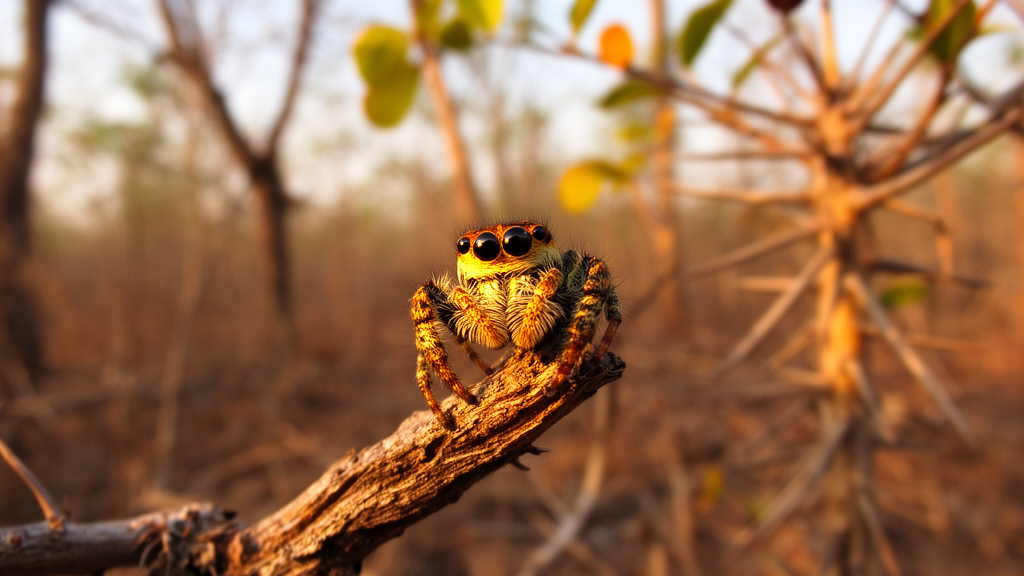
Deep in the dry forests of north-western Madagascar, a biomonitoring expedition has uncovered spiders that science had never seen before. Researchers working in the Mariarano classified forest have described three new species of plexippine jumping spiders, all belonging to the tribe Plexippini, one of the most recognisable groups within the family Salticidae. The discovery, published in the journal African Invertebrates, also delivers the first confirmed specimen record of the widespread species Plexippus petersi from Madagascar. For a family of spiders famed for their acute vision and athletic hunting style, the find is a reminder of how much of the island’s invertebrate life remains formally unknown.
Jumping spiders are the most diverse family of spiders on Earth, with 6,654 known species distributed across 681 genera according to the 2024 World Spider Catalog. More than 1,000 salticid species are recorded from the Afrotropical region, yet sampling across that vast area is geographically uneven. Madagascar, long recognised as a global biodiversity hotspot where habitat diversity and endemism are especially pronounced relative to land area, has 105 salticid species recorded from 40 genera. Strikingly, only 47 of those 105 species have been documented in the past 100 years, meaning that more than half of the island’s known jumping spider fauna has not been positively recorded in a century. Previous spider research on the island has repeatedly highlighted high numbers of undescribed species, and the new paper adds to that evidence.
The three new species were collected during expeditions in June to August of 2017, 2018 and 2023, run by the Biodiversity Inventory for Conservation (BINCO), Operation Wallacea, and the Development and Biodiversity Conservation Action for Madagascar. The Mariarano area, with its enigmatic dry forests and adjacent savannah, has already yielded numerous putative endemics, including a couple of new spider species described in earlier work and many more currently in preparation. The new study begins the process of tackling the jumping spiders of the region, focusing specifically on the tribe Plexippini, whose Madagascan representatives include several genera with unclear boundaries.
Two of the new species belong to the genus Evarcha, raising the global count of that genus from 93 to 95 species. The first, Evarcha tsipikafotsy, takes its name from the Malagasy words for stripes and white, referring to the lateral fringes of white setae on the carapace. The species is most similar in palpal conformation to E. madagascariensis, the sole previously known Evarcha on the island and known only from a single holotype male, and to E. patagiata from the Levant. All three share a single large retrolateral tibial apophysis, an embolus running clockwise along the edge of the cymbium for over a third of its length, and a moderate posterior tegular expansion. But E. tsipikafotsy is clearly separated by a posterior tegular expansion projected distinctly at the four o’clock position with a separate finger-like protrusion, an embolus about two-thirds the length of the cymbium, and a sinuous RTA apex. Females, meanwhile, most resemble E. arcuata of Europe and northern Asia, but differ in having thick, tightly coiled copulatory ducts, fertilisation ducts positioned roughly halfway up the epigynal region, and large, deep epigynal atria covering about three-quarters of the epigynal surface.
The second new Evarcha, E. vavannyangisy, is named for the Malagasy words for squid and beak, a nod to its most arresting feature: a deeply bifurcated retrolateral tibial apophysis with a squid-beak-like appearance, combining a rounded ventral element and a sharp pointed dorsal element. Within the genus this trait is highly distinctive, shared with only E. zayu from China and E. amanzi from South Africa. E. vavannyangisy differs from E. zayu in the depth of the bifurcation, a very small basomedian tegular bump rather than a very pronounced expansion, and an embolus that remains slender for its entire length. From E. amanzi it is readily separated by the very small basomedian tegular expansion and an embolus that wraps around roughly half the perimeter of the bulb. The male holotype, collected at Matsedroy camp in July 2017, shows a brownish-orange carapace with black patches around the eyes, deep reddish-brown mouthparts, and a dark reddish-brown first leg bearing fields of long erect setae.
The third new species, Thyene volombavatanany, joins a genus of flattened plexippines characterised by a strong, stout first leg, tufts of distinct dark bristles lateral and posterior to the anterior lateral eyes that form horn-like structures, and male palps with a circular tegulum twice encircled by the embolus and a thin tibial apophysis. The name amalgamates the Malagasy words for arm and moustache, referring to the extensive hairs on the ventral surfaces of the femur and tibia of the first leg. Thyene volombavatanany resembles T. aperta, known from Ivory Coast, Tanzania and Zimbabwe, in its elongated body, large first legs and general palpal conformation, both sharing a rounded bulb twice surrounded by the embolus running clockwise with a narrow, long, flat prolateral tegular expansion at the base. The new species is distinguished by an abdomen that is generally uniform in colouration with black mottling but without a white spot, and by a retrolateral tibial apophysis approximately the length of the tibia with an apex about one-third of the basal tibial width. Only three Thyene species were previously known from Madagascar, and none had been recorded through positive specimen identification since 1908.
The taxonomic work behind these descriptions relied on detailed morphological comparison of preserved specimens, all held in 70% ethanol and deposited in the Royal Museum for Central Africa in Tervuren, Belgium. Male pedipalps were dissected and illustrated, while female epigynes were excised with a custom-made fine hooked needle, digested in warm lactic acid solution for three to five minutes, and observed in methyl salicylate before examination under a compound microscope. Images were captured with a Zeiss Discovery V12 stereomicroscope and Axiocam 208 colour camera, with z-stacked photomontages of between 10 and 30 images merged using Helicon Focus software. Scanning electron micrographs of the male palp and first leg of E. tsipikafotsy provided additional structural detail. All measurements are given in millimetres, and the male holotype of E. tsipikafotsy, for example, has a total length of 6.48 mm with a carapace length of 3.48 mm.
The diagnostic characters that separate these species are concentrated in the genitalia, the standard currency of spider taxonomy. In E. tsipikafotsy the embolus originates behind the tegular expansion at the five o’clock position in ventral view, contours the edge of the tegulum, branches off at the ten o’clock position and runs up towards the apex of the cymbium. The sperm duct follows the curve of the tegulum clockwise from the nine o’clock position. In E. vavannyangisy the embolus arises at the five-thirty position and terminates at around the quarter-past position, wrapping around the tegulum for just over half a turn. In T. volombavatanany the sperm duct arises medially and loops around the tegulum for half its length, while the embolus is moderately short and straight, directed prolaterally and tapering to a sharp point. Such fine-scale differences in embolus trajectory, tegular expansion and tibial apophysis shape are what allow morphologically similar plexippines to be told apart, particularly in genera like Evarcha, which has been suggested to act as a dumping ground genus likely harbouring many unrelated species and cryptic generic diversity, making a universal definition difficult to propose.
Beyond the three new species, the team reports the first confirmed specimen record of Plexippus petersi from Madagascar, based on a single female collected in the Mariarano classified forest in June 2017. The species is recorded widely across south-eastern Asia, and the only published specimen records in Africa are from Mozambique, with putative identifications from south-western Kenya, northern Tanzania and far eastern Madagascar held in museum databases. The new record therefore confirms the presence of this cosmopolitan jumper on the island with positive specimen evidence for the first time, illustrated through photographs of the habitus and epigyne.
The broader significance of the study lies in what it says about Madagascar’s dry forests, among the island’s most threatened habitats. With only 47 of 105 recorded salticid species documented in the past 100 years, and with a single biomonitoring programme in one region yielding three new plexippines plus a new country record, the paper suggests that the true diversity of Madagascan jumping spiders is far higher than current catalogues indicate. The authors frame the work as part of an ongoing effort, with many more new species from the Mariarano area in preparation, and the descriptions are accompanied by photographs and drawings of all new species, diagnosed and illustrated in full. As habitat loss continues across the island’s dry forest belt, documenting its endemic fauna before it disappears has become an increasingly urgent scientific mission, and these three striped, squid-beaked and moustached spiders are the latest additions to that growing inventory.
Subject of Research: Three new species of plexippine jumping spiders (Salticidae, Salticinae, Plexippini) from dry forest in Boeny region, north-western Madagascar
Article Title: Three new species of plexippine jumping spiders ( Salticidae , Salticinae , Plexippini ) from dry forest in Boeny region, north-western Madagascar
Article References: Murray, K. I., Escobar-Toledo, J., & Pett, B. L. (2024). Three new species of plexippine jumping spiders (Salticidae, Salticinae, Plexippini) from dry forest in Boeny region, north-western Madagascar. African Invertebrates, 65(2), 61-74. https://doi.org/10.3897/afrinvertebr.65.126810
Image Credits: AI Generated
DOI: 10.3897/afrinvertebr.65.126810
Keywords: Three, species, plexippine, jumping, spiders, Salticidae, Salticinae, Plexippini, forest, Boeny, region, north-western
Cite Scienmag News
Margaret Porter. (October 18, 2026). Three New Jumping Spider Species Emerge from Madagascar’s Vanishing Dry Forests. Scienmag. https://scienmag.com/three-new-jumping-spider-species-emerge-from-madagascars-vanishing-dry-forests/
Margaret Porter. "Three New Jumping Spider Species Emerge from Madagascar’s Vanishing Dry Forests." Scienmag, 18 October 2026, https://scienmag.com/three-new-jumping-spider-species-emerge-from-madagascars-vanishing-dry-forests/. Accessed 18 October 2026.
Margaret Porter. "Three New Jumping Spider Species Emerge from Madagascar’s Vanishing Dry Forests." Scienmag. October 18, 2026. https://scienmag.com/three-new-jumping-spider-species-emerge-from-madagascars-vanishing-dry-forests/


