


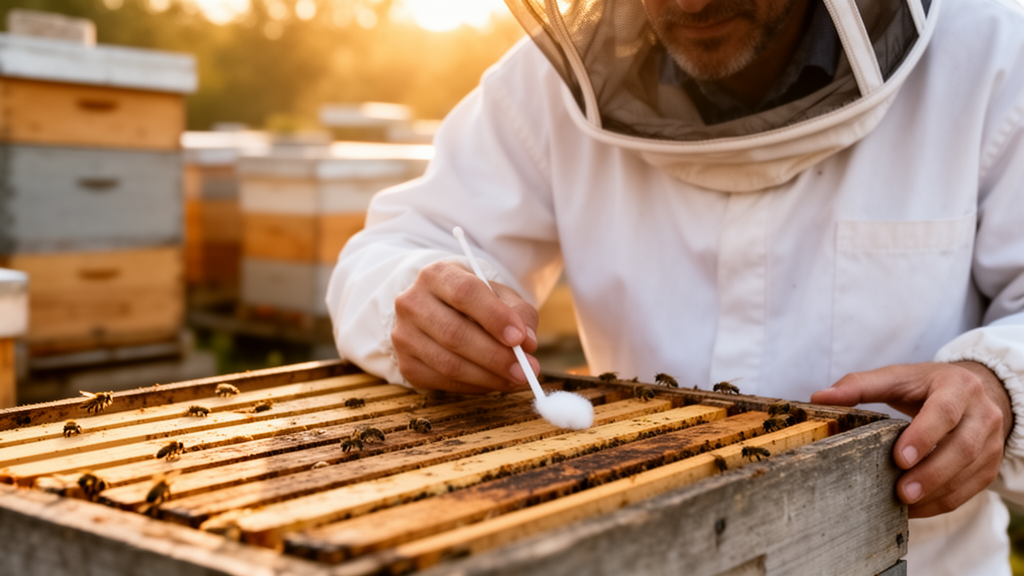
Environmental nucleic acid sampling has transformed the way scientists monitor biodiversity, letting researchers detect species from the genetic traces they leave behind in water, soil, and air. Now, a study published in Metabarcoding and Metagenomics suggests that one of the most promising repositories of terrestrial genetic material may be sitting right at the doorstep of the European honeybee (Apis mellifera). By comparing swabs taken from hive entrances with the honey, pollen, and bee samples traditionally used for genetic monitoring, researchers found that simple surface swabbing recovered comparable or greater taxonomic diversity across bacteria, animals, fungi, plants, and RNA viruses. The findings point toward a scalable, non-invasive method for biosecurity surveillance and biodiversity monitoring that could be adopted by beekeepers and citizen scientists without specialist training.
Honeybee hives have long been recognised as rich sources of environmental nucleic acids, or eNA, encompassing both DNA and RNA from a wide range of taxonomic origins. Bees forage across landscapes, collecting pollen and nectar from flowering plants while simultaneously picking up microbial spores, fungal fragments, and viral particles. Genetic material from these sources accumulates within the hive, where it can be extracted and analysed to reveal the surrounding vegetation, detect plant pathogens, and assess honeybee health through the identification of pests and pathogens. Previous studies have used hive samples to monitor plant biodiversity, identify weed incursions, detect honeydew-producing insects, and even determine the regional provenance of honeys being sold commercially. However, the collection of internal hive samples such as honey, pollen, and bees requires specialists to open and handle hives, is seasonally dependent, and can weaken colonies over time if long-term monitoring is undertaken. Opening hives during colder months to collect samples can also risk colony survival.
The research team, working at sites in the Australian Capital Territory, set out to compare the effectiveness of non-invasive hive entrance swabbing with seven commonly used sample types. At a former pastoral property surrounded by grassland nature reserves and residential areas, they collected hive entrance swabs, hive debris swabs, honey, internal pollen, pollen trap samples, return forager bees, and top box bees across three sampling days in January 2023. Each hive entrance was swabbed using a sterile nylon FLOQSwab dipped in deionised water, rubbed across the entire length of the entrance four times while twisting to reach a range of depths inside the hive. Three consecutive swabs were collected per hive, along with the more invasive samples. All samples were immediately placed on ice in the field and stored at minus 80 degrees Celsius until DNA and RNA extraction, with no storage buffers used.
For DNA metabarcoding, the researchers amplified four genetic markers targeting bacterial 16S, animal COI, fungal ITS1, and plant ITS2 regions. The animal COI reactions included a peptide nucleic acid clamp specifically developed for this study to reduce amplification of honeybee DNA, allowing non-honeybee animal taxa to be detected more effectively. After quality control and filtering, over 5.2 million metabarcoding reads were obtained across the four markers. The results were striking: hive entrance swabs and hive debris swabs consistently recovered the highest number of taxa for bacteria, animals, and fungi. For the fungal ITS1 marker, hive entrance swabs detected 232 of the 309 total fungal taxa observed in the dataset, along with the highest total reads and average reads per sample. For bacteria, both swab types recovered 33 unique taxa each out of 35 total observed, while pollen trap samples produced the lowest number of total reads and unique taxa.
Plant detections told a slightly different story. Honey samples produced the highest average number of unique plant taxa per sample, closely followed by swab samples, with no significant differences observed between these sample types. Internal pollen samples, despite returning the highest total reads for the plant marker, yielded the lowest average number of unique taxa per sample. Return forager bees, which might be expected to carry the freshest plant genetic material, identified only 33 of the 62 total plant taxa detected. The researchers suggest this unexpected pattern may reflect the dynamic foraging behaviour of bees, which varies with the colony’s nutritional needs. Pollen is typically consumed more quickly than honey stores, meaning honey likely provides a cumulative record of the local environment while pollen samples give a more contemporary view of recent flowering activity.
For RNA virus detection, the team used metatranscriptomic sequencing on a subset of sample types collected in April 2024 from a separate apiary bordering Black Mountain and the Australian National Botanic Gardens. After quality control, 67 viruses were identified from a combined total of 17 million reads assigned to contigs. Honey samples had the highest observed number of viruses across all sample types, with an average of 23 viruses per replicate, followed by hive entrance swabs with 16 and top box bee samples with 14. Internal pollen samples contained the lowest observed number of viruses with an average of 7.73. All four sample types detected fungal and plant viruses, though honey samples comprised the highest number of plant viruses with 23 detected, followed by hive entrance swabs and top box bees with 10 each. Fungal viruses were most abundant in swab samples, with 10 detected. Honeybee-specific viruses were most abundant in bee samples, followed by honey and hive entrance swabs.
Five of the top 10 viruses detected across all sample types were associated with the plant genus Camellia, all detected in each sample type. The remaining five included two fungi-associated viruses, two viruses associated with clovers, and the honeybee virus black queen cell virus. The researchers note that the lack of honeybee and other insect viruses detected in pollen samples was surprising, given multiple other studies report success in detecting honeybee viruses using pollen. They attribute this result to the small number of hives sampled and a general low prevalence of honeybee viruses in these hives at the time of sampling. The trade-offs between the number of viruses detected and the depth and completeness of viral sequences emphasise that the most suitable sample type depends on the specific virus surveillance goal.
Replication analysis revealed important guidance for optimising sampling effort. When comparing the number of unique taxa collected from each swab replicate, a downward trend was observed following subsequent swabbing of the same area. For bacteria, only one additional unique taxon was detected from a second swab replicate, with no new taxa detected on the third. For fungi, however, swabbing replicates continued to detect additional unique taxa across each replicate, with 31 and 19 additional taxa detected in replicates two and three of the hive entrance swabs. Based on species accumulation curves, replication was sufficient for bacterial and animal communities, but further replication would be needed to recover additional fungal and plant diversity. The researchers recommend collecting two swab replicates per hive as sufficient for capturing taxonomic diversity from hive eDNA metabarcoding, while noting that sampling from additional hives is likely more beneficial than collecting more swab replicates from a single hive.
The effectiveness of hive entrance swabbing likely stems from the accumulation and persistence of eNA across the hive entrance and base. Hive debris typically accumulates at the base as a result of routine colony activities such as brood rearing and food storage. High bee traffic through the hive entrance facilitates the deposition of pollen, microbial spores, and other biological material from returning foragers, while passive air flow can draw eNA from the surrounding area into hives. The comparable and often better recovery of eNA from swabs over more direct sample types was somewhat surprising to the researchers, given that individual bees carry only a fraction of the total eNA and represent a narrower time window compared to honey and hive debris, which accumulate genetic material over longer periods. Each sample type captures a distinct temporal and ecological snapshot of the hive environment.
The study represents the most comprehensive comparison of hive eNA sample types to date and provides an improved sampling protocol that can be implemented for a range of biosecurity surveillance activities. Hive entrance swabbing offers clear logistical advantages: it is simple enough for non-specialists to collect, non-invasive for the ongoing persistence of hives, suitable for year-round sampling without seasonal constraints, and does not weaken colonies over time. The researchers suggest that leveraging established hive networks with this approach offers a highly scalable strategy for detecting honeybee pests and pathogens, plant pathogens, and surrounding vegetation across diverse landscapes. Engaging with beekeepers to capture hive eNA across urban and agricultural landscapes presents an exciting opportunity to support both hive health and environmental monitoring, one that can be strengthened through collaboration with citizen scientists and scaled across broad geographic areas with minimal impact on the hives themselves.
Subject of Research: Surface swabs outperform most traditional honeybee (Apis mellifera) hive samples for recovery of eDNA and eRNA
Article Title: Surface swabs outperform most traditional honeybee ( Apis mellifera ) hive samples for recovery of eDNA and eRNA
Article References: Hill, E., Milla, L., Encinas-Viso, F., O'Dwyer, J., Gooden, B., Hopper, M., & Roberts, J. (2025). Surface swabs outperform most traditional honeybee (Apis mellifera) hive samples for recovery of eDNA and eRNA. Metabarcoding and Metagenomics, 9, Article e165436. https://doi.org/10.3897/mbmg.9.165436
Image Credits: AI Generated
Keywords: Surface, swabs, outperform, most, traditional, honeybee, Apis, mellifera, hive, samples, recovery, eDNA
Cite Scienmag News
Juliet Wilcox. (October 18, 2026). Surface swabs outperform most traditional honeybee hive samples for eDNA and eRNA recovery. Scienmag. https://scienmag.com/surface-swabs-outperform-most-traditional-honeybee-hive-samples-for-edna-and-erna-recovery/
Juliet Wilcox. "Surface swabs outperform most traditional honeybee hive samples for eDNA and eRNA recovery." Scienmag, 18 October 2026, https://scienmag.com/surface-swabs-outperform-most-traditional-honeybee-hive-samples-for-edna-and-erna-recovery/. Accessed 18 October 2026.
Juliet Wilcox. "Surface swabs outperform most traditional honeybee hive samples for eDNA and eRNA recovery." Scienmag. October 18, 2026. https://scienmag.com/surface-swabs-outperform-most-traditional-honeybee-hive-samples-for-edna-and-erna-recovery/


