


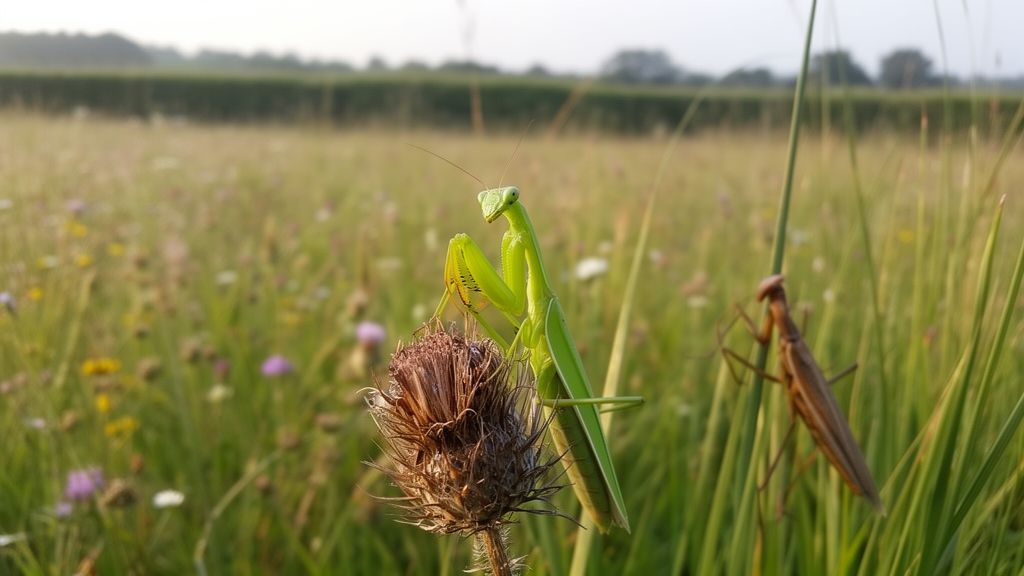
Two praying mantis species are quietly colonizing new corners of Europe, and the first evidence of their arrivals came not from professional field surveys but from ordinary people with smartphones. A new study published in the Journal of Orthoptera Research documents, for the first time, the presence of the dwarf mantis Miomantis paykullii in Türkiye, Cyprus, and Spain, and the Mediterranean dwarf mantis Ameles spallanzania in Slovakia, Romania, Luxembourg, and Türkiye. Every one of these seven country-level first records was identified from photographs uploaded to Instagram, iNaturalist, and the biodiversity aggregator GBIF, then verified by researchers who contacted the original observers directly for location details and permission to use the images.
The findings matter because both species are thermophilic, meaning they thrive in warm conditions, and both are now appearing far north of their known ranges. M. paykullii is native to the Afrotropical region, including Egypt, the Sahara, and Mauritania, and until recently its only Mediterranean record was a pair of males documented in Portugal in 2014. A. spallanzania, once confined to the Western Alps, has been spreading rapidly across the Mediterranean and beyond. The new records show A. spallanzania reaching Slovakia, Romania, and Luxembourg as recently as 2024, while M. paykullii was first photographed in Cyprus in 2019, in Türkiye in 2021, and in Spain in 2022.
The identification process relied on established morphological criteria for European mantises, with the researchers cross-checking each record against photographs of potentially confusable species to prevent misidentification. When observers were reachable, the team requested exact coordinates and original images. In one particularly valuable case, a single female M. paykullii collected from a building adjacent to an artificial garden in the Muratpaşa district of Antalya, Türkiye, was sent to the authors for confirmation. After being transferred to captivity, the female laid an ootheca, the foam-encased egg mass characteristic of mantises, from which 21 first-instar nymphs emerged. The adult, the ootheca, and the nymphs were preserved in 96% alcohol for future morphological and molecular work.
Strikingly, every single specimen of both species was observed in anthropogenic areas: parks, parking lots, hotel gardens, apartment balconies, building walls, picnic tables, and the landscaped vegetation at the gate of Larnaca Airport in Cyprus. Two adult females were photographed on the landscape plantings at the airport gate in August 2023, and the observer reported seeing numerous additional nymphs and adults at the same site. In Salobreña, Spain, an adult female and a male nymph were recorded in October 2022 in an area surrounded by agricultural fields and buildings. In İskenderun, Hatay, an adult female turned up inside a house at night. The pattern is consistent: these mantises are not dispersing through natural habitats but through the human-built landscape.
This urban association supports the hypothesis that human activities, particularly transportation and landscaping, are driving the spread. For A. spallanzania, previous research has implicated railway networks in its dispersal across the Mediterranean, and the species is considered sedentary and habitat-specific, making natural long-distance migration unlikely. Females have shorter wings and more limited movement than males, and new populations can only establish through oothecae laid by fertilized females. The fact that most new records cluster near human settlements strongly suggests that oothecae or individuals are being moved inadvertently with plants, soil, vehicles, or cargo.
The Turkish record of A. spallanzania adds an intriguing biogeographic detail. The specimen, an adult female photographed in a garden near the seashore in Büyükçekmece, Istanbul, in August 2019, was found on the European side of the country. The Bosphorus strait acts as a geographical barrier between the Thracian and Anatolian regions, and no records exist yet from the Anatolian side. The researchers suggest the expansion may have occurred through the Balkans via the dense railway network connecting Bulgaria, although notably no records of the species have been found between Istanbul and the Bulgarian border. That gap itself supports the idea that the mantis is jumping between transport hubs rather than creeping continuously across the landscape.
The Slovakian record offers evidence that the species may already be established in Central Europe. In September 2024, observers photographed an adult female and male near a parking lot in Šaľa, Slovakia, and captured something remarkable: sexual cannibalism, with the female consuming the male during mating. The presence of both sexes together, mating behavior, and a second and third individual observed in the same parking area suggest a breeding population rather than a lone stowaway. A nymph recorded in Koerich, Luxembourg, in October 2024 points the same way. Perhaps most significant, the researchers argue that A. spallanzania, which is known to overwinter as a nymph in warm southern latitudes, may now be surviving the winter as a nymph in northern latitudes thanks to climate change, allowing self-sustaining populations to form well beyond the species’ historical thermal limits.
M. paykullii tells a different story. Unlike A. spallanzania, whose new records show geographical continuity across Europe, the new populations of M. paykullii in Spain and Cyprus are separated from the native range by open sea. The researchers map potential maritime dispersal routes: a shipping lane connects Israel, where natural populations occur, to Limassol in Cyprus, and the records from the Port of Limassol and nearby urban gardens suggest the species arrived by sea. Antalya, Türkiye, and Motril, Spain, both port cities, show the same pattern. There is even a direct active sea route from Israel to Salerno, Italy. Yet no records of M. paykullii exist in northern latitudes despite sea traffic from Israel to Istanbul, hinting that climate factors may currently limit the species to warm Mediterranean coastal zones.
The data compilation itself reveals how dramatically citizen science has transformed the study of these insects. For A. spallanzania, only 24% of the recorded locations came from the literature and preserved museum specimens, while 76% were sourced from citizen science platforms and social media. For M. paykullii, the imbalance is even more extreme: just 9% of locations came from traditional sources, while 91% came from citizen-sourced records. The researchers compiled records spanning 1882 to October 2024 for A. spallanzania and 1961 to 2024 for M. paykullii, categorized each location by whether it had been formally reported in the country’s literature, and generated distribution maps using QGIS geographic information system software.
The authors urge researchers to monitor both species closely, warning of their demonstrated ability to adapt easily to new regions and their potential to become invasive. The caution is grounded in precedent: the springbok mantis Miomantis caffra, native to South Africa, has established itself in Portugal and California and become invasive in New Zealand, where it preys on the native mantis Orthodera novaezealandiae. Predator species arriving in new territories can displace native mantises through predation and niche competition, and mantis invasions can also affect crops and garden ecosystems. Continued citizen science monitoring, the researchers argue, will be essential for tracking the spread dynamics of these two newcomers, assessing their impact on native species, and guiding any necessary precautions before these adaptable predators become Europe’s next established invaders.
Subject of Research: First detections of two non-native praying mantis species in seven European countries through citizen science records
Article Title: Detection of the recent arrivals of Ameles spallanzania and Miomantis paykullii in various European countries through citizen science contributions
Article References: Yılmaz, K., & Sevgili, H. (2025). Detection of the recent arrivals of Ameles spallanzania and Miomantis paykullii in various European countries through citizen science contributions. Journal of Orthoptera Research, 34(2), 175-180. https://doi.org/10.3897/jor.34.140630
Image Credits: AI Generated
Keywords: Detection, recent, arrivals, Ameles, spallanzania, Miomantis, paykullii, various, European, countries, citizen, science
Cite Scienmag News
Patricia Pace. (October 18, 2026). Citizen scientists reveal two alien mantis species quietly spreading across Europe. Scienmag. https://scienmag.com/citizen-scientists-reveal-two-alien-mantis-species-quietly-spreading-across-europe/
Patricia Pace. "Citizen scientists reveal two alien mantis species quietly spreading across Europe." Scienmag, 18 October 2026, https://scienmag.com/citizen-scientists-reveal-two-alien-mantis-species-quietly-spreading-across-europe/. Accessed 18 October 2026.
Patricia Pace. "Citizen scientists reveal two alien mantis species quietly spreading across Europe." Scienmag. October 18, 2026. https://scienmag.com/citizen-scientists-reveal-two-alien-mantis-species-quietly-spreading-across-europe/


