


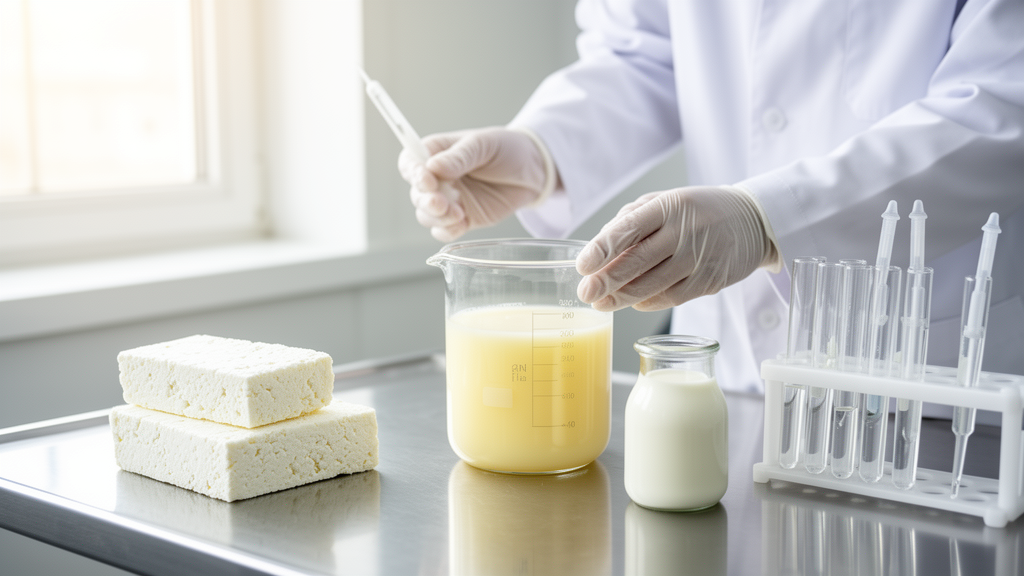
Scientists in India have completed one of the most detailed nutritional audits yet of buffalo milk paneer and the acid whey left behind after it is made, and their findings could change how the dairy industry treats one of its most troublesome waste streams. The study, published in Innovations in Agriculture, measured the physico-chemical properties and full amino acid profiles of both products using high-performance liquid chromatography, and the results show that acid whey, typically poured down the drain as a low-value by-product, carries a surprisingly rich load of both essential and non-essential amino acids. In a country where paneer production is projected at roughly 150,000 tonnes per year, about one percent of total milk output, the volume of whey generated alongside it is enormous, and the new data suggest that discarding it means discarding a genuine nutritional resource.
Paneer is a soft, high-protein dairy product central to Indian cuisine and especially important for the country’s large vegetarian population, which relies on it as a dense source of high-quality protein, fat, and minerals. It is produced by heating buffalo milk and coagulating it with approved acidulants such as citric acid, which curdles the milk proteins so they can be strained and pressed into the familiar blocks. What remains after straining is whey, the greenish-yellow milk serum whose colour depends on the type and grade of milk used. Because paneer manufacturing uses acid rather than rennet, the resulting liquid is classified as acid whey, a by-product that is notoriously difficult to dispose of safely and whose treatment inflates the operating costs of dairy effluent plants.
The research team, working with buffalo milk procured from the dairy plant of Kerala Veterinary and Animal Sciences University in Mannuthy, Thrissur, prepared paneer using food-grade citric acid and then subjected both the paneer and the separated acid whey to a battery of analytical tests. Moisture, total solids, fat, protein, ash, lactose, pH, and acidity were all quantified, with fat measured by the Werner Schmidt acid digestion method, protein by the Micro Kjeldahl technique, ash in a muffle furnace, and amino acids by the AminoQuant method as prescribed by the Food Safety and Standards Authority of India. Every parameter was run in triplicate and the data were analysed as means with standard deviations using SPSS statistical software, giving the results a solid footing for comparison with earlier work.
The physico-chemical analysis painted a clear picture of what buffalo paneer actually contains. The fresh product held 41.75 percent moisture and 58.24 percent total solids, with crude protein at 24.72 percent and fat at 27.67 percent, figures that place it firmly in the category of a protein- and energy-dense food. Solids-not-fat came to 29.72 percent, lactose to 1.82 percent, ash to 2.04 percent, and the pH stood at 6.32 with acidity of 0.30 percent. These values aligned closely with those reported in earlier studies of buffalo paneer, confirming that the product made in the trial was representative of what consumers across India buy and eat every day.
The acid whey told the opposite story in bulk terms but a similar one in nutritional terms. It contained 93.21 percent moisture and only 6.78 percent total solids, with crude protein at 1.58 percent, fat at 2.43 percent, solids-not-fat at 4.31 percent, lactose at 3.76 percent, and ash at 0.37 percent. Its pH of 5.26 and acidity of 0.19 percent reflected the acid coagulation process that produced it. Yet even at such low solid concentrations, the whey matched the profiles reported in previous analyses of acid whey, and the researchers emphasise that the sheer scale of whey production means these small percentages add up to a substantial pool of recoverable nutrients.
The amino acid profiling was where the study delivered its most striking results. In buffalo paneer, leucine emerged as the major essential amino acid at 9.1 grams per 100 grams, followed closely by lysine at 9.0, phenylalanine at 7.2, valine at 7.1, isoleucine at 6.1, threonine at 5.1, methionine at 1.2, tryptophan at 1.0, and histidine at 0.7. Among the non-essential amino acids, glutamic acid dominated at 16.4 grams per 100 grams, trailed by aspartic acid at 8.3, proline at 7.2, serine at 4.3, tyrosine at 4.2, alanine at 3.8, cysteine at 2.6, arginine at 2.4, and glycine at 1.3. The abundance of leucine, isoleucine, and valine is particularly significant because these three branched-chain amino acids act as key metabolic regulators of lipid metabolism, protein homeostasis, and glucose levels, and they are metabolised directly by skeletal muscle, where they boost protein synthesis, help maintain muscle mass, and supply energy during extended exercise.
The acid whey, far from being nutritionally empty, showed an amino acid profile that in several respects rivalled the paneer itself. Leucine was again the leading essential amino acid, and at 10.1 grams per 100 grams it actually exceeded the level found in the paneer. Lysine followed at 8.7, threonine at 6.3, isoleucine at 5.9, valine at 5.2, phenylalanine at 3.2, methionine at 1.9, tryptophan at 1.6, and histidine at 1.3. On the non-essential side, glutamic acid led at 13.7 grams per 100 grams, with aspartic acid at 9.3, proline at 6.9, arginine at 5.0, serine at 4.9, alanine at 4.2, tyrosine at 3.7, glycine at 3.7, and cysteine at 1.8. Notably, whey surpassed paneer in threonine, methionine, tryptophan, histidine, aspartic acid, arginine, serine, alanine, and glycine, meaning that the liquid discarded during paneer making holds appreciable quantities of amino acids that the solid product contains in smaller amounts.
The nutritional importance of these findings is amplified by what is known about whey protein digestibility. Compared with protein sources such as corn, soy, and wheat, whey proteins are among the most accessible to the human body and serve as rich reservoirs of essential amino acids. Amino acids delivered through whey protein are absorbed and utilised more readily than free amino acid solutions, which makes whey an efficient vehicle for nutrition. This efficiency explains why scientists have already explored incorporating whey into a wide range of applications, from spice and herb fortified paneer products and zinc complexes to biofuel production and edible films and coatings, and the new amino acid data strengthen the case for each of these avenues.
The researchers argue that acid whey should be reclassified in the minds of manufacturers as a valuable dairy by-product rather than a waste problem. They propose that it can be used to prepare ready-to-drink whey beverages, protein concentrates, and ready-to-mix beverage powders, and that it can serve as a fortificant to raise the protein and amino acid content of various dairy and food products. By utilising whey to its maximum potential, small-scale cheese and paneer makers who struggle with disposal could simultaneously reduce the environmental pollution caused by unsafe discharge and capture a stream of nutrients that would otherwise be lost. The team also suggests that further research into modifying the amino acid content of both paneer and whey could increase their biological value and digestibility even further.
For an industry built on buffalo milk, the message of the study is straightforward: the greenish-yellow liquid strained away from every batch of paneer is not refuse but a concentrated source of the same branched-chain and essential amino acids that make paneer itself nutritionally prized. As dairy processors face rising effluent treatment costs and growing pressure to operate sustainably, the detailed amino acid maps produced in this research offer a technical foundation for turning a disposal liability into a functional food ingredient, a protein supplement, or a beverage base, and they add fresh momentum to the global effort to extract full value from every litre of milk that enters the production chain.
Subject of Research: Study of physico-chemical properties and amino acid profiling of buffalo paneer and acid whey
Article Title: Study of physico-chemical properties and amino acid profiling of buffalo paneer and acid whey
Article References: Balakrishnan, I., Vinoj, V., Muthusamy, D., & Vyshak, V. L. (2024). Study of physico-chemical properties and amino acid profiling of buffalo paneer and acid whey. Innovations in Agriculture, 7, 1-4. https://doi.org/10.3897/ia.2024.124224
Image Credits: AI Generated
Keywords: physico-chemical, properties, amino, acid, profiling, buffalo, paneer, whey, scientific research
Cite Scienmag News
Daisy Hatcher. (October 18, 2026). Buffalo paneer by-product whey revealed as rich source of essential amino acids. Scienmag. https://scienmag.com/buffalo-paneer-by-product-whey-revealed-as-rich-source-of-essential-amino-acids/
Daisy Hatcher. "Buffalo paneer by-product whey revealed as rich source of essential amino acids." Scienmag, 18 October 2026, https://scienmag.com/buffalo-paneer-by-product-whey-revealed-as-rich-source-of-essential-amino-acids/. Accessed 18 October 2026.
Daisy Hatcher. "Buffalo paneer by-product whey revealed as rich source of essential amino acids." Scienmag. October 18, 2026. https://scienmag.com/buffalo-paneer-by-product-whey-revealed-as-rich-source-of-essential-amino-acids/


