


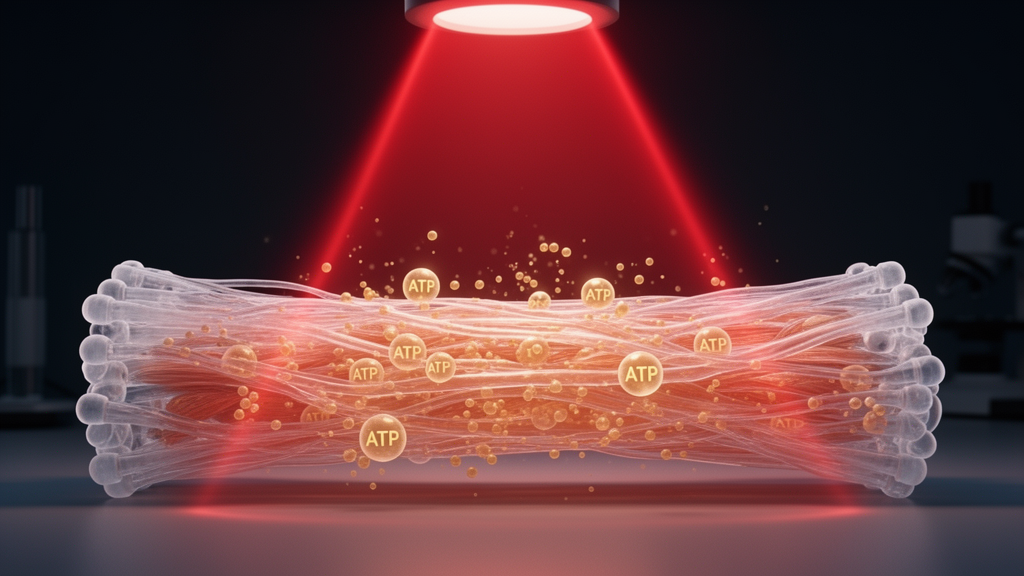
Photobiomodulation, the practice of shining near-infrared laser light on tissue to stimulate healing and recovery, has long been treated as a case of more-is-better. A new computational study from researchers at the Capital University of Physical Education and Sports in Beijing suggests that this intuition breaks down in a striking way: in their model of skeletal muscle, the cellular energy response rises with laser power only up to a point, plateaus, and then declines, even as tissue temperature keeps climbing without limit. The work, published in Scientific Reports, offers one of the most detailed multiphysics pictures yet of what actually happens inside layered skin, fat, and muscle when a therapeutic laser is switched on.
The team, led by Linlong Zhang and corresponding author Xianxin Jiang, built a three-dimensional computational framework that couples three distinct physical processes that normally get modeled in isolation. The first is light transport, which tracks how near-infrared photons scatter and get absorbed as they pass through the layered architecture of skin, subcutaneous fat, and skeletal muscle. The second is heat transfer, which describes how absorbed optical energy raises tissue temperature and how that heat diffuses away over time. The third is a phenomenological model of adenosine triphosphate, or ATP, related activity, the cellular energy currency that photobiomodulation is thought to stimulate through light-sensitive chromophores in mitochondria. By solving all three simultaneously, the framework can evaluate how optical delivery, thermal loading, and biological response change together rather than sequentially.
The researchers compared three commonly used near-infrared wavelengths: 810, 850, and 900 nanometers. Under identical optical conditions, 900 nanometers produced the highest average and maximum light levels within the muscle layer, while 850 nanometers gave an intermediate response. Because the coupled analyses needed a representative wavelength, the team retained 850 nanometers for the full set of simulations, a choice that keeps the model grounded in a wavelength widely used in clinical and sports recovery devices.
One of the most counterintuitive findings concerns beam geometry. When the researchers widened the laser beam, increasing the Gaussian 1/e^2 beam radius, the local light concentration near the tissue surface dropped markedly, but the average light level within the muscle barely changed. This means that a wider beam spreads the same optical power over a larger area, reducing hot spots at the surface without sacrificing the depth-averaged dose that reaches the target tissue. For device designers, this suggests that beam radius is a powerful lever for controlling surface thermal loading without compromising muscle-level light delivery.
The central result of the study is the relationship between optical power and the modeled ATP-related response. At 850 nanometers with a beam radius of 4 millimeters, the muscle-averaged ATP-related response increases at low optical power, reaches a near-flat maximum of approximately 14.73 percent between 0.50 and 0.75 watts, and then gradually decreases to approximately 12.29 percent at 2.50 watts. In other words, the model predicts a plateau and then a decline, not a monotonic rise. The team attributes this shape to the phenomenological inhibition term in their ATP model, which captures the idea that excessive light exposure can suppress, rather than enhance, cellular energy-related activity.
Meanwhile, the thermal picture is far less forgiving. Maximum tissue temperature and cumulative thermal exposure increase continuously with optical power, with no plateau and no decline. At 0.75 watts, the modeled maximum temperature is 38.584 degrees Celsius, a modest elevation above physiological baseline. At 2.50 watts, it rises to 45.857 degrees Celsius, a level that approaches thresholds associated with tissue damage. The contrast between the two trends is the study’s most important message: greater light delivery does not necessarily produce a greater modeled cellular energy response and may instead increase thermal loading.
A local sensitivity analysis added another layer of nuance. The researchers found that the magnitude and location of the modeled response maximum depend on the selected inhibition threshold, the parameter that determines at what light level the ATP-related activity begins to be suppressed. This means that the precise shape of the dose-response curve is not a universal prediction but a conditional one, shaped by the phenomenological parameters chosen to represent the biology. The team is explicit about this limitation, noting that the framework’s predictions remain conditional on the selected tissue properties, geometry, and phenomenological parameters.
The authors are careful to distinguish what the framework can and cannot support. It enables systematic comparison of coupled optical, thermal, and biological trends across wavelengths, powers, and beam geometries, something that would be difficult and expensive to do experimentally. But it does not, on its own, provide quantitative physiological or clinical interpretation. Experimental measurements and higher-fidelity light-transport models are required before the predictions can be translated into treatment guidelines or device specifications. The team frames the work as a tool for hypothesis generation and trend comparison, not as a substitute for clinical validation.
For the growing community of athletes, physiotherapists, and researchers using near-infrared photobiomodulation for muscle recovery, the study offers a sobering quantitative reminder. The therapeutic window is not defined by how much light can be delivered but by where the coupled optical, thermal, and biological trends intersect. Pushing laser power higher does not push the modeled energy response higher; it pushes tissue temperature higher. The Beijing team’s framework gives researchers a way to map that intersection in three dimensions, and it sets the stage for the experimental work needed to confirm where the real therapeutic window lies.
Subject of Research: Biophysics
Article Title: A multiphysics computational framework for evaluating ATP response and thermal loading during skeletal muscle photobiomodulation
Article References: Zhang, L., Liu, Y., Qin, S., Lin, Y., Zheng, S., & Jiang, X. (2026). A multiphysics computational framework for evaluating ATP response and thermal loading during skeletal muscle photobiomodulation. Scientific Reports. https://doi.org/10.1038/s41598-026-66515-z
Image Credits: AI Generated
DOI: 10.1038/s41598-026-66515-z
Keywords: photobiomodulation, ATP, skeletal muscle, computational modeling, laser therapy, thermal loading, multiphysics, Scientific Reports, computational, framework, evaluating, response
Cite Scienmag News
Denise Maddox. (October 18, 2026). New Model Reveals Why More Laser Power Does Not Mean More Muscle Energy. Scienmag. https://scienmag.com/new-model-reveals-why-more-laser-power-does-not-mean-more-muscle-energy/
Denise Maddox. "New Model Reveals Why More Laser Power Does Not Mean More Muscle Energy." Scienmag, 18 October 2026, https://scienmag.com/new-model-reveals-why-more-laser-power-does-not-mean-more-muscle-energy/. Accessed 18 October 2026.
Denise Maddox. "New Model Reveals Why More Laser Power Does Not Mean More Muscle Energy." Scienmag. October 18, 2026. https://scienmag.com/new-model-reveals-why-more-laser-power-does-not-mean-more-muscle-energy/


