


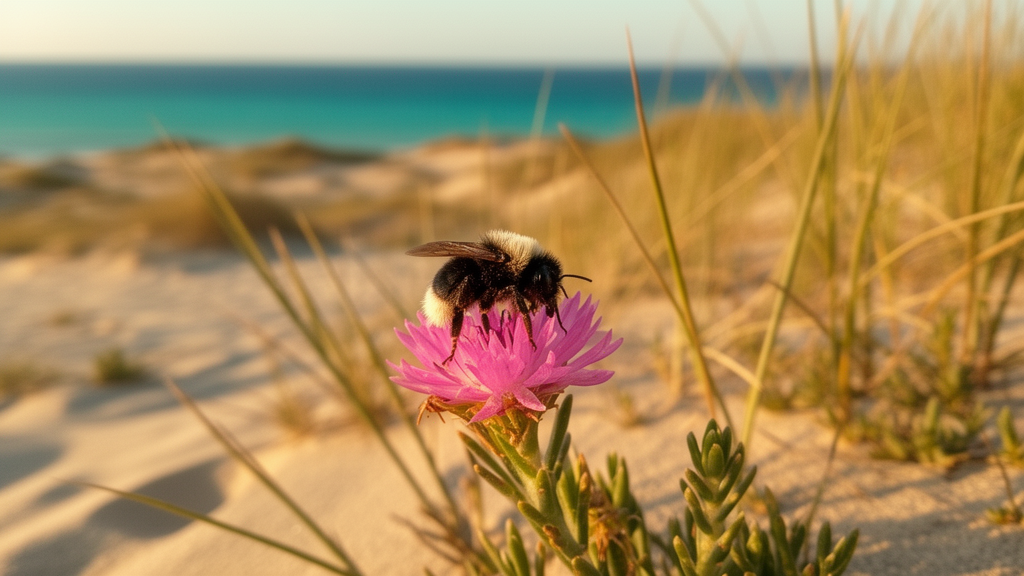
On a narrow peninsula jutting into the Tyrrhenian Sea from northern Sardinia, entomologists sweeping nets over flowering coastal dunes have uncovered a wild bee species entirely new to science. The insect, a mining bee of the genus Andrena, has been formally described as Andrena culucciae sp. nov. in the Journal of Hymenoptera Research. Its discovery on the Culuccia peninsula, a roughly 300-hectare mosaic of Mediterranean scrub, wetlands, vineyards and herbaceous dunes, is more than a routine taxonomic addition. It forces a rethink of one of Europe’s most stubbornly confused species complexes and, remarkably, leads to the dismissal of a bee subspecies that had stood on the books since 1938.
The genus Andrena is a giant among bee lineages, containing approximately 1,738 species worldwide divided into subgenera whose number itself is debated, with older counts suggesting 101 and a recent revised classification proposing around 130. Within this enormous radiation sits the subgenus Plastandrena, a group recognisable by a hind tibial spur that is distinctly broadened at its base, a rugose areolate propodeal triangle, a rounded pronotum, an entirely black male face and coarsely punctate terga. Among its roughly 36 valid species, the Andrena pilipes/nigrospina complex has been a taxonomic headache since the nineteenth century, when authors across different geographic areas described forms under different names that were later synonymised into two closely related species: Andrena pilipes Fabricius, 1781 and Andrena nigrospina Thomson, 1872.
Separating these two species has long required dissection. According to previous taxonomic treatments, the species can only be reliably distinguished by examining the genital capsule of the male, because female specimens cannot be morphologically separated due to variations in pubescence colour between generations or species. The two taxa also differ in life cycle: Andrena pilipes is bivoltine, flying in March-April and July-August, and has narrow penis valves, whereas Andrena nigrospina is univoltine, flying in May-June, with basally broad penis valves. Genetic separation proved equally elusive for years, owing to a lack of confidently identified material, until recent analyses of new sequences from different geographic regions combined with phenological data found support for both taxa, each showing low intraspecific variation while variation between the two clades averaged 1.63 percent.
During a survey of flower-visiting insects on the Culuccia peninsula between 2022 and 2024, researchers from Roma Tre University and collaborating institutions collected Andrena specimens that did not fit either known species. The team, comprising Matteo Annessi, Alessandra Riccieri and Andrea Di Giulio, gathered bees with entomological nets between 10 am and 4 pm, assigning each individual a unique identification code, collection date, WGS84 coordinates, environmental type and the plant species on which it was observed. Specimens were euthanized by freezing at minus 20 degrees Celsius for subsequent DNA analysis, then stored dry and preserved at the Museum of Zoology and Comparative Anatomy of Roma Tre University in Rome. The holotype, a single male, was collected on 18 May 2024 on the coastal dune plant Armeria pungens, while paratypes included females taken on Cistus monspeliensis, Echium plantagineum, Jasione montana and Bunias erucago.
To test whether the Sardinian bees represented a distinct lineage, the researchers extracted total genomic DNA from one leg of eight specimens, one male and seven females, using the salting out protocol. They amplified the barcode fragment of the mitochondrial Cytochrome C Oxidase subunit I gene with the standard Folmer primer pair, verified amplification on a one percent agarose gel, and sequenced the purified products. The resulting 570-base-pair COI sequences were aligned with MUSCLE in MEGA 12 together with sequences of other Western Palaearctic Plastandrena species downloaded from BOLD, plus outgroup taxa including Andrena flavipes, Andrena thoracica and two Panurgus species. The team then built a consensus Neighbor-Joining tree with 1000 bootstrap replicates under the K2P model and a Maximum Likelihood tree with IQ-TREE, selecting the best substitution model with ModelFinder and estimating node support through 1000 replicates of ultrafast bootstrap and Shimodaira-Hasegawa-like approximate ratio tests.
The molecular results were striking. All eight COI sequences of the new species were monophyletic with high support in both the Neighbor-Joining tree, where bootstrap support reached 99, and the Maximum Likelihood tree, where ultrafast bootstrap reached 99 and SH-aLRT reached 98.4. In the Neighbor-Joining analysis, the new species forms a clade sister to Andrena pilipes plus Andrena nigrospina, while the Maximum Likelihood tree, though failing to recover Andrena nigrospina as monophyletic, still shows the new taxon as an isolated and well-defined clade. P-distance values told a compelling story: the new species differs from Andrena nigrospina by 1.64 percent and from Andrena pilipes by 1.74 percent, both figures exceeding the 1.01 percent distance between Andrena nigrospina and Andrena pilipes themselves. A haplotype network built with TCS detected 16 haplotypes, with three belonging to the new species, nine to Andrena pilipes and five to Andrena nigrospina, all clearly separated.
The morphological evidence proved equally decisive, and unusually, it works for both sexes. Males of the new species, measuring 12 to 13 millimetres, differ from Andrena pilipes by a longer genital capsule and broader penis valves at the base, with maximum penis valve width of 0.36 to 0.38 millimetres compared with 0.25 to 0.27 in Andrena pilipes, and by translucent marginal zones on tergites two through five, which are dark in both related taxa. The cuspis of the volsella is triangular and spatulate with a rounded apex, unlike the short, slender, apically pointed form in Andrena pilipes, a difference confirmed through scanning electron microscopy using a FIB/SEM DualBeam system at Roma Tre University’s electron microscopy laboratory. Females, measuring 14 to 16 millimetres, show an unambiguous colour signature: the setae on the hind femur are white and the tibial scopa is predominantly brown. In Andrena pilipes and Andrena nigrospina both structures are white, while in the disputed Sardinian form both are black. For the first time in this complex, females can be identified reliably by morphology alone.
That disputed Sardinian form, described by Alfken in 1938 as the subspecies Andrena pilipes iliensis, was characterised by small size, black scopa and more finely punctate mesonotum and terga. Its validity had long been controversial, since individuals with black scopa have also been found in Corsica, Sicily, Morocco, southern Greece and Crete, suggesting the trait is a climatic variation induced by southern conditions rather than a genuine insular lineage. The new molecular data settle the argument. Specimens of Andrena pilipes f. iliensis were completely nested within the clade of Andrena pilipes in both phylogenetic trees and shared the same haplotype with other Andrena pilipes specimens, showing no significant morphological differences beyond smaller body size and black scopa. The researchers therefore conclude that Andrena pilipes iliensis is not a valid subspecies but rather an insular form adapted to a restricted habitat, a so-called warm form of the wider species.
Phenology adds a further layer of distinction. The new species was observed only in May and early June across three field seasons, suggesting a univoltine life cycle whose flight period does not overlap with that of Andrena pilipes, which occurs in early spring and summer. Its flight pattern instead resembles that of Andrena nigrospina, the univoltine species absent from Italy, which also flies in May and June. Comprehensive surveys of the peninsula recorded the disputed Sardinian form in April, again without overlap with the new taxon. Ecologically, most specimens were collected on Armeria pungens in the herbaceous vegetation of coastal dunes with coarse sand, though the bees were also recorded on plants from the Boraginaceae, Brassicaceae, Campanulaceae and Cistaceae families, indicating a polylectic diet like its closest relatives.
The possible association with coastal dune habitats carries significant conservation implications, given the high ecological vulnerability of these environments across the Mediterranean region. Mediterranean dunes are under intense pressure from tourism, development and climate change, and a bee potentially tied to them could be at risk before its full distribution is even known. The researchers suggest the new species could be endemic to Sardinia, or shared with Corsica, but could also occur elsewhere in the Mediterranean, and they call for further observations and molecular studies to confirm its range. They also note that more advanced genetic techniques would be particularly beneficial in cases where ambiguity exists between morphological data and standard barcodes, a pattern seen in other insect groups. An identification key for the Andrena pilipes/nigrospina complex accompanies the description, giving ecologists and conservationists a practical tool. For now, one of Europe’s most confused bee groups has gained a clearly defined member, and a narrow Sardinian peninsula has earned a place on the map of Mediterranean pollinator discovery.
Subject of Research: A new species of Andrena (Hymenoptera, Andrenidae) from northern Sardinia (Italy)
Article Title: A new species of Andrena ( Hymenoptera , Andrenidae ) from northern Sardinia (Italy)
Article References: Annessi, M., Riccieri, A., & Di Giulio, A. (2025). A new species of Andrena (Hymenoptera, Andrenidae) from northern Sardinia (Italy). Journal of Hymenoptera Research, 98, 795-816. https://doi.org/10.3897/jhr.98.161702
Image Credits: AI Generated
Keywords: species, Andrena, Hymenoptera, Andrenidae, northern, Sardinia, Italy, scientific research
Cite Scienmag News
Gavin Prescott. (October 18, 2026). New Andrena bee species discovered on Sardinian dunes. Scienmag. https://scienmag.com/new-andrena-bee-species-discovered-on-sardinian-dunes/
Gavin Prescott. "New Andrena bee species discovered on Sardinian dunes." Scienmag, 18 October 2026, https://scienmag.com/new-andrena-bee-species-discovered-on-sardinian-dunes/. Accessed 18 October 2026.
Gavin Prescott. "New Andrena bee species discovered on Sardinian dunes." Scienmag. October 18, 2026. https://scienmag.com/new-andrena-bee-species-discovered-on-sardinian-dunes/


