


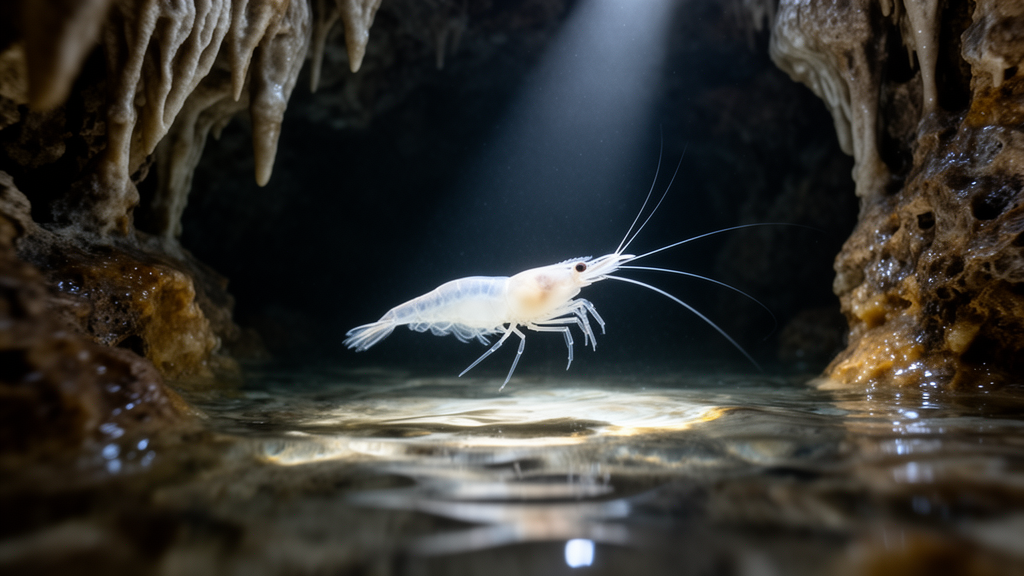
Deep beneath the limestone hills of Guiyang in Guizhou Province, southwestern China, a team of speleologists has pulled a ghost from the darkness: a brand-new species of freshwater shrimp that has never seen light, has lost its eyes entirely, and has drifted so far from its surface relatives that its DNA barely recognizes them. The animal, formally described as Caridina zhaoi sp. nov. in the journal Zoosystematics and Evolution, was found living in the cold, still waters of an underground river at the bottom of a roughly 90-meter-deep vertical shaft in Xiangshui Cave. It is the latest addition to a rapidly growing roster of subterranean species from one of the planet’s most extensive karst landscapes, and it is a vivid reminder of how much life remains hidden in the world’s groundwater systems.
The discovery matters because cave faunas are among the most fragile and least surveyed ecosystems on Earth. Stygobionts, the specialized animals that live permanently in groundwater, are exquisitely adapted to their environment and often restricted to a single cave system or aquifer. When that aquifer is polluted or pumped dry, an entire evolutionary lineage can vanish before science has ever recorded it. Caridina zhaoi, named in honor of the young speleologist Zhao Fei who collected the specimens, now brings the total number of stygobiont Caridina species in China to ten, and the count of Chinese stygobiont atyid shrimps to fifteen. Guizhou Province alone harbors six of these obligate cave-dwellers, more than any other region in the country.
The new shrimp belongs to the family Atyidae, a globally distributed group of freshwater shrimps that plays a vital role in aquatic food webs and nutrient cycling. Atyids are typically found in sunlit streams and rivers across the tropics and subtropics, where they graze on biofilm and filter particles from the water. But a subset of the family has taken a radically different path, colonizing the perpetual darkness of caves and underground rivers. In these stable but food-poor environments, evolution has repeatedly produced the same striking suite of traits: complete loss of body pigmentation, reduction or loss of eyes, and elongated appendages. Biologists call this convergent package stygomorphy, and it makes subterranean faunas an invaluable natural laboratory for studying adaptive evolution, speciation, and phylogeography.
China possesses some of the most complex karst terrain on the planet, and Guizhou sits at its heart. Over millions of years, slightly acidic rainwater has dissolved the soluble limestone, carving out a dense network of interconnected caves, sinkholes, and underground rivers. These fragmented aquatic islands are ideal conditions for diversification and endemism, because populations isolated in separate cave systems can evolve independently for vast stretches of time. Yet the cryptic invertebrates that inhabit these waters, including stygobiont atyid shrimps, remain significantly underexplored. Before this survey, the eight cave-dwelling atyids recorded from Guizhou were clustered almost entirely in just two areas, Libo County and Tongren City, with no records anywhere else simply because so few biospeleological surveys had been conducted in the central part of the province.
That gap is precisely what the new discovery helps fill. During a recent expedition to Xiangshui Cave in Guiyang’s Wudang District, at an altitude of about 1390 meters, the team encountered a population of depigmented, eyeless shrimp concentrated in a pool at the terminus of an approximately 200-meter-long underground river. Water temperature in the system remains constant at roughly 15 degrees Celsius year-round, a hallmark of deep karst aquifers. The shrimps were collected with cage nets and dip nets, photographed alive with a macro camera rig, and preserved in 75 percent ethanol for deposition at the Guizhou Institute of Biology. Remarkably, the new species shares its aquifer with Triplophysa wudangensis, a stygobiotic fish described only in 2022, suggesting that Xiangshui Cave hosts an entire undocumented subterranean community.
Morphologically, Caridina zhaoi is a textbook stygobiont. Its body is smooth and strongly depigmented, so translucent that its yellow internal organs are clearly visible through the cuticle. Its eyes are highly reduced, with the cornea indistinct and entirely unpigmented. Beyond these classic cave adaptations, the species carries a suite of subtle anatomical signatures that separate it from every other known Chinese cavernicolous Caridina. It has a relatively long rostrum, the forward-projecting toothed spine on the head, reaching from the base of the second segment to slightly beyond the third segment of the antennular peduncle, with a distinctive pattern of dorsal and ventral teeth. The stylocerite, a blade-like scale on the antennule, is comparatively short. The proportions of the joints of the first and second walking legs differ measurably from those of its congeners, and the dactylus, the terminal claw segment, of the third and fifth pereiopods bears characteristic armature, including a prominent claw-like spine on the third leg and roughly forty comb-like spinules on the fifth.
The comparative anatomy is where the species’ distinctiveness becomes truly granular. Caridina zhaoi differs from C. demenica, C. acuta, and C. alba in rostral morphology, since those species have very short rostrums that are unarmed or bear only minute teeth. Compared with C. longshan, the new species has far fewer ventral rostral teeth, between zero and five versus twelve to seventeen, and stouter chelae on the first and second pereiopods. It differs from C. caverna in the tongue-like rather than kidney-shaped endopod of the male first pleopod, and in the rod-shaped rather than distally swollen appendix masculina of the second pleopod. From C. ablepsia it is separated by a stouter carpus on the second pereiopod, four rather than five pairs of spines on the posterior telson margin, and the absence of a posteromedian projection on the telson. Even against its most morphologically similar Guizhou neighbors, C. sinanensis and C. incolor, the new species is distinguished by the complete lack of eye pigment, a shorter stylocerite, stouter leg carpi, and fewer spinules on the uropodal diaeresis and the fifth-leg dactylus.
DNA evidence clinches the case. The team extracted genomic DNA from two specimens and amplified the mitochondrial cytochrome c oxidase subunit I gene, the standard barcode locus for animal species identification, using the widely applied Folmer primer pair. The final aligned dataset comprised 622 base pairs, compared against sequences of twelve Chinese Caridina species retrieved from public databases, including four cavernicolous species, along with representatives of Neocaridina, Sinodina, Paracaridina, and an outgroup palaemonid shrimp. The results were unambiguous. The intraspecific genetic distance between the two specimens of the new species was just 1.13 percent, while interspecific divergence from other atyids ranged from 14.70 percent, against C. sinanensis, to a striking 23.47 percent, against the epigean C. serratirostris. Those values, an order of magnitude larger than the within-species distance, strongly support the new shrimp’s validity as a distinct lineage.
Phylogenetic analyses using maximum likelihood and Bayesian inference told a more complicated story. The trees resolved only a few sister-group relationships with confidence, and the exact placement of the new species remained unresolved, an outcome the authors attribute to the limited availability of reference sequences for Chinese cave atyids in public databases. What the trees did show clearly is that Caridina zhaoi forms an independent lineage, separate from all sampled congeners. The authors note that further sampling and multi-locus analyses will be required to elucidate its evolutionary relationships, a common situation in understudied groups where the phylogeny lags behind the taxonomy.
The broader pattern emerging from this discovery is hard to ignore. To date, 28 cave-dwelling species of Atyidae have been documented in China across five genera, distributed through the karst regions of the south, with the highest diversity in Guangxi and Guizhou. Novel stygobiont taxa are being identified in southern Chinese karst areas at a growing pace, which the authors interpret as evidence that subterranean biodiversity in the region remains significantly underestimated. They argue that integrative studies combining morphological analysis, molecular phylogenetics, and biogeographic modeling are urgently needed to clarify the evolutionary trajectories, speciation drivers, and ecological adaptations of these unique groundwater communities, and to inform conservation strategies for their fragile karst habitats. For now, a pale, eyeless shrimp gliding through the cold dark of a Guiyang aquifer stands as the newest ambassador for a hidden world that science is only beginning to map.
Subject of Research: Caridina zhaoi sp. nov., a new stygobiont atyid shrimp (Decapoda, Caridea, Atyidae) from a limestone cave in Guizhou Province, China
Article Title: Caridina zhaoi sp. nov., a new stygobiont atyid shrimp ( Decapoda , Caridea , Atyidae ) from a limestone cave in Guizhou Province, China
Article References: Jiang, X., Zhou, J., & Chen, H. (2026). Caridina zhaoi sp. nov., a new stygobiont atyid shrimp (Decapoda, Caridea, Atyidae) from a limestone cave in Guizhou Province, China. Zoosystematics and Evolution, 102(2), 601-609. https://doi.org/10.3897/zse.102.182296
Image Credits: AI Generated
Keywords: Caridina, zhaoi, stygobiont, atyid, shrimp, Decapoda, Caridea, Atyidae, limestone, cave, Guizhou, Province
Cite Scienmag News
Gavin Prescott. (October 18, 2026). Ghostly eyeless shrimp discovered in Chinese limestone cave. Scienmag. https://scienmag.com/ghostly-eyeless-shrimp-discovered-in-chinese-limestone-cave/
Gavin Prescott. "Ghostly eyeless shrimp discovered in Chinese limestone cave." Scienmag, 18 October 2026, https://scienmag.com/ghostly-eyeless-shrimp-discovered-in-chinese-limestone-cave/. Accessed 18 October 2026.
Gavin Prescott. "Ghostly eyeless shrimp discovered in Chinese limestone cave." Scienmag. October 18, 2026. https://scienmag.com/ghostly-eyeless-shrimp-discovered-in-chinese-limestone-cave/


