


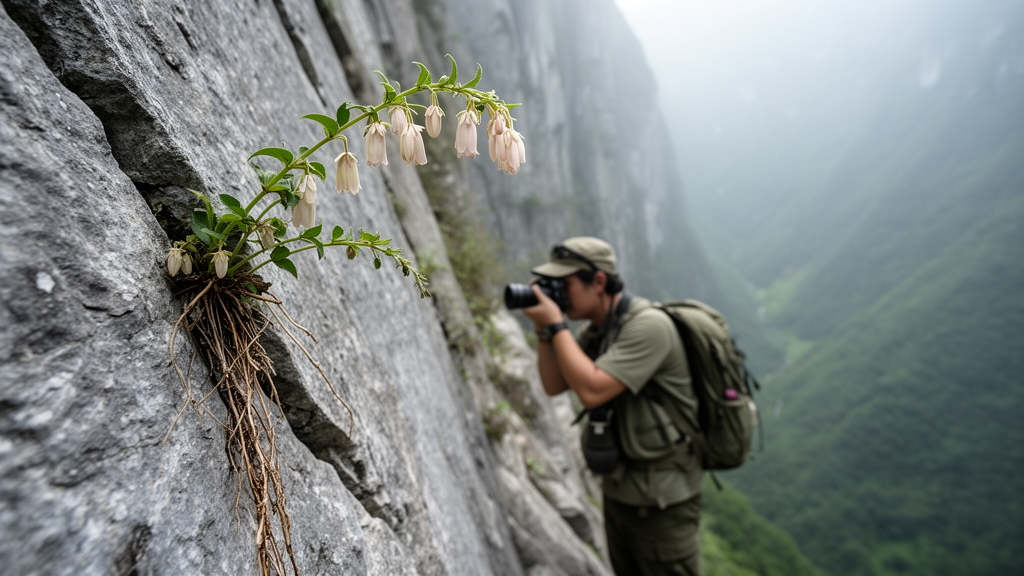
On a damp, moss-covered limestone cliff in Maguan County, in the karst landscapes of south-eastern Yunnan, China, botanists surveying the terrain in March 2026 came across a small, unfamiliar herb no taller than 15 centimetres. Its obovate to spatulate leaves sat almost stemless on the rock face, and its pale purple, bell-shaped flowers stood out against the grey stone. After detailed morphological analysis, comparison with herbarium specimens from China and adjacent regions, and a review of published literature, the team led by Wen-Wen Pan, Fu-Guan Deng and C. Xiong confirmed the plant was unknown to science. They have now formally described it as Mitreola brachypoda, a new species of Loganiaceae, in the journal PhytoKeys.
The genus Mitreola is a small group of flowering plants within the family Loganiaceae, currently comprising 22 species distributed across Africa, the Americas, Asia, Oceania and the Pacific Islands. Southern and south-western China represent the primary centre of diversity for the genus, with 15 species documented in the country, 13 of which are endemic. The majority of these Chinese species are restricted to limestone karst habitats — rugged landscapes of soluble rock where water has carved cliffs, gorges and cave systems over millions of years. These fragmented, nutrient-poor environments act as evolutionary islands, isolating plant populations and driving the emergence of species found nowhere else.
Mitreola brachypoda is a perennial lithophytic herb, meaning it grows directly on rock. Its stem is prostrate near the base and erect toward the tip, terete in cross-section, roughly 3 millimetres in diameter, and sparsely pilose when young before becoming hairless with age. The leaves are opposite and often clustered at the stem or branch apex, with remarkably short petioles of just 0 to 5 millimetres — a trait that gives the species its name. The specific epithet brachypoda derives from the Greek brachys (short) and podos (stalk), in reference to these distinctly abbreviated leaf stalks.
The leaf blades are papery when dry, obovate to spatulate, measuring 1.8 to 5.5 centimetres long and 1.5 to 2.6 centimetres wide. The upper surface is dark green to green, the lower light green, with sparse hairs on both surfaces, especially along the veins. The base is cuneate to attenuate, the margin entire and ciliate, and the apex acute, obtuse or rounded. Lateral veins number 5 to 9, occasionally up to 12, on each side of the midrib, sunken on the upper surface and protuberant beneath. Stipules are triangular, roughly 1 millimetre long and interpetiolar.
The inflorescences are terminal and axillary, usually 2 to 4 per plant, forming dense umbel-like thyrsoids with several cymes, each bearing 8 to 15 flowers. The peduncle is terete, 3 to 12 centimetres long, purplish-red and sparsely pilose. Flowers are actinomorphic and pentamerous, with five ovate calyx lobes 1.5 to 1.8 millimetres long. The corolla is campanulate — bell-shaped — white or pale purple, glabrous outside and roughly 5 millimetres across. The tube is about 1 millimetre long, with a ring of translucent hairs roughly 0.5 millimetres long spreading horizontally at the throat. The five ovate corolla lobes measure 2.3 to 2.5 by 1.5 to 1.8 millimetres, with ciliate margins and rounded apices. Stamens are inserted near the middle of the corolla tube, with filaments about 0.3 millimetres long and ovate anthers roughly 0.2 millimetres long. The ovary is semi-inferior and bilocular, the style about 0.5 millimetres long, and the stigma capitate. Capsules have not yet been observed.
Mitreola brachypoda is morphologically most similar to M. bullata, a species described from the same Sino-Vietnamese karst belt in 2021. However, the new species can be reliably distinguished by a combination of vegetative and reproductive traits. Its petioles are 0 to 5 millimetres long, compared with 10 to 26 millimetres, occasionally up to 35, in M. bullata. The leaf blades are obovate to spatulate with a cuneate to attenuate base, rather than elliptic or long elliptic. The leaf surface is not bullate — blistered or puckered — unlike the densely pilose, bullate leaves of its relative. The lateral veins are light green on the abaxial surface rather than purplish-red. The inflorescence is a dense umbel-like thyrsoid rather than a sparse dichasium, with a peduncle reaching up to 12 centimetres compared with a maximum of 4 centimetres. The corolla is campanulate and white or pale purple, with a tube of about 1 millimetre — half or less than the length of the lobes — whereas M. bullata has an urceolate, light purple corolla with a tube roughly subequal to the lobes.
These consistent differences, the authors argue, support recognition of the Yunnan material as a distinct species. While shared characters — a semi-inferior ovary, capitate stigma and opposite leaves — place it firmly within Mitreola, the short petioles and congested inflorescence suggest possible affinity with other karst-endemic species in southern China and northern Vietnam. The discovery adds to a rapidly growing list of Mitreola species described from the region in recent years, including M. crystallina, M. bullata, M. lincangensis, M. viridiflora and now M. brachypoda from Yunnan, along with M. quanruii from Guangxi and M. sinhoensis from northern Vietnam.
This pattern of repeated discovery of range-restricted species across the Sino-Vietnamese karst belt suggests that the actual species richness of Mitreola may still be underestimated. The limestone karsts of the border region appear to function as both refugia — safe havens where ancient lineages persist — and speciation drivers, where geographic isolation on fragmented outcrops promotes the divergence of new forms. South-eastern Yunnan, in particular, stands out as a primary centre of diversity and endemism for the genus.
From a conservation perspective, Mitreola brachypoda is currently known only from a single population of approximately 30 to 40 mature individuals at the type locality, at an elevation of around 1450 metres, where it grows on moist, moss-covered cliffs alongside the fern Lepisorus fortunei and the pepper relative Piper sintenense. The data available are insufficient to comprehensively assess its conservation status, and the species is provisionally classified as Data Deficient under the IUCN Red List Categories and Criteria. Nevertheless, given the fragmented and vulnerable nature of karst habitats under increasing anthropogenic pressure — including agricultural expansion and tourism development — the authors call for urgent field surveys in adjacent areas of Maguan County and across the border into northern Vietnam, together with long-term monitoring, to better evaluate the species’ true distribution, population size and potential threats.
The type specimen was collected on 8 March 2026 at Gulinqing Township, Maguan County, in the Wenshan Zhuang and Miao Autonomous Prefecture, and deposited at the Herbarium of Guangxi Institute of Botany, with isotypes also held there. Flowering occurs from February to April. The Chinese vernacular name is duǎn bǐng dù liáng cǎo, written 短柄度量草, translating roughly as short-petioled Mitreola herb. As botanists continue to explore the world’s most botanically rich and least surveyed landscapes, each new species described — however small and however few individuals remain — sharpens the picture of global biodiversity and underscores how much remains to be discovered, and protected, on the planet’s most fragile geological stages.
Subject of Research: Mitreola brachypoda (Loganiaceae), a new species from south-eastern Yunnan, China
Article Title: Mitreola brachypoda ( Loganiaceae ), a new species from south-eastern Yunnan, China
Article References: Pan, W.-W., Xiong, C., Deng, F.-G., Wei, J., Fu, J.-X., & Lei, H.-Q. (2026). Mitreola brachypoda (Loganiaceae), a new species from south-eastern Yunnan, China. PhytoKeys, 277, 279-285. https://doi.org/10.3897/phytokeys.277.195011
Image Credits: AI Generated
DOI: 10.3897/phytokeys.277.195011
Keywords: biodiversity, botany, China, conservation, karst, new species, plant science, taxonomy, Yunnan, Mitreola, brachypoda, Loganiaceae
Cite Scienmag News
Margaret Porter. (October 18, 2026). New bell-flowered plant species discovered clinging to Yunnan limestone cliffs. Scienmag. https://scienmag.com/new-bell-flowered-plant-species-discovered-clinging-to-yunnan-limestone-cliffs/
Margaret Porter. "New bell-flowered plant species discovered clinging to Yunnan limestone cliffs." Scienmag, 18 October 2026, https://scienmag.com/new-bell-flowered-plant-species-discovered-clinging-to-yunnan-limestone-cliffs/. Accessed 18 October 2026.
Margaret Porter. "New bell-flowered plant species discovered clinging to Yunnan limestone cliffs." Scienmag. October 18, 2026. https://scienmag.com/new-bell-flowered-plant-species-discovered-clinging-to-yunnan-limestone-cliffs/


