


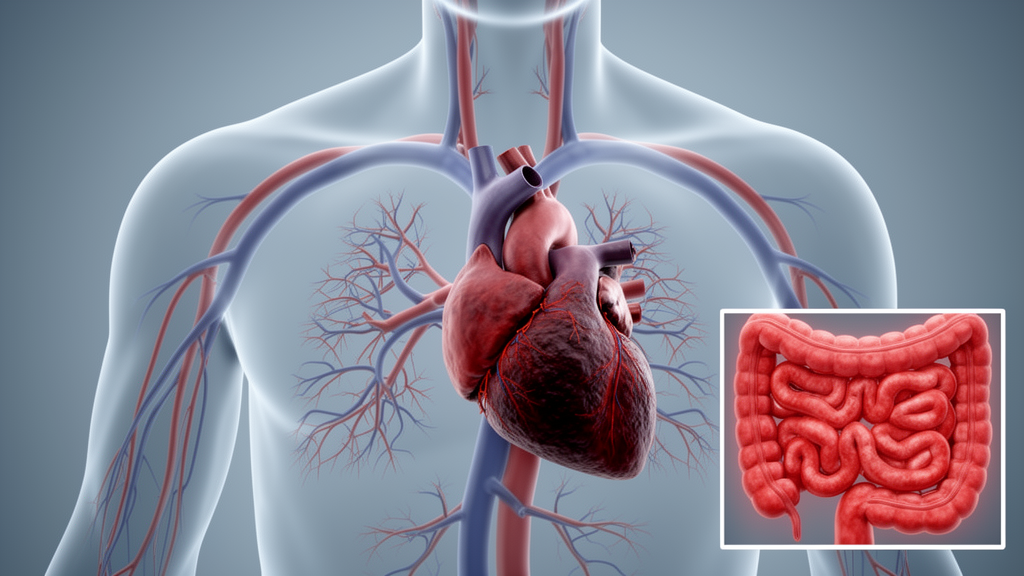
A 41-year-old man walked into a hospital with back pain and walked out, twice, without answers. Two weeks later he was on a cardiac surgery table, his chest opened down the middle, a surgeon pulling clots out of the main arteries feeding his lungs. The chain of events that put him there — documented in a case report published in the journal Pharmacia — reads like a slow-motion collision of medical risk factors, each one individually survivable, together nearly lethal. It is also a story that clinicians say should change how doctors think about patients who accumulate thrombotic dangers the way most people accumulate frequent-flyer miles.
The patient’s troubles began with ulcerative colitis, a chronic inflammatory disease of the large intestine that affects millions worldwide. To keep his disease in remission, he had been taking corticosteroids for a long time — a class of powerful anti-inflammatory drugs that are both a mainstay of treatment and, as this case makes brutally clear, a quiet architect of downstream catastrophe. Chronic steroid use, generally defined as three months or more, roughly triples a person’s risk of venous thromboembolism, the family of clotting disorders that includes deep vein thrombosis and pulmonary embolism. The drugs do this directly, by raising levels of procoagulant proteins such as fibrinogen, factor VIII, and von Willebrand factor, while simultaneously suppressing the body’s fibrinolytic machinery — the system that dissolves clots before they become problems.
But steroids have a second, slower weapon. Long-term glucocorticoid therapy interferes with bone remodeling at multiple points: it suppresses the formation of new bone-building cells, triggers the programmed death of existing osteocytes, and disrupts calcium homeostasis. The result is secondary osteoporosis, which develops in an estimated 30 to 50 percent of patients on prolonged therapy and raises the risk of vertebral fractures by approximately 160 percent. In this patient’s case, the bone loss went unmonitored — no regular bone density scans — and the diagnosis arrived only after his spine had already begun to fail. When he fell from standing height and developed severe back pain, the initial computed tomography scan missed the damage entirely, and he was sent home.
What followed was a cascade in which each misfortune amplified the next. Advised to rest, the patient spent two weeks largely immobile, managing his worsening pain with self-administered oxycodone. Prolonged bed rest disables the calf muscle pump, the rhythmic squeezing of leg muscles that normally drives venous blood back toward the heart. Without it, blood pools in the deep veins of the legs and pelvis, altering the shear stress on vessel walls and pushing the endothelium — the delicate inner lining of the veins — toward a prothrombotic state. A repeat CT scan finally revealed the truth: multiple vertebral fractures running from the seventh thoracic vertebra down to the third lumbar vertebra. He was admitted for surgical stabilization, planned in two stages because of the extent of the damage.
Hours after the first operation, as he was recovering from anesthesia, the accumulated machinery of clot formation delivered its verdict. The patient developed acute shortness of breath and respiratory distress. CT pulmonary angiography — the gold standard for confirming pulmonary embolism — showed a massive obstruction: thrombotic material lodged in the pulmonary arterial tree, mechanically blocking blood flow from the right side of his heart to his lungs. The physiology of such an event is unforgiving. Blood backs up, the right ventricle strains against the resistance, gas exchange collapses, and the body spirals into hypoxemia. When he arrived at the cardiac surgery center, his oxygen saturation was 75 percent on room air — a level at which organs begin to fail — and his D-dimer, a blood marker of active clot breakdown, was elevated at 5.53 micrograms per milliliter. Echocardiography showed early right heart strain: an enlarged right ventricle, tricuspid regurgitation, and elevated right ventricular pressure.
With his circulation failing and thrombolysis — the clot-dissolving drug approach — not a viable option, the surgical team took him to the operating room for an urgent pulmonary embolectomy. The procedure, described in the case report, is a tour de force of perfusion medicine. Through a median sternotomy, the team placed the patient on cardiopulmonary bypass, fully heparinized his blood, and cooled him to mild hypothermia at 34 degrees Celsius. The heart was arrested with cold blood cardioplegia. Surgeons opened the main pulmonary artery downstream of the pulmonary valve, extended the incision into the left pulmonary artery, and physically extracted the clots from the pulmonary trunk and both main branches. They then gently compressed each lung to dislodge smaller clots from the periphery into the larger vessels, where they could be suctioned away. After rewarming and reperfusion, the patient was weaned from bypass successfully. A postoperative vascular workup confirmed the likely source: a deep vein thrombosis in his left femoropopliteal segment, the thigh-to-knee stretch of vein where stasis had done its work.
The case, its authors argue, illustrates Virchow’s triad — the nineteenth-century framework that still governs how physicians think about clot formation — operating at full, synergistic force. The triad names three conditions that promote thrombus formation: venous stasis, endothelial injury, and hypercoagulability. This patient had all three simultaneously, from multiple directions at once. His ulcerative colitis drove inflammation-induced hypercoagulability, with activated platelets, endothelial dysfunction, and impaired fibrinolysis; patients with the condition carry a two- to threefold elevated risk of venous thromboembolism compared with the general population, with incidence around 7.6 percent versus 3.3 percent in matched controls. His corticosteroids added a pharmacological prothrombotic push. His fractures and bed rest supplied the stasis. And the spinal surgery itself — responsible for roughly 20 percent of all venous thromboembolism cases — delivered direct endothelial injury and a systemic inflammatory surge. Together, the authors estimate, this combination can raise thromboembolic risk more than tenfold above baseline.
There is an irony buried in the pharmacology. The patient was also taking vedolizumab, sold as Entyvio, a monoclonal antibody that blocks the α4β7 integrin on lymphocytes, preventing those immune cells from migrating into gut tissue. The drug had apparently done its job — his colitis was well controlled, which should have reduced his inflammation-driven clotting risk. Yet the steroid therapy the disease demanded continued to erode his skeleton in the background, invisible because no one was scanning for it. The case report uses this tension to pose an uncomfortable question for modern medicine: in an era when inflammatory bowel disease can be managed with an expanding arsenal of targeted biologics, when should chronic steroids be tapered or abandoned altogether, and what monitoring obligations come with prescribing them?
The patient’s recovery was not linear. Extubated the day after surgery, he deteriorated on postoperative day two — delirium, decreased responsiveness, an absent cough reflex — requiring reintubation and continuous sedation. His physicians traced much of this to opioid withdrawal: two weeks of self-administered oxycodone had created a dependence that complicated his intensive care course, delayed rehabilitation, and prolonged his immobility yet again. Clonidine proved ineffective; with methadone unavailable, morphine was substituted with a gradual taper. Only after roughly a week was he successfully extubated, and his condition improved steadily from there. A second-stage spinal surgery ultimately proved unnecessary — the fractures remained stable — and he was discharged on postoperative day 31 for home-based rehabilitation, walking with thoracolumbar orthosis support and eventually resuming normal daily activities. A later flare of his ulcerative colitis was managed by his gastroenterology team.
The broader lesson the authors draw is about arithmetic — the clinical kind. No single risk factor in this patient’s history would have flagged him as an emergency waiting to happen. Steroids are prescribed constantly; colitis is common; back pain after a fall is mundane. But risk factors for venous thromboembolism do not merely add, they compound, and the case raises the question the authors leave pointedly open: at what cumulative threshold should a patient’s combined risk trigger prophylactic anticoagulation, and how should clinicians weigh the bleeding danger of blood thinners against the clotting danger of doing nothing? Early recognition, they emphasize, depends on a high index of suspicion, and in cases of massive pulmonary embolism with hemodynamic collapse, surgical embolectomy remains a life-saving option when drugs fail or are contraindicated. This patient survived because a multidisciplinary team — neurosurgeons, intensivists, cardiologists, cardiac surgeons — moved fast enough to beat a clot that had been years in the making. The report’s quiet warning is that the next patient with the same stacked risks may not get that chance unless someone counts the factors before the fall.
Subject of Research: A case report of massive pulmonary embolism caused by compounding risk factors including corticosteroid therapy, ulcerative colitis, and vertebral fractures
Article Title: How many risk factors are too many: massive pulmonary embolism in a patient with ulcerative colitis and steroid-induced vertebral fractures: a case report
Article References: Georgiev, S., Pampulova, L., Abedinov, P., Iliev, R., Hadzhiev, E., & Petkov, D. (2026). How many risk factors are too many: massive pulmonary embolism in a patient with ulcerative colitis and steroid-induced vertebral fractures: a case report. Pharmacia, 73, Article e208292. https://doi.org/10.3897/pharmacia.73.e208292
Image Credits: AI Generated
DOI: 10.3897/pharmacia.73.e208292
Keywords: pulmonary embolism, venous thromboembolism, corticosteroids, ulcerative colitis, osteoporosis, vertebral fractures, Virchow's triad, embolectomy, deep vein thrombosis, vedolizumab, thromboprophylaxis, case report
Cite Scienmag News
Ophelia Keating. (October 18, 2026). When Risk Factors Stack: Steroids, Colitis, and a Massive Pulmonary Embolism. Scienmag. https://scienmag.com/when-risk-factors-stack-steroids-colitis-and-a-massive-pulmonary-embolism/
Ophelia Keating. "When Risk Factors Stack: Steroids, Colitis, and a Massive Pulmonary Embolism." Scienmag, 18 October 2026, https://scienmag.com/when-risk-factors-stack-steroids-colitis-and-a-massive-pulmonary-embolism/. Accessed 18 October 2026.
Ophelia Keating. "When Risk Factors Stack: Steroids, Colitis, and a Massive Pulmonary Embolism." Scienmag. October 18, 2026. https://scienmag.com/when-risk-factors-stack-steroids-colitis-and-a-massive-pulmonary-embolism/


